Topic

Model Deployment

All digests tagged Model Deployment

Can you forecast next week's weather? thumbnail

· 31:21

Can you forecast next week's weather?

This technical discussion explores the evolution of weather forecasting, detailing the shift from resource-intensive physics-based models to more efficient AI/ML approaches. The conversation highlights how modern ML tools, particularly those provided by Hugging Face, are standardizing the workflow for running, evaluating, and fine-tuning these complex scientific models. Key focus areas include using the `EarthMover` marketplace for scientific data, leveraging object storage (`buckets`) for data management, and utilizing Hugging Face Jobs for scalable, accessible computation.

Key takeaways

  1. Paradigm Shift in Forecasting Models

    Historically, forecasting relied on physics-based models, which are accurate but computationally demanding and resource-intensive. AI-based models offer a significant advantage by requiring substantially less time and energy for computation, allowing for faster experimentation and iteration.

  2. ML/LLM Parallelism in Weather Prediction

    Weather forecasting models share conceptual similarities with Large Language Models (LLMs). Both utilize an autoregressive paradigm: taking an initial state (like a token or a snapshot of the atmosphere) as input, and predicting the next state (e.g., what happens in the next six hours) sequentially.

  3. Standardizing Data and Compute Infrastructure

    The complexity of scientific data is managed through the `EarthMover` marketplace, which allows users to fetch specific variables (e.g., temperature, wind) on demand, rather than downloading all global data at once. Hugging Face provides infrastructure solutions, including Jobs and object storage (`buckets`), to make running these models accessible even without dedicated GPU clusters.

  4. Ensemble Modeling and Evaluation

    To improve forecast reliability, ensemble models are used, predicting a range of possible outcomes rather than a single deterministic forecast. Evaluation is challenging because ground truth data is often unavailable; thus, reanalysis (e.g., ERA5) or analysis data is used as a proxy for ground truth, and specialized metrics are needed to assess performance on skewed variables like precipitation.
Watch on YouTube Full article

Why Great Models Fail: Lessons From 9 Years of Deploying ML Models - Megan Robertson thumbnail

· 59:14

Why Great Models Fail: Lessons From 9 Years of Deploying ML Models - Megan Robertson

The talk outlines critical lessons from deploying ML models in production, arguing that model accuracy alone is insufficient for real-world success. Success requires rigorous project scoping, continuous monitoring infrastructure, and ensuring the model's value proposition (Value Ad) significantly outweighs its maintenance cost and potential risks. Key failure points include minimal stakeholder consultation, ignoring data drift, and failing to plan for inevitable changes in the operational environment.

Key takeaways

  1. Stakeholder Value is Paramount 13:20

    The model's value must be quantifiable (KPI) and its contribution must outweigh the cost of maintenance. Stakeholders must guide the project scope, preventing engineers from building technically cool but commercially irrelevant solutions.

  2. Scope Definition is a Multi-Step Process 23:20

    Proper scoping requires defining who is served (stakeholders/end users), clearly articulating the problem, understanding constraints and risks, identifying possible solutions (MVP approach: crawl, walk, run), and planning maintenance.

  3. ML Models Require Continuous Monitoring 58:20

    Since models are trained on a single point in time, they must be monitored for performance degradation. Strategies include tracking data issues (e.g., distribution changes), feature drift, and model-specific metrics (e.g., Mean Absolute Error, F1 scores).

Watch on YouTube Full article

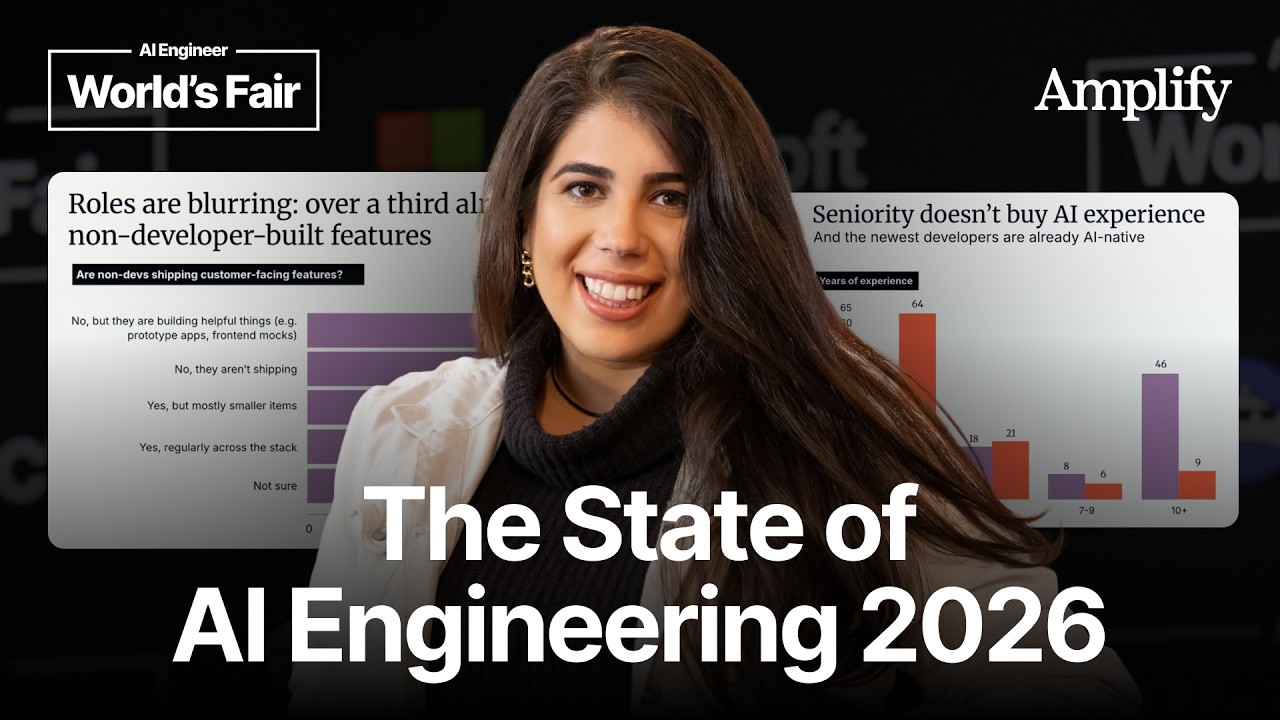
2026 State of AI Engineering — Barr Yaron, Amplify Partners thumbnail

· 19:47

2026 State of AI Engineering — Barr Yaron, Amplify Partners

The state of AI engineering is characterized by rapid maturity and increased complexity. Survey data from 1,048 respondents indicates that while open-weight models augment closed systems, the primary drivers for model choice are quality, agentic capabilities (like tool calling), and cost. Cost has become a 'first-class engineering constraint,' forcing teams to manage usage carefully. Furthermore, agents are rapidly evolving from summarization tools to systems with write access, necessitating robust control layers and sophisticated evaluation (eval) processes.

Key takeaways

  1. AI Experience is Democratizing 0:03

    The AI engineering workforce is maturing quickly; the median new engineer has nearly as much AI experience as a 10-year software veteran, indicating that AI skills are becoming foundational to modern development.

  2. Cost is a Primary Constraint 0:08

    Three out of four respondents report adjusting their AI usage based on cost, establishing 'cost' as a first-class engineering constraint alongside quality and capability.

  3. Agents are Taking Action 0:11

    Agentic workflows have shifted significantly: they are no longer limited to reading or summarizing, but are increasingly taking actions inside systems. Write access for agents has increased dramatically (from 52% to 89%).

  4. Evaluation Remains the Biggest Challenge 0:12

    Across all layers of the stack, 'eval' (evaluation) remains the number one biggest challenge reported by engineers.

Watch on YouTube Full article