The Video Signal technical video digests

· 15:00

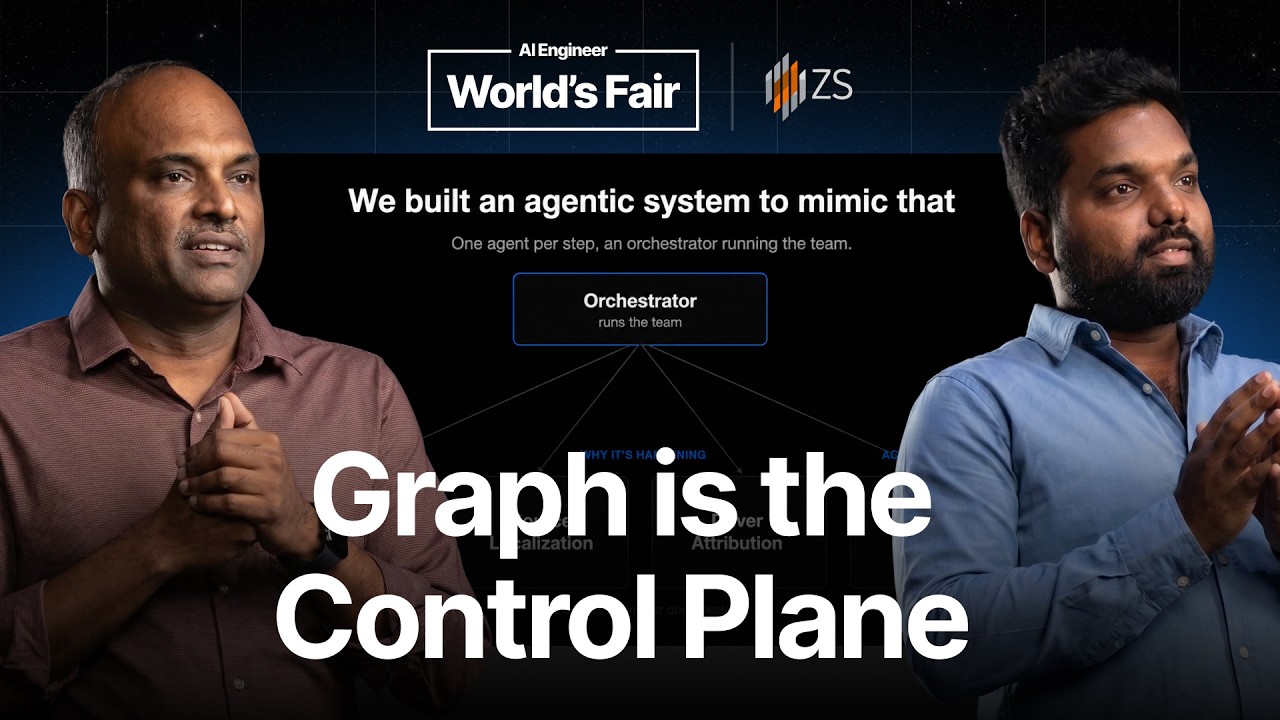
Why We Killed Our Multi-Agent Pipeline — Subbiah Sethuraman and Abhilash Asokan, ZS Associates

The video details the architectural overhaul of a multi-agent pipeline designed for complex pharma commercial analytics. The initial system failed because it attempted to mimic human analyst behavior by assigning separate agents to every step (signal detection, localization, attribution, synthesis), leading to context loss and incoherent reasoning. The rebuild focused on three key principles: 1) Separating deterministic signal detection into a pre-agent automated pipeline; 2) Consolidating core reasoning into a single agent that owns the end-to-end picture; and 3) Utilizing a Knowledge Graph (KG) not as a data lookup table, but as a 'control plane' to bound hypotheses and guide the investigation process. This resulted in a system capable of producing complex analyses in minutes, matching months of human effort.

Key takeaways

  1. Deterministic vs. Agentic Workflow 11:41

    Complex workflows must separate deterministic parts (like signal detection) into automated pipelines that run before the agent is activated. Agents should be reserved for investigation and reasoning, not initial data fetching or filtering.

  2. Single Point of Reasoning Ownership 13:25

    Instead of distributing judgment across multiple agents, consolidate the entire end-to-end reasoning process into a single main agent. This agent can use tools to spawn sub-agents only for focused lookups, ensuring coherence and maintaining ownership of the overall conclusion.

  3. Knowledge Graph as Control Plane

    A Knowledge Graph must be treated as a control plane—a mechanism that dictates what hypotheses an agent can test and what path it can take—rather than merely being a lookup table for data. This bounds the search space and ensures domain relevance.
Watch on YouTube Full article

· 20:54

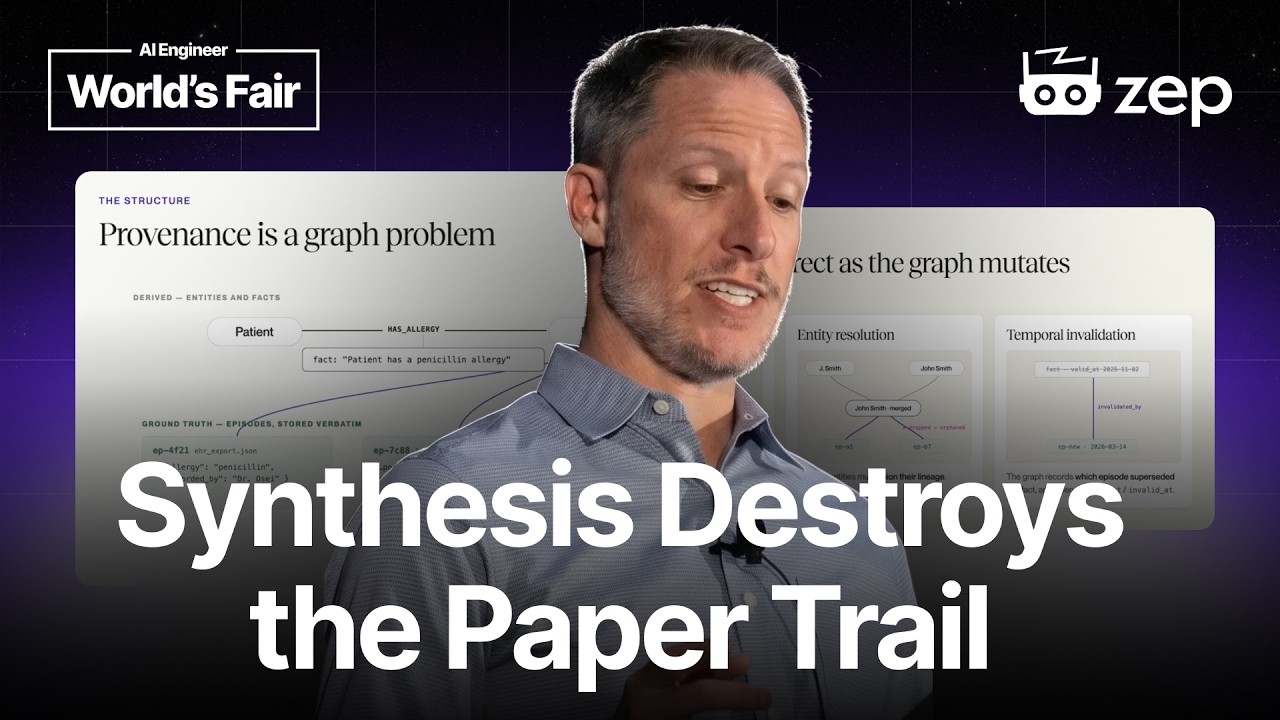
Citation Needed: Provenance for LLM-Built Knowledge Graphs — Daniel Chalef, Zep AI

The synthesis of facts by Large Language Models (LLMs) often destroys the original source attribution or 'paper trail.' Daniel Chalef argues that traditional methods like simple Source IDs fail when data undergoes complex transformations, such as entity merging or fact invalidation. He proposes that provenance for LLM-built knowledge graphs must itself be a graph structure. The open-source framework Graphiti models sources as 'episodes' and uses graph walks to trace every derived fact back to its original source(s), ensuring compliance (e.g., GDPR deletion) and verifiable veracity.

Key takeaways

  1. LLM Synthesis Destroys Provenance

    Because LLMs synthesize facts non-deterministically, the resulting output artifact may not appear verbatim in the source inputs, making simple source ID tracking insufficient for complex agent applications.

  2. Provenance Requires a Graph Structure 7:00

    To maintain lineage through mutations and merges, provenance must be modeled as a knowledge graph where facts are derived from linked sources (episodes). Tracing a fact's origin then becomes a simple 'graph walk.'

  3. Graphiti Enables Robust Lineage Management 10:06

    The Graphiti framework models source data as episodes, allowing derived facts to inherit all necessary links. This structure supports complex operations like metadata projection (e.g., filtering only 'EHR' verified sources) and GDPR-compliant deletion.

Watch on YouTube Full article

· 18:04

Local Agentic Theory For Mobile Games — Shafik Quoraishee & Joanne Song, The New York Times

The presentation outlines 'Local Agentic Theory' for mobile games, arguing that the future of AI gaming lies in decentralized, on-device agents rather than centralized cloud models. These local agents use advanced techniques (like LLM reasoning over game state) to provide highly personalized experiences. Furthermore, this approach allows accessibility features to move beyond static toggles, enabling real-time, dynamic tuning of gameplay difficulty and interaction controls based on the user's live context (e.g., tracking eye gaze or shaky taps).

Key takeaways

  1. Local Computation is Essential for Mobile AI 4:09

    Running AI locally minimizes latency, avoids expensive cloud inference calls, and ensures privacy by keeping computation within the device's security zone. This allows advanced AI features to function reliably even without constant internet connectivity (e.g., in a subway tunnel).

  2. Agentic Systems vs. Reinforcement Learning (RL) 7:36

    While RL models train by changing weights through cycles, an agentic system uses language models and in-context learning to reason over the game's state space. This allows for a more dynamic loop that adapts to new situations using local device functionality.

  3. The Device Budget Constraint 13:39

    Local agents must operate within strict resource budgets: time (fitting planning into a single 16ms frame for 60Hz refresh rates), space (managing model weights and state history compression), and energy (optimizing processing to prevent rapid battery drain).

  4. Accessibility as a Graded Dial, Not Toggles

    Traditional fixed-state games are limited by static menus. The proposed model uses international standards like WCAG 2.2 to build dynamic player states. Agents can actively monitor user input (e.g., tracking eye gaze or analyzing shaky taps) and dynamically adjust controls—such as resizing targets or injecting exit routes from focus traps—to meet the player's real-time needs.

Watch on YouTube Full article

· 20:27

Video Has No Memory. Here's How We Built One. — James Le, TwelveLabs

Video AI systems currently lack 'memory,' meaning they process each query from scratch rather than maintaining a durable understanding of an entire video corpus. The solution proposed is building a dedicated memory layer by treating video not as a bag of frames, but as a spatial temporal volume. This architecture utilizes a Context Graph—a navigable structure connecting entities, appearances, relationships, and metadata across time—to enable deep reasoning, advanced tracking, and multi-source analysis (e.g., analyzing an entire World Cup corpus).

Key takeaways

  1. Video is a Spatial Temporal Volume 0:50

    Instead of treating video as a stack of images or text tokens, it must be modeled as a spatial temporal volume that preserves continuity across space, time, visual information, speech, sound, and motion. (0:50)

  2. The Need for a Memory Layer 2:06

    Existing systems suffer from wrong context, weak memory (lacking durable continuity), and insufficient reasoning over complex video data. A dedicated memory layer is required to connect moments across different files or seasons. (2:06)

  3. Context Graph Structure 7:48

    The optimal mental model for video intelligence is a Context Graph, which provides a durable, queryable representation linking time-bounded moments (evidence units), entity appearances, relationships, and corpus-level themes. (7:48)

  4. Core Design Principles 9:04

    To build effective video memory, systems must 'ingest once and reason many times,' store primitives (not just answers), ground every claim to a specific timestamp, let intent shape the memory, and keep the layer composable via APIs. (9:04)

Watch on YouTube Full article

· 21:18

Why Agentic Systems Need Ontologies — Frank Coyle, UC Berkeley

The talk argues that while Large Language Models (LLMs) and agentic systems represent a powerful shift toward AI, their inherent probabilistic nature makes them unreliable for mission-critical tasks. To mitigate failures—such as incorrect order statuses or double refunds—the solution is 'Neurosymbolic AI': coupling the LLM's generative power with external, formal ontologies. An ontology acts as a logical guardrail, enforcing constraints (e.g., payment status must be one of three values) that are impossible to reliably enforce using prompt engineering alone.

Key takeaways

  1. The Problem with Probabilistic Agents

    LLMs reason probabilistically over domains they only half understand, leading to failures in brittle tools and fragile handoffs. These errors cannot be reliably stopped by mere instructions or prompt engineering.

  2. Neurosymbolic AI: Guardrails for LLMs 7:04

    This approach ties together neural networks (LLMs) with symbolic AI (rule-based systems and ontologies). The ontology provides the necessary guardrails to keep the probabilistic model constrained and honest.

  3. The Role of Ontologies 8:43

    An ontology is a formal specification of a shared conceptualization, defining typed entities, their relationships, and constraints. It allows systems to validate proposed actions (e.g., ensuring an order can only be refunded once).

Watch on YouTube Full article

· 19:38

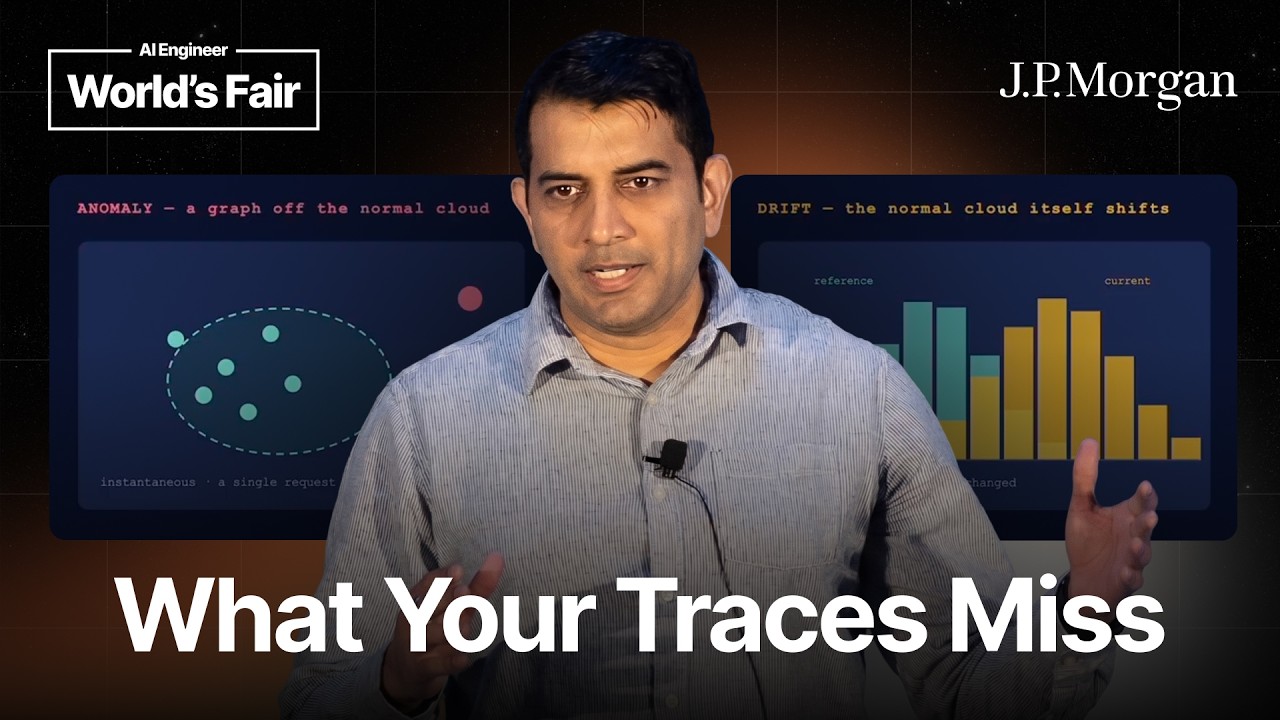
Learned Execution Graphs for Anomaly Detection & Drift in APIs — Ritvik Pandya, JP Morgan Chase

This talk details using short-lived execution graphs (DAGs) to monitor API request processing for advanced anomaly and drift detection. Instead of relying on traditional service level monitoring (SLM) that reports 'healthy' averages, this method models the entire request flow as a Directed Acyclic Graph (DAG). By comparing the actual execution graph against a learned baseline, it can pinpoint performance issues or skipped steps to specific nodes, drastically reducing root cause analysis time. The system differentiates between transient anomalies and persistent drift—categorizing drift into structural, volume, and covariate types—to ensure accurate alerting and proactive system re-baselining.

Key takeaways

  1. Execution Graphs for Monitoring

    Representing API request processing as a DAG allows holistic tracking of middleware steps, context passing, and execution order. This provides granular visibility beyond simple endpoint latency checks.

  2. Anomaly vs. Drift Detection 12:13

    The system distinguishes between sudden anomalies (e.g., traffic spikes) and slow drift—a gradual change in performance or pattern over time—which requires updating the baseline itself.

  3. Three Types of Drift 14:15

    Drift is categorized into structural (new/removed nodes), volume (expected request load changes), and covariate (changes in input data distribution, e.g., different currency types).

Watch on YouTube Full article

· 44:21

Stanford CS547 HCI Seminar | Spring 2026 | Promoting Agency in Human-AI Interaction

This seminar explores designing AI systems that promote user agency when LLMs are used as personal advisers (coaches/counselors), rather than mere assistants. The core thesis is that successful health behavior change requires systems to elicit qualitative context and navigate uncertainty to provide non-prescriptive support. Practical implementations, such as the GPT coach chatbot and the Bloom iOS application, demonstrate how integrating motivational interviewing strategies with wearable data can improve user mindset and sense of control. Algorithmically, the work proposes 'zero-shot Bayesian Adaptive Planning' using LLMs to strategically balance asking informative questions versus acting on known information by modeling latent uncertainty over the user's state.

Key takeaways

  1. Shift from Assistant to Adviser 2:00

    LLM usage is shifting toward deeply personal advice (e.g., health, relationships), requiring a design paradigm that augments the user rather than automating tasks. This necessitates non-prescriptive support.

  2. The Role of Qualitative Context 4:00

    Effective coaching relies on eliciting qualitative context (goals, values, motivations) over quantitative data (step count, heart rate). This aligns with principles from Motivational Interviewing.

  3. GPT coach Implementation 8:10

    The GPT coach chatbot uses three prompt chains—Dialogue State Chain, Motivational Interviewing Chain, and Tool Use Chain—to integrate qualitative coaching strategies with quantitative data from the Apple Health Kit API.

  4. Algorithmic Solution: Bayesian Adaptive Planning 17:55

    To improve strategic decision-making, the proposed algorithm uses Reinforcement Learning (RL) theory to model latent uncertainty ($ heta$) over the user's state. The agent must learn to strategically trade off asking informative questions against acting on current knowledge.

Watch on YouTube Full article

· 1:29

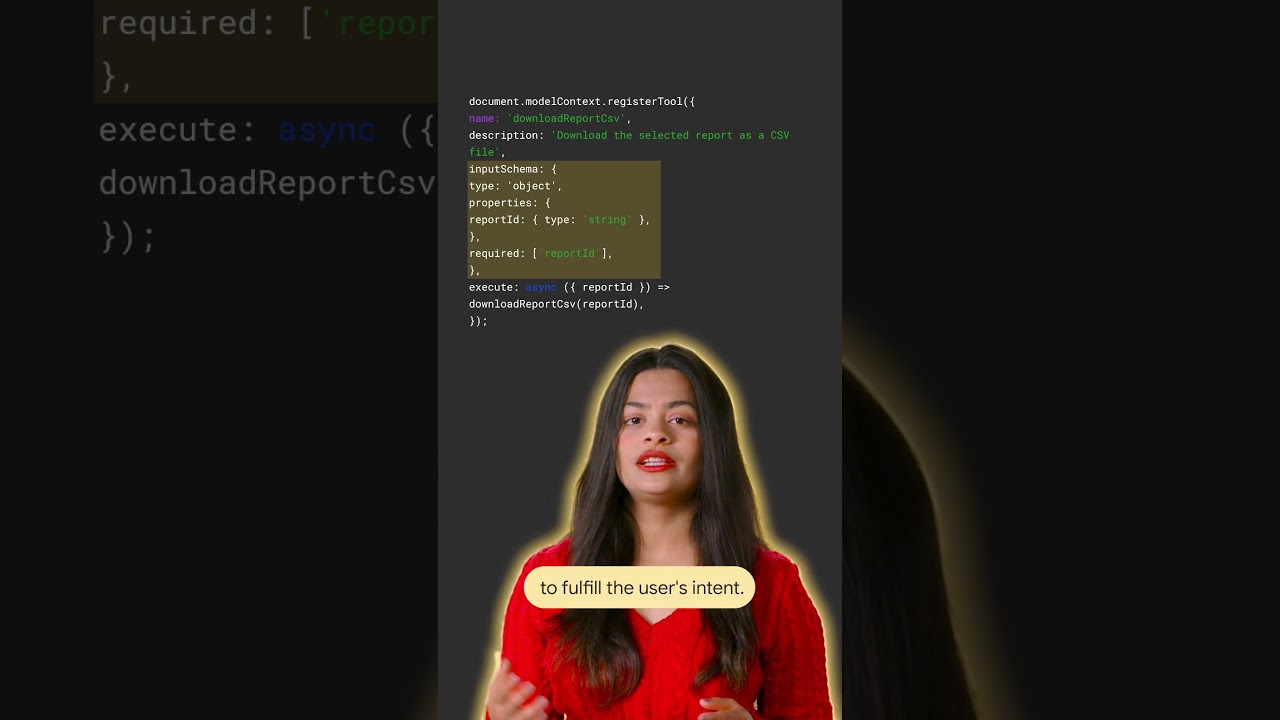
Expose your site's actions to AI agents using WebMCP

This talk introduces WebMCP (Web Manifest Capabilities Protocol), a method for web sites to expose their functional capabilities directly to AI agents. Instead of relying on agents to interpret the UI like a human, developers can register tools using plain JavaScript, defining explicit inputs and outputs via a schema. This allows agents to perform direct tool calls (e.g., 'Download report CSV') rather than attempting button interactions, significantly improving reliability for automated agent workflows.

Key takeaways

  1. Problem with Current AI Agent Interaction

    AI agents often fail or go off course because they misinterpret the visual interface (UI) of a website, forcing them to interact like a human user.

  2. WebMCP Solution: Exposing Capabilities

    WebMCP allows sites to explicitly expose what they can do. Developers register tools using plain JavaScript, providing a name, description, and function that performs the action.

  3. Reliable Agent Interaction via Schema

    By defining explicit inputs and outputs (the schema), agents can bypass guesswork. They discover capabilities and execute direct tool calls, such as calling 'Download report CSV' directly.

  4. Alternative Exposure Methods

    If JavaScript is not used, capabilities can be exposed by annotating supported HTML forms instead.

Watch on YouTube Full article

· 15:58

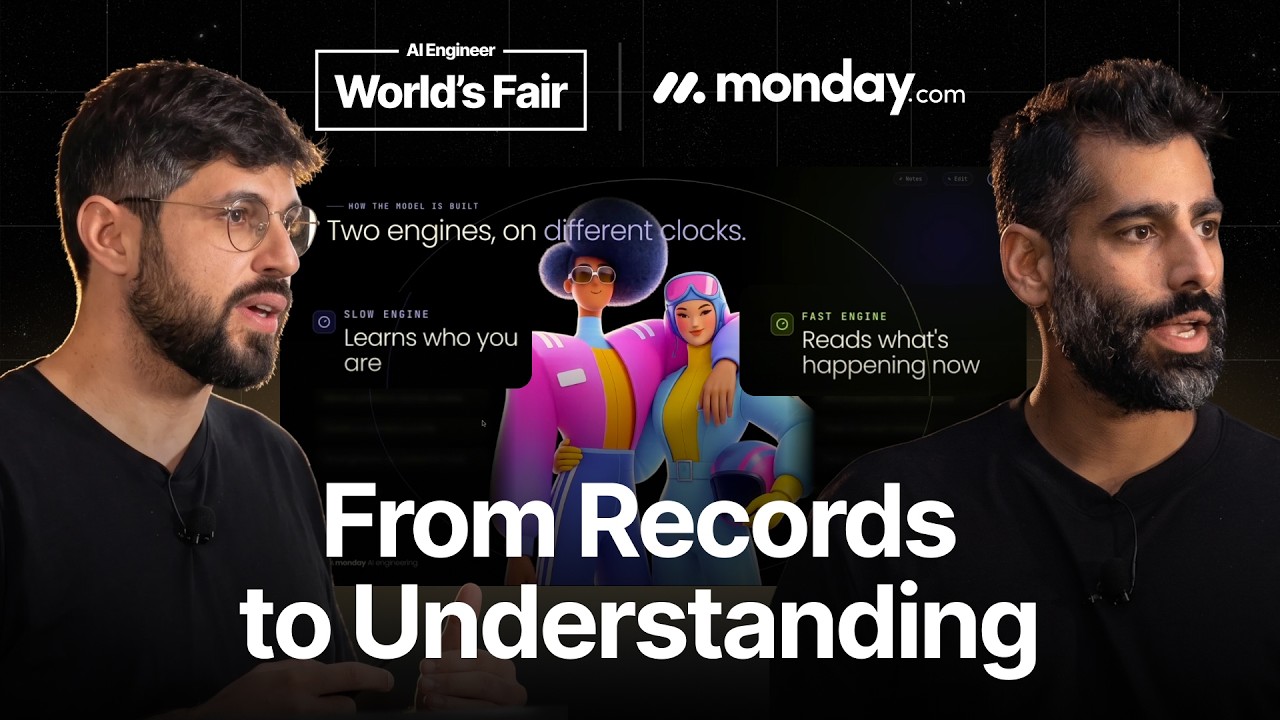
From Systems of Record to Systems of Context — Omri Bruchim, monday.com

The talk outlines a fundamental shift in enterprise software from 'Systems of Record'—which merely log what happened—to 'Systems of Context,' which actively understand the meaning and connections between data points. monday.com addresses this challenge by building a 'Monday world model' using two distinct, precomputed engines: a slow engine for durable, long-term user profiling (who you are) and a fast engine for real-time signals (what is urgent today). This architecture mirrors both the brain's hippocampus/neocortex function and the Lambda data architecture, ensuring that AI agents can reason on deep context rather than just retrieving disconnected data.

Key takeaways

  1. The Problem: Data vs. Understanding

    Current AI assistants have access to vast amounts of data (boards, emails, Slack messages) but often fail because the core problem is not retrieval (data availability), but 'understanding'—the ability to connect disparate pieces of information and determine true user priority.

  2. The Solution: System of Context

    Instead of just logging events, the system must build a context layer ahead of time. This 'Monday world model' allows AI agents (like Sidekick/Psyche) to understand not only *what* happened but *why* it matters and *who* is affected.

  3. Architectural Design: Two Engines 13:35

    The context layer is built using two engines running on different time windows. The slow engine mines weeks of activity to build a durable profile of user patterns and goals, while the fast engine processes recent data for live signals and immediate urgency.

  4. Resilience and Intelligence

    This dual-engine approach provides resilience; if one source fails, the system degrades gracefully. Furthermore, it allows the AI to understand when to be proactive (notify) and when to remain silent.

Watch on YouTube Full article

· 1:56:13

Poolside’s Model Factory, Laguna S, Open Models, and the Race to AGI — Eiso Kant, Poolside AI

The discussion centers on the engineering systems required for achieving AGI, arguing that model building is fundamentally a process of infrastructure and data management rather than pure intelligence. Poolside details its 'Model Factory,' an end-to-end system enabling rapid iteration (from six months to eight weeks) by treating model development as an industrialized process. Key technical advancements include streaming data directly into training, ensuring perfect reproducibility via immutable data layers, and leveraging agentic systems that write code and manage jobs. The consensus emphasizes that future progress relies on improving compute efficiency through low-precision methods (e.g., FP8) and focusing on behavioral traits like persistence and reasoning over sheer model size.

Key takeaways

  1. Model Building is 90% Engineering 20:30

    The core challenge in foundation model development lies in building robust, scalable infrastructure. The Model Factory manages the entire lifecycle—from raw data ingestion and filtering to large-scale distributed training and post-training refinement.

  2. The Importance of Reproducibility 26:40

    Achieving scientific rigor requires treating data as an immutable layer, versioning code, and ensuring perfect reproducibility. This allows researchers to track and trace every experiment down to the single token.

  3. Shift from Tool Calls to Code Writing 29:10

    The industry is moving beyond simple tool calls (e.g., stuffing 50 tools in a system prompt) toward models writing complex, conditional code scripts that interact with an internal virtual machine environment.

  4. Focus on Behavior and Efficiency 1:00:00

    The gains seen in smaller models (like Laguna S) come less from raw intelligence and more from improved behaviors, such as persistence, verification, and backtracking. This suggests that the peak performance for knowledge work may be at much lower parameter counts than previously assumed.

Watch on YouTube Full article

· 46:21

The AI Slop Problem Nobody's Talking About | Substack CEO Interview

The discussion addresses 'AI slop'—the proliferation of low-effort, thoughtless content generated by AI that threatens the quality of public discourse. While tools like Pangram provide a signal on whether text was likely LLM-generated, the core argument is that detection cannot measure human intent or thoughtfulness. Value in the digital age shifts to unique perspectives and ideas found at the 'edges' of conceptual distributions, requiring platforms to prioritize transparency and thoughtful contribution over sheer volume.

Key takeaways

  1. AI Detection Measures Text Generation, Not Thought

    Tools like Pangram can estimate if text passed through an LLM (by measuring patterns in language use), but this metric cannot determine if the content was created with deep care or genuine thought. The true value remains human intent and thoughtful engagement.

  2. The Problem of Slop is a Denial of Service Attack on Discourse 5:25

    Generating massive amounts of plausible-sounding AI content (e.g., 'write me 10,000 viral posts') acts as a denial of service attack against the public square, making it difficult for readers to find genuine value or new perspectives.

  3. Value Shifts to Conceptual Variance 21:35

    The most valuable ideas are those that fall outside the 'central distribution' favored by LLMs. The ideal technological solution is a 'Pangram for ideas,' which would map the wider, diverse human conceptual space versus the tighter, averaged LLM output.

  4. Transparency as the New Norm 14:25

    The solution involves establishing a new cultural norm of transparency. Platforms should provide tools (like adding context on 'how I make this statement') to allow readers to understand the process and effort behind the content, whether human or AI-assisted.

Watch on YouTube Full article

· 45:17

The Agent Development Lifecycle 101 by Harrison Chase

The Agent Development Lifecycle outlines a systematic approach for moving AI agents from isolated demos to reliable production systems. The process is broken down into five stages: Build, Test, Deploy, Monitor, and Govern. Key focus areas include ensuring agent reliability at scale by implementing durable execution, managing complex state via virtual file systems, and using advanced observability tools like tracing and online evaluation (evals) to detect failures and drive continuous improvement.

Key takeaways

  1. Systematic Iteration is Key 3:50

    Successful teams treat agents not as one-off projects but as systems requiring systematic iteration across the entire lifecycle: build, test, deploy, monitor, and improve. The primary challenge in shipping agents reliably at scale is ensuring consistent behavior.

  2. Agent Development Components 5:50

    The core components are Build (frameworks/harnesses), Test (data sets, metrics, benchmarks like Terminal Bench 2), Deploy (durable execution, sandboxes), Monitor (tracing, online evals), and Govern (cost control, tool access management).

  3. The Role of Tracing and Observability 17:06

    Tracing is fundamental for debugging agents, allowing developers to see the inputs and outputs at every step (including tool calls) to understand why an LLM or agent failed. Online evals extend this by scoring production traces without needing ground truth.

  4. Self-Improving Agents 31:30

    Advanced platforms, like LangSmith Engine, are beginning to automate the improvement loop. They run in the background over existing traces, clustering issues and suggesting fixes (code or prompt changes), thereby drastically lowering the burden of operating agents at scale.

Watch on YouTube Full article

· 10:09

How are large language models trained?

Large Language Models (LLMs) undergo two core training phases: pre-training and post-training. Pre-training uses next token prediction on massive datasets to build foundational language knowledge. Post-training refines this model for safety, helpfulness, and instruction following using techniques like Supervised Fine-Tuning (SFT) and Reinforcement Learning (RL). The process requires complex engineering at scale, including managing petabytes of data and utilizing advanced evaluation methods like auto-raters.

Key takeaways

  1. Pre-training: Foundational Knowledge

    The initial phase trains the model using next token prediction (a self-supervised task). This allows the LLM to implicitly learn language patterns and world knowledge without manual labeling. Scaling this process is a massive engineering challenge, requiring complex parallelism across thousands of interconnected GPUs, automated recovery systems, and pipelines for petabytes of data.

  2. Post-training: Alignment and Refinement 5:40

    This phase focuses on aligning the model to be safe, helpful, and accurate. It primarily involves Supervised Fine-Tuning (SFT) using gold standard examples, or Reinforcement Learning (RL), where a separate Reward Model grades responses for quality, pushing the LLM toward desired behaviors.

  3. Evaluation and Measurement 7:40

    Measuring model success requires defining clear criteria. While pre-training measures next word prediction accuracy, post-training focuses on alignment (e.g., helpfulness). Evaluation is scaled using a second LLM—an auto rater—to score responses against defined criteria.

Watch on YouTube Full article

· 8:02

/goal: Building big features with dcode

The video introduces `dcode`, an open-source, model-agnostic coding agent, and its new `/goal` command. This feature enables long-running, persistent tasks by wrapping the standard agent loop in a 'goal loop.' Instead of relying on single-shot requests for large features (like meaty PRs), `/goal` establishes visible acceptance criteria that guide the agent's work over hours. The demonstration shows how to use this mechanism to add native browser control to `dcode`, allowing the user to steer, amend requirements, and inspect progress using tools like LangSmith tracing.

Key takeaways

  1. The /goal Command 2:50

    The `/goal` command provides a long-running, persistent objective for agents tackling large tasks. It shifts alignment work upfront, making it visible and allowing mid-run tailoring of requirements (3:46).

  2. Goal Loop Mechanism 0:35

    The goal loop wraps the agent's inner action loop. The outer loop continuously checks if actions satisfy the durable acceptance criteria; if not, the goal remains active until evidence satisfies all requirements (0:17).

  3. Steering and Amending Goals 4:40

    Users can inspect the current state with `/goal show` or update/correct requirements mid-run using `/goal amend`, which interprets the message within the context of the active goal (3:46).

Watch on YouTube Full article

· 18:05

60% Faster Time-to-Interview: Transforming Hiring with AI Agents with LangChain

LinkedIn details the architecture of a hiring agent built with LangChain and LangGraph that successfully cut time-to-interview by 60% for small businesses. The system evolved from static workflows to an advanced agentic control model utilizing a central planner within a plan-execute-replan loop. Key architectural components include specialized memory types (conversational and experiential), middleware hooks for PII detection, and rigorous 'harness engineering' techniques—such as state flag chaining and one-shot tool guards—to ensure the probabilistic nature of LLMs results in a dependable product.

Key takeaways

  1. Hiring is an Agent Problem

    The hiring process is inherently iterative (plan, act, observe, adapt), requiring continuous adaptation rather than being a one-shot task. This necessitates an agentic approach.

  2. Architectural Evolution to LangGraph 0:03

    The system progressed from hard-coded static workflows (if/then) to sequential LangChain chains, culminating in LangGraph for its true agentic control model featuring a central planner and plan-execute-replan loop.

  3. Choosing LangGraph 0:05

    LinkedIn selected LangGraph over 89 evaluated frameworks because it complements existing infrastructure, builds upon core LangChain primitives (runnables, tools), and allowed for zero rewrite adoption.

  4. Achieving Determinism via Harness Engineering 0:10

    To make the agent dependable, LinkedIn implemented advanced 'harness engineering' techniques, including context management (checkpoint trimming), output format determinism (template confirmation/fallbacks), and node-change determinism (state flag chaining and one-shot tool guards).

Watch on YouTube Full article

· 16:56

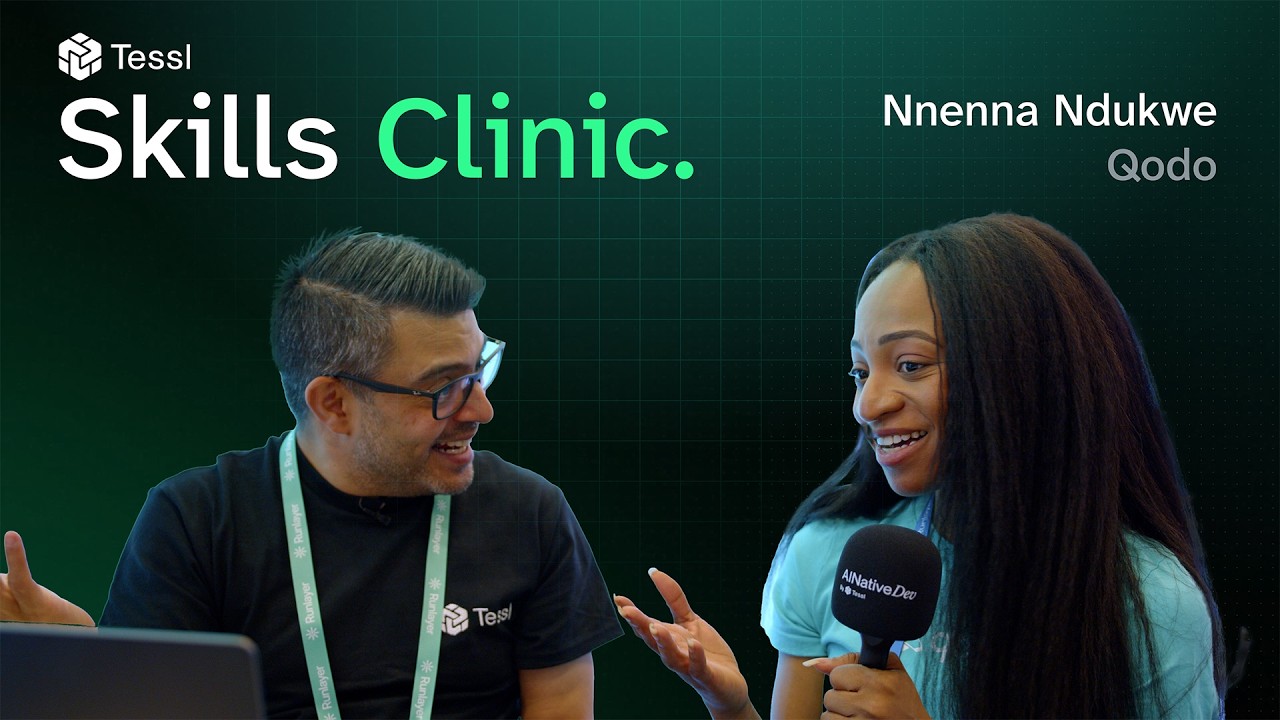
Tessl Skills Clinic - Nnenna Ndukwe from Qodo

The session demonstrates how automated AI agent skills can be rigorously tested and improved using Tessl's review process against Anthropic's best practices. By applying human-guided refinements—particularly enhancing the skill description with natural trigger phrases and optimizing structure—the Qodo PR Resolver skill score jumped from 78% to 89%. This highlights that while AI generation is powerful, manual validation and refinement are crucial for achieving high-quality, reliable agent performance in production workflows.

Key takeaways

  1. Skill Description is Critical for Agent Triggering

    The skill's description metadata is identified as the single biggest factor determining if an agent will use it. Improving this by adding natural trigger phrases (e.g., 'coding issues,' 'code reviews') significantly increases discoverability and usage likelihood.

  2. Human Refinement Boosts Skill Quality

    Research suggests that while AI-generated skills are useful, validated and refined skills (human intervention) show a significant performance uplift. The average jump observed was approximately 14% for human-written skills.

  3. The Importance of Post-Fix Verification

    It is a best practice to include a validation step (e.g., running linters and static analysis) after an agent has applied fixes, ensuring the code remains compliant even after automated changes.

Watch on YouTube Full article

· 31:30

GPT-Red: Can AI red teams stop prompt injections?

This technical discussion explores how AI is being used in advanced cybersecurity defense mechanisms, specifically focusing on automated red teaming and scam interception. Key tools discussed include OpenAI's internal GPT-Red model, which significantly improves model resilience against prompt injections (e.g., reducing attack effectiveness from 95% to 10%). Another tool, ScamBuster, uses AI to bait scammers into revealing their tactics and infrastructure for threat intelligence gathering. The conversation concludes by addressing the widening gap between technical skill and raw ability in cybersecurity, warning that while AI provides immense power, human professionals must maintain foundational skills to remain effective.

Key takeaways

  1. GPT-Red's Effectiveness Against Prompt Injection 0:23

    OpenAI utilizes GPT-Red, an internal automated red teaming model, which performs better than human red teamers. This process was key in making models like GPT 5.6 Sol more robust; for instance, 'fake chain of thought attacks' that were 95% effective on GPT 5.1 are only 10% effective on GPT 5.6.

  2. ScamBuster for Threat Intelligence 5:21

    ScamBuster is an open-source AI tool designed to interact with email scammers, subtly gathering information about their tactics and infrastructure (IOCs) that can be fed back into security teams and law enforcement.

  3. The Skill vs. Ability Gap 10:35

    Bruce Schneier's essay highlights that AI is decoupling skills from abilities in cybersecurity, meaning individuals can now perform sophisticated hacks without the years of training and ethical framework traditionally required.

  4. Maintaining Foundational Skills 20:05

    The consensus takeaway for professionals is that while AI acts as a force multiplier, individuals must continue to develop their personal skills (e.g., the ability to blue/red team) to handle scenarios where the AI fails or cannot complete the task.

Watch on YouTube Full article

· 31:39

Simon Martinelli - Lessons from Spec-driven Development - AI Native DevCon June 2026

The talk introduces the AI Unified Process, a spec-driven approach designed to combat code and specification drift in large, long-lived enterprise applications. Instead of treating code as the source of truth, this method uses system use cases (specifically SysML use cases) and domain/entity models as stable contracts. AI is leveraged not for full regeneration, but for generating and updating code and tests incrementally from these specifications, enabling modernization efforts that are more robust than simple 'lift and shift' migrations.

Key takeaways

  1. Spec-Driven Development (SDD) as the Source of Truth 21:33

    System use cases act as a stable contract for application behavior. Code is derived from these specs, ensuring that changes are managed through formal requirements updates rather than relying solely on code maintenance.

  2. Modernization via Specification Extraction 23:50

    For modernization projects (e.g., ERP systems), the process involves reverse-engineering use cases and entity models from existing documentation, code, and tests. This allows for feature integration without being limited to a simple technology migration.

  3. Architectural Shift: Self-Contained Systems 27:20

    To effectively use AI in large systems, the architecture should move away from overly distributed microservices (which create context management issues) toward 'Self-contained systems'—vertical splits that keep UI, business logic, and database within a single project or application.

Watch on YouTube Full article

· 40:56

Better Agent Auth — Bereket Habtemeskel & Paola Estefania, Better Auth

This workshop details the Agent Auth protocol, a solution designed to secure autonomous AI agents operating services for users or organizations. The core principle shifts from granting broad user credentials (acting *as* the user) to giving specific, traceable authority (acting *for* the user). Key mechanisms include agent identity management using private keys, fine-grained capability discovery via directories, and granular authorization that limits actions to explicitly granted capabilities.

Key takeaways

  1. Shift from Credentials to Authority 2:00

    Instead of providing agents with full user credentials, the protocol treats the agent as a principal actor with its own distinct authority. This is analogous to hiring an assistant rather than giving them CEO access.

  2. Capability Discovery and Authorization 4:05

    The system requires a directory mechanism for agents to discover what services are available and what specific actions (capabilities) they can perform, moving beyond broad scopes like 'read.'

  3. Agent Identity and Traceability 5:10

    Every agent must possess a unique identity (private key). This allows the system to maintain comprehensive audit logs, track exactly which agent performed an action on behalf of which user, enabling immediate revocation if misuse occurs.

Watch on YouTube Full article

· 15:36

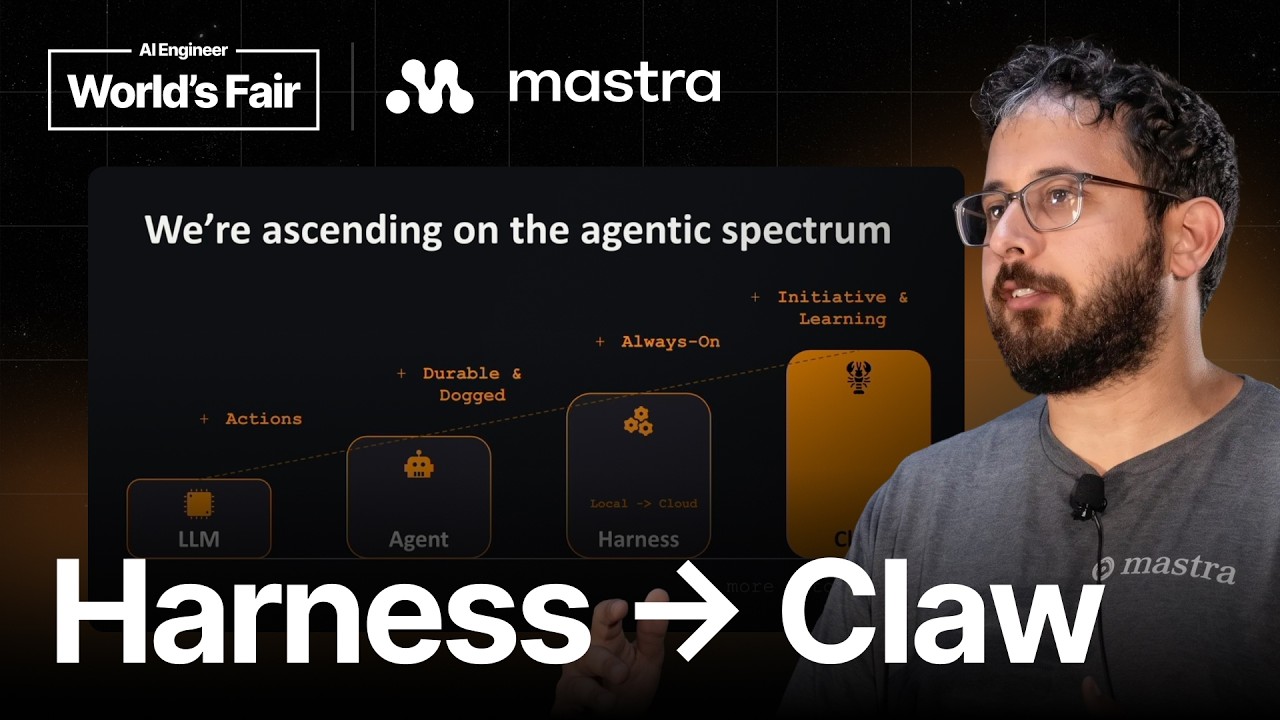
Every Harness Will Become A Claw — Sam Bhagwat, Mastra

The evolution of AI agents is moving from localized 'Harnesses'—tools used for coding and task execution—to persistent, always-on services called 'Claws.' This transition involves imbuing agents with initiative, external connectivity (like a heartbeat), and continual learning capabilities. The speaker proposes Steinberger's law: every harness will expand until it becomes a Claw, driven by the desire for powerful, integrated developer experiences.

Key takeaways

  1. Harnesses are evolving into Claws 1:42

    The next generation of agents moves beyond local execution to become always-on services that listen to external events (e.g., Slack, mobile apps) and maintain a persistent 'heartbeat.'

  2. Agentic Spectrum Advancement 0:49

    Agents are advancing through stages: Agent $ ightarrow$ Harness $ ightarrow$ Claw. Key technical advancements include durability, doggedness, planning mode, and parallel subagents.

  3. Cloud vs. Local Architecture 1:48

    The shift from local harnesses to cloud harnesses provides greater parallelism and resources but necessitates a different distributed system architecture.

Watch on YouTube Full article