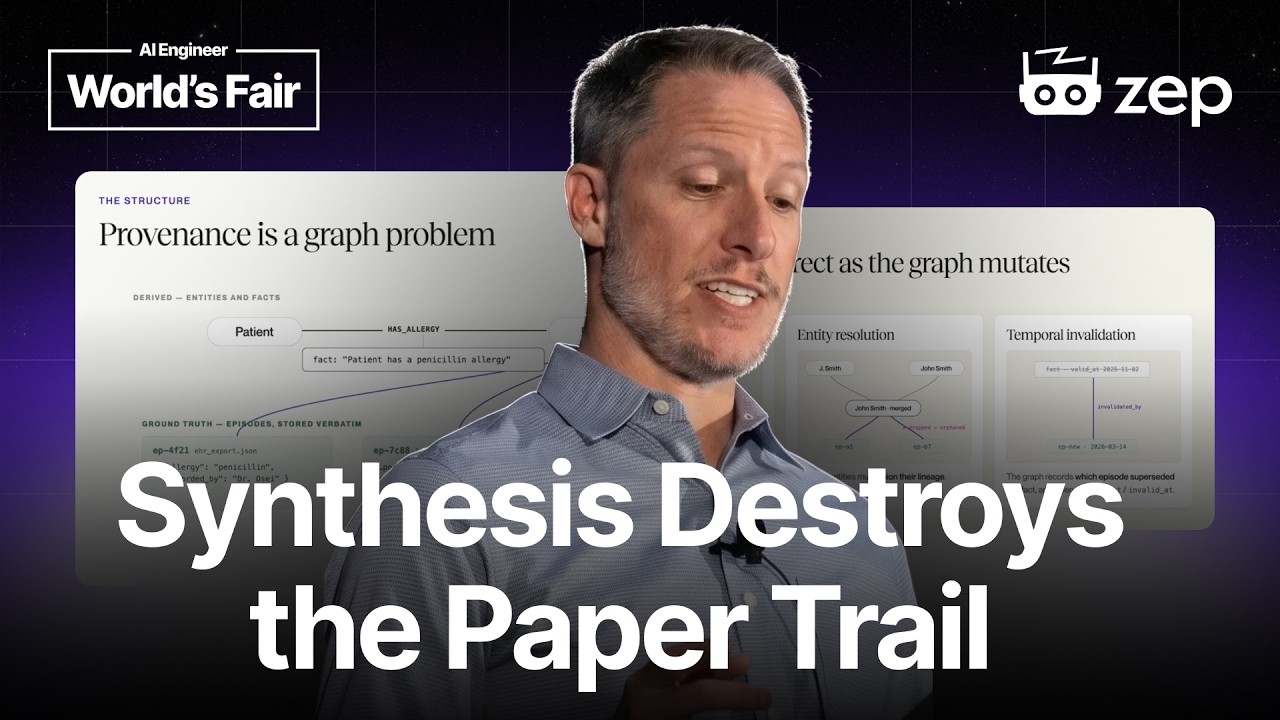
Citation Needed: Provenance for LLM-Built Knowledge Graphs — Daniel Chalef, Zep AI
The synthesis of facts by Large Language Models (LLMs) often destroys the original source attribution or 'paper trail.' Daniel Chalef argues that traditional methods like simple Source IDs fail when data undergoes complex transformations, such as entity merging or fact invalidation. He proposes that provenance for LLM-built knowledge graphs must itself be a graph structure. The open-source framework Graphiti models sources as 'episodes' and uses graph walks to trace every derived fact back to its original source(s), ensuring compliance (e.g., GDPR deletion) and verifiable veracity.
Key takeaways
-
LLM Synthesis Destroys Provenance
Because LLMs synthesize facts non-deterministically, the resulting output artifact may not appear verbatim in the source inputs, making simple source ID tracking insufficient for complex agent applications.
-
Provenance Requires a Graph Structure
7:00
To maintain lineage through mutations and merges, provenance must be modeled as a knowledge graph where facts are derived from linked sources (episodes). Tracing a fact's origin then becomes a simple 'graph walk.'
-
Graphiti Enables Robust Lineage Management
10:06
The Graphiti framework models source data as episodes, allowing derived facts to inherit all necessary links. This structure supports complex operations like metadata projection (e.g., filtering only 'EHR' verified sources) and GDPR-compliant deletion.