Topic

Knowledge Graphs

All digests tagged Knowledge Graphs

· 20:23

AI tools for Forward Deployed Engineering — Vasuman Moza, Varick Agents

The core bottleneck in enterprise AI adoption is not model intelligence or execution capability, but rather the ability to deeply understand and re-engineer complex, undocumented human business processes. Forward Deployed Engineers (FDEs) are critical for this process, mapping existing workflows—including edge cases and handoffs—and building autonomous agents on top of legacy systems (e.g., SAP, NetSuite). The technical solution involves using a Veric OS platform that builds agents on existing systems without requiring costly migrations, leveraging dependency graphs, and employing custom post-trained models to extract accurate context from messy enterprise data.

Key takeaways

  1. The AI Bottleneck is Context, Not Execution

    While modern LLMs can solve the execution of work (intelligence constraint), the primary bottleneck remains understanding the unique business processes within a specific company. Every department (e.g., healthcare sales vs. SaaS sales) operates differently, requiring deep context extraction.

  2. Forward Deployed Engineering (FDE) Role 7:24

    FDEs are responsible for mapping how humans currently perform work and then re-engineering the process around AI. This ensures that AI solutions are adoptable and deliver measurable, department-wide ROI rather than failing as isolated 'point solutions.'

  3. Non-Disruptive Deployment Strategy 17:02

    To overcome enterprise resistance to migration (e.g., spending $5 million over five years on NetSuite), agents must be built *on top* of existing systems of record (Salesforce, SAP, Dynamics) rather than requiring a full system overhaul.

  4. Agent Tooling for FDEs

    The Veric platform provides specialized tools: an Engagement Agent (assistant to synthesize notes/docs), and a Workflow Agent that ensures the constructed workflow correctly shadows real-world process edge cases. A future autonomous assistant will handle minor changes without human intervention.
Watch on YouTube Full article

· 15:00

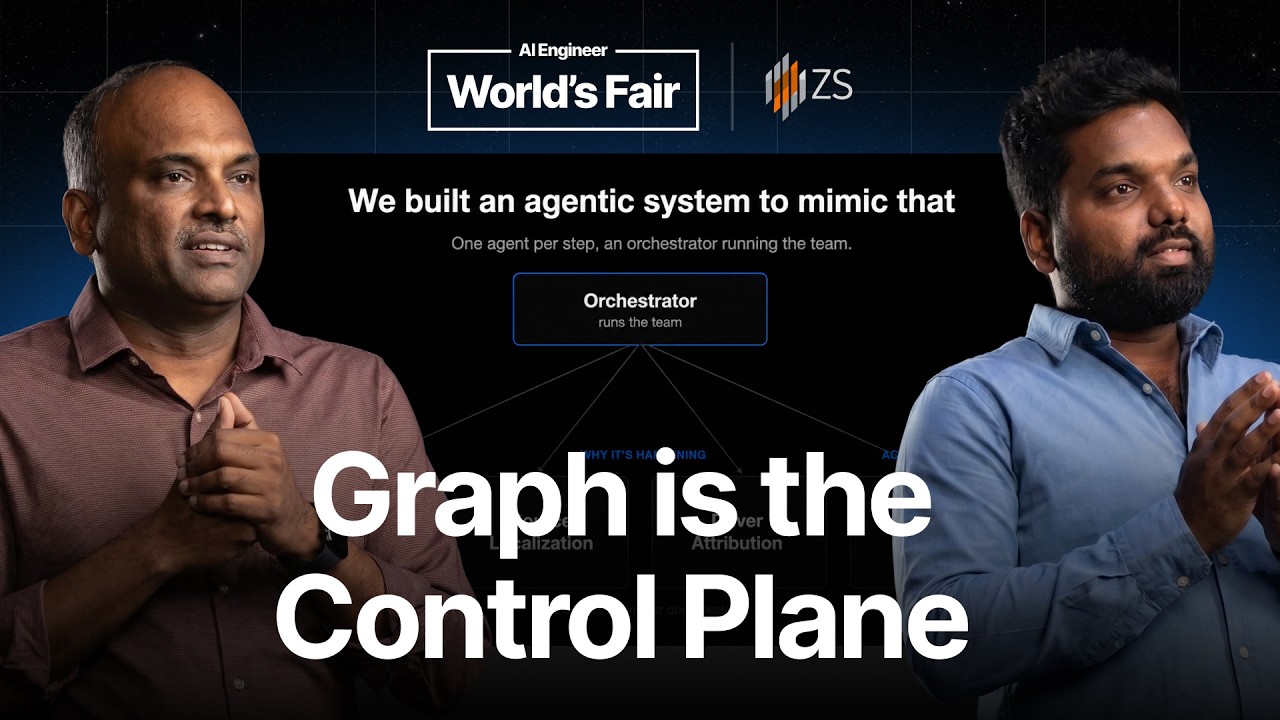
Why We Killed Our Multi-Agent Pipeline — Subbiah Sethuraman and Abhilash Asokan, ZS Associates

The video details the architectural overhaul of a multi-agent pipeline designed for complex pharma commercial analytics. The initial system failed because it attempted to mimic human analyst behavior by assigning separate agents to every step (signal detection, localization, attribution, synthesis), leading to context loss and incoherent reasoning. The rebuild focused on three key principles: 1) Separating deterministic signal detection into a pre-agent automated pipeline; 2) Consolidating core reasoning into a single agent that owns the end-to-end picture; and 3) Utilizing a Knowledge Graph (KG) not as a data lookup table, but as a 'control plane' to bound hypotheses and guide the investigation process. This resulted in a system capable of producing complex analyses in minutes, matching months of human effort.

Key takeaways

  1. Deterministic vs. Agentic Workflow 11:41

    Complex workflows must separate deterministic parts (like signal detection) into automated pipelines that run before the agent is activated. Agents should be reserved for investigation and reasoning, not initial data fetching or filtering.

  2. Single Point of Reasoning Ownership 13:25

    Instead of distributing judgment across multiple agents, consolidate the entire end-to-end reasoning process into a single main agent. This agent can use tools to spawn sub-agents only for focused lookups, ensuring coherence and maintaining ownership of the overall conclusion.

  3. Knowledge Graph as Control Plane

    A Knowledge Graph must be treated as a control plane—a mechanism that dictates what hypotheses an agent can test and what path it can take—rather than merely being a lookup table for data. This bounds the search space and ensures domain relevance.

Watch on YouTube Full article

· 20:54

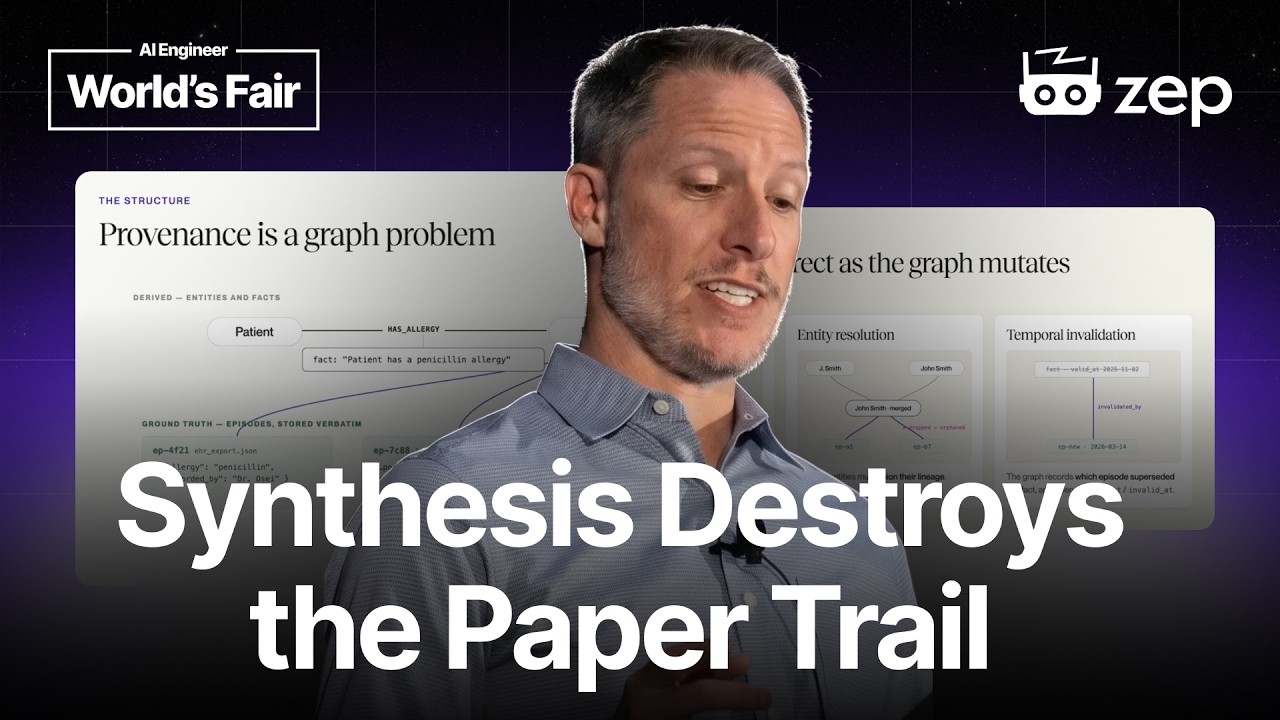
Citation Needed: Provenance for LLM-Built Knowledge Graphs — Daniel Chalef, Zep AI

The synthesis of facts by Large Language Models (LLMs) often destroys the original source attribution or 'paper trail.' Daniel Chalef argues that traditional methods like simple Source IDs fail when data undergoes complex transformations, such as entity merging or fact invalidation. He proposes that provenance for LLM-built knowledge graphs must itself be a graph structure. The open-source framework Graphiti models sources as 'episodes' and uses graph walks to trace every derived fact back to its original source(s), ensuring compliance (e.g., GDPR deletion) and verifiable veracity.

Key takeaways

  1. LLM Synthesis Destroys Provenance

    Because LLMs synthesize facts non-deterministically, the resulting output artifact may not appear verbatim in the source inputs, making simple source ID tracking insufficient for complex agent applications.

  2. Provenance Requires a Graph Structure 7:00

    To maintain lineage through mutations and merges, provenance must be modeled as a knowledge graph where facts are derived from linked sources (episodes). Tracing a fact's origin then becomes a simple 'graph walk.'

  3. Graphiti Enables Robust Lineage Management 10:06

    The Graphiti framework models source data as episodes, allowing derived facts to inherit all necessary links. This structure supports complex operations like metadata projection (e.g., filtering only 'EHR' verified sources) and GDPR-compliant deletion.

Watch on YouTube Full article

· 21:18

Why Agentic Systems Need Ontologies — Frank Coyle, UC Berkeley

The talk argues that while Large Language Models (LLMs) and agentic systems represent a powerful shift toward AI, their inherent probabilistic nature makes them unreliable for mission-critical tasks. To mitigate failures—such as incorrect order statuses or double refunds—the solution is 'Neurosymbolic AI': coupling the LLM's generative power with external, formal ontologies. An ontology acts as a logical guardrail, enforcing constraints (e.g., payment status must be one of three values) that are impossible to reliably enforce using prompt engineering alone.

Key takeaways

  1. The Problem with Probabilistic Agents

    LLMs reason probabilistically over domains they only half understand, leading to failures in brittle tools and fragile handoffs. These errors cannot be reliably stopped by mere instructions or prompt engineering.

  2. Neurosymbolic AI: Guardrails for LLMs 7:04

    This approach ties together neural networks (LLMs) with symbolic AI (rule-based systems and ontologies). The ontology provides the necessary guardrails to keep the probabilistic model constrained and honest.

  3. The Role of Ontologies 8:43

    An ontology is a formal specification of a shared conceptualization, defining typed entities, their relationships, and constraints. It allows systems to validate proposed actions (e.g., ensuring an order can only be refunded once).

Watch on YouTube Full article