Topic

Forward Deployed Engineering

All digests tagged Forward Deployed Engineering

· 20:23

AI tools for Forward Deployed Engineering — Vasuman Moza, Varick Agents

The core bottleneck in enterprise AI adoption is not model intelligence or execution capability, but rather the ability to deeply understand and re-engineer complex, undocumented human business processes. Forward Deployed Engineers (FDEs) are critical for this process, mapping existing workflows—including edge cases and handoffs—and building autonomous agents on top of legacy systems (e.g., SAP, NetSuite). The technical solution involves using a Veric OS platform that builds agents on existing systems without requiring costly migrations, leveraging dependency graphs, and employing custom post-trained models to extract accurate context from messy enterprise data.

Key takeaways

  1. The AI Bottleneck is Context, Not Execution

    While modern LLMs can solve the execution of work (intelligence constraint), the primary bottleneck remains understanding the unique business processes within a specific company. Every department (e.g., healthcare sales vs. SaaS sales) operates differently, requiring deep context extraction.

  2. Forward Deployed Engineering (FDE) Role 7:24

    FDEs are responsible for mapping how humans currently perform work and then re-engineering the process around AI. This ensures that AI solutions are adoptable and deliver measurable, department-wide ROI rather than failing as isolated 'point solutions.'

  3. Non-Disruptive Deployment Strategy 17:02

    To overcome enterprise resistance to migration (e.g., spending $5 million over five years on NetSuite), agents must be built *on top* of existing systems of record (Salesforce, SAP, Dynamics) rather than requiring a full system overhaul.

  4. Agent Tooling for FDEs

    The Veric platform provides specialized tools: an Engagement Agent (assistant to synthesize notes/docs), and a Workflow Agent that ensures the constructed workflow correctly shadows real-world process edge cases. A future autonomous assistant will handle minor changes without human intervention.

Watch on YouTube Full article

· 17:38

How Forward Deployed Engineering is done at Cognition — Jia Wu

Forward Deployed Engineering (FDE) at Cognition focuses on maximizing the overlap between product capabilities and complex customer problem spaces, moving beyond simple code generation. The core value proposition is measured by tangible business outcomes—such as reducing delivery timelines or increasing PR acceptance rates—rather than merely token usage. FDE embeds within client ecosystems to identify high-leverage areas for AI agents like Devin, addressing the full software development lifecycle (SDLC) challenges including testing, review, and maintenance.

Key takeaways

  1. Shifting Focus from Tokens to Outcomes

    The industry trend is shifting away from optimizing for token usage toward measuring true business outcomes. Cognition measures value by demonstrating a real delta—for example, an 82% reduction in delivery timelines after agent activation.

  2. FDE's Role: Maximizing Problem-Product Overlap 8:36

    FDE aims to maximize the intersection between existing product domains and critical customer problems. This requires deep understanding of the client’s problem space, identifying the highest leverage points for automation.

  3. The Value is Non-Linear 3:25

    Adoption of AI agents follows a non-linear curve: initial use may be a step function, but enterprise-wide adoption and integration lead to parabolic growth as product capabilities align with the customer's full backlog.

  4. Core Mandates of FDE

    FDE operates under two mantras: relentlessly tying into the customer (who are the 'lifeblood') and prioritizing correctness and customer success at all costs. The goal is to make the customer successful, not just ship code.

Watch on YouTube Full article

· 14:05

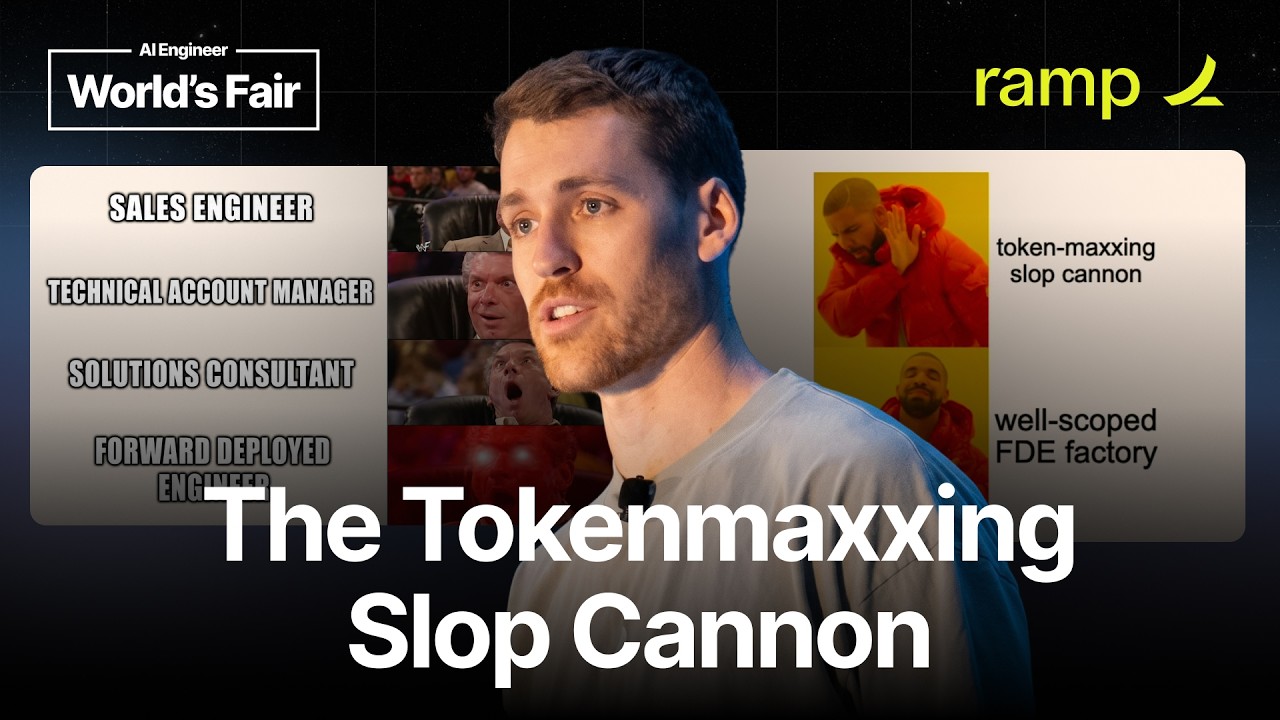
How Forward Deployed Engineering is done at Ramp — Leo Mehr

The talk outlines two core principles for Forward Deployed Engineering (FDE): always scoping and scaling with tokens. FDE teams must resist the urge to simply say 'yes' to every request; instead, they must rigorously scope requirements by asking context-gathering questions to ensure the right product is built. To scale this function, the entire FDE pipeline—from initial intake to spec writing—must be automated using AI agents (scaling with tokens). This requires building robust agent harnesses and implementing validation loops using evals, rubrics, and human feedback.

Key takeaways

  1. Always Scope First 5:16

    FDEs must pause before accepting urgent requests (e.g., SAP S/4HANA integrations) to gather context and determine what is truly necessary for the customer's success, rather than simply fulfilling the immediate ask.

  2. Scale with Tokens 8:24

    The future of FDE requires automating every stage of the request lifecycle—from gathering context to writing a spec—by replacing manual work with AI agents and model capabilities.

  3. Hybrid Approach is Key

    Effective modern FDE needs both human judgment (for taste and final validation) and agent volume/automation to handle the sheer scale of incoming requests.

Watch on YouTube Full article

· 16:49

The Dirty Secret of Forward Deployed Engineering — Natalie Meurer, Sierra

Forward Deployed Engineering (FDE) is not a single discipline but an outcome-focused role that has evolved significantly from initial platform stability work (DevOps) to complex data integration and customer enablement. The core thesis is that as coding becomes cheap due to AI agents, the value of engineering shifts entirely to understanding the customer's problem, integrating disparate data sources, and being accountable for measurable business outcomes.

Key takeaways

  1. FDE is an outcome-based role, not a code-writing one. 0:12

    The durable part of FDE involves integrating data, understanding the customer context, and maintaining accountability to a specific result, rather than merely writing software code.

  2. FDE's evolution tracks platform maturity. 0:06

    Early FDE focused heavily on DevOps and ensuring platform stability (e.g., deploying on an EC2 instance). This evolved into data integration using concepts like the Ontology, leading to modern platforms like Foundry that focus on 'data to decision-making.'

  3. Pricing models reflect accountability. 0:13

    The shift from seat-based pricing (assuming a tool) toward usage or outcome-based pricing confirms that the value lies in guaranteeing results, which is the hallmark of FDE.

  4. AI agents are simply FDE reborn. 0:15

    Agent engineering is viewed as a subset and manifestation of FDE principles, where engineers use LLMs to enable outcomes for customers. The role requires combining product knowledge with customer-facing solutioning.

Watch on YouTube Full article

· 18:09

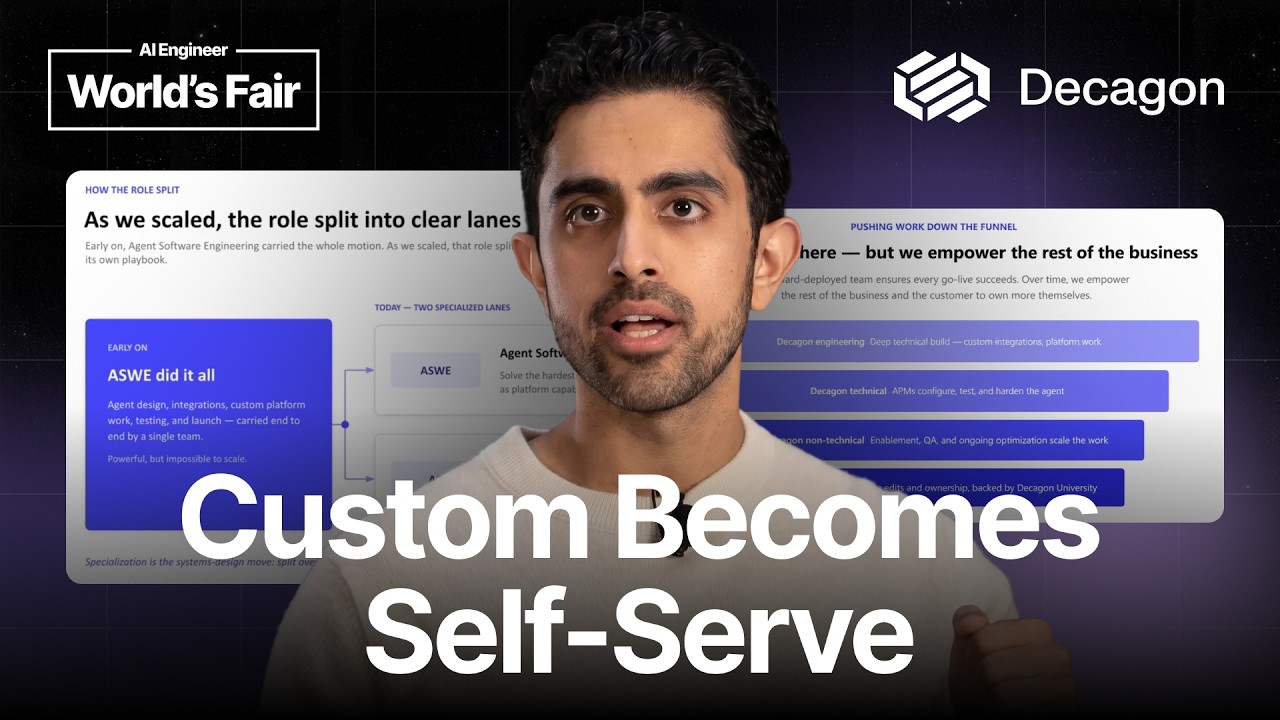
How Forward Deployed Engineering is done at Decagon — Sunny Rekhi

The talk details the function and evolution of Forward Deployed Engineering (FDE) at Decagon, a company specializing in AI customer service agents. FDE is described as being functionally identical to product engineering, requiring engineers to not only configure complex agent workflows for specific enterprises but also to proactively identify and build platform features that solve anticipated problems across multiple clients. The core philosophy emphasizes architectural restraint: ensuring all custom work is designed to be self-serve and compound into the overall platform, allowing the solution to scale from bespoke deployments to a generalized product.

Key takeaways

  1. FDE Blurs with Product Engineering

    The line between forward deployed service and internal product development is highly blurred. When an enterprise expresses a pain point, it should be treated as a potential product feature that needs prioritization for the entire platform (13:00).

  2. Focus on Architectural Restraint 13:40

    A critical skill in scaling FDE is exercising restraint—avoiding simple one-off patches and instead architecting solutions so they benefit future, unknown customers. This ensures the solution does not become a brittle 'black box' (8:20).

  3. Custom Work Must Compound

    The goal of every deployment is to ensure that custom integrations or workflows are systematically fed back into the platform, transforming bespoke solutions into self-service capabilities for all customers (14:18).

Watch on YouTube Full article

· 17:48

Forward Deployed Engineering 101 — Kevin Bai, Anthropic, ex Palantir & Rippling Founding FDE

Forward Deployed Engineering (FDE) is a go-to-market model where companies sell an 'outcome' rather than just a product or service. This involves loaning specialized engineers who build bespoke solutions on top of the company's core platform. FDE is necessary when selling highly technical platforms to non-technical, large enterprise buyers (e.g., Fortune 500 clients). To scale this model successfully, the underlying technology must be built upon a reusable platform with shared primitives, preventing the function from devolving into an unmaintainable 'dev shop.'

Key takeaways

  1. FDE Focuses on Outcomes, Not Products/Services 5:14

    The goal is to sell the final business outcome (e.g., higher throughput of sales) rather than selling a piece of software or the time of an engineer. This model allows companies to land large contracts that self-serve motions cannot reach.

  2. FDE is Required for Specific Situations 6:58

    An FDE function is only necessary when selling something very technical (like an app building platform) to a non-technical buyer. If the product is simple or the buyer is highly technical, other GTM strategies may suffice.

  3. Platform Reusability Prevents Failure 11:56

    To scale FDE successfully, engineers must build on a platform of shared primitives. If every engineer builds entirely from scratch for each customer, the function becomes an unmaintainable 'dev shop,' leading to massive maintenance costs.

  4. AI Accelerates FDE Adoption

    The current shift toward agentic and customizable platforms means that nearly all companies may face the situation of selling complex solutions to non-technical customers, making FDE a more common motion.

Watch on YouTube Full article