Topic

AI Engineering

All digests tagged AI Engineering

· 16:49

The Dirty Secret of Forward Deployed Engineering — Natalie Meurer, Sierra

Forward Deployed Engineering (FDE) is not a single discipline but an outcome-focused role that has evolved significantly from initial platform stability work (DevOps) to complex data integration and customer enablement. The core thesis is that as coding becomes cheap due to AI agents, the value of engineering shifts entirely to understanding the customer's problem, integrating disparate data sources, and being accountable for measurable business outcomes.

Key takeaways

  1. FDE is an outcome-based role, not a code-writing one. 0:12

    The durable part of FDE involves integrating data, understanding the customer context, and maintaining accountability to a specific result, rather than merely writing software code.

  2. FDE's evolution tracks platform maturity. 0:06

    Early FDE focused heavily on DevOps and ensuring platform stability (e.g., deploying on an EC2 instance). This evolved into data integration using concepts like the Ontology, leading to modern platforms like Foundry that focus on 'data to decision-making.'

  3. Pricing models reflect accountability. 0:13

    The shift from seat-based pricing (assuming a tool) toward usage or outcome-based pricing confirms that the value lies in guaranteeing results, which is the hallmark of FDE.

  4. AI agents are simply FDE reborn. 0:15

    Agent engineering is viewed as a subset and manifestation of FDE principles, where engineers use LLMs to enable outcomes for customers. The role requires combining product knowledge with customer-facing solutioning.

Watch on YouTube Full article

· 2:37:48

Build a Document Review App in 3 Hours (Python, React, Azure)

This video provides an end-to-end guide for building a sophisticated document review application designed for invoice and receipt processing. The solution utilizes a modern monorepo architecture, integrating Python (FastAPI) for the backend logic, React for the frontend UI, and Microsoft Azure services (Document Intelligence and Azure OpenAI) for core AI capabilities. The process demonstrates creating a robust, multi-stage pipeline that handles document classification, data extraction, business rule validation, and general ledger account suggestion.

Key takeaways

  1. Hybrid Document Processing Pipeline

    The application uses a hybrid approach by combining specialized pre-trained models (Azure Document Intelligence) for high accuracy/low cost extraction with general LLMs (Azure OpenAI) for complex tasks like classification and suggesting General Ledger accounts. This ensures robustness against edge cases.

  2. Structured Data Modeling

    Pydantic is used extensively to enforce strict schemas on extracted data, transforming raw JSON output into predictable Python objects for reliable business logic application.

  3. Modular Pipeline Design Pattern

    The backend implements a chainable pipeline pattern (Classification -> Extraction -> Validation -> GL Suggestion). This modular design allows individual steps to be easily added, swapped, or removed without breaking the overall workflow.

  4. Enterprise Cloud Setup

    The entire system is designed for enterprise readiness by utilizing Azure services and demonstrating deployment via Azure Container Apps (ACA), emphasizing best practices for production environments.

Watch on YouTube Full article

· 19:18

Harness Engineering is not Enough: Why Software Factories Fail — Dex Horthy, HumanLayer

The video argues that current efforts in 'harness engineering' and increasing tokens are insufficient for building reliable AI software factories because they fail to address fundamental model training shortcomings. The core problem is maintaining codebase quality over time (maintainability), which current reward functions do not penalize. To move forward safely, the speaker advocates returning to rigorous human-led upfront planning: Product Review $\rightarrow$ System Architecture $\rightarrow$ Program Design (down to types and call graphs) $\rightarrow$ Vertical Slices.

Key takeaways

  1. The Failure of 'Lights Off' Factories 12:10

    Attempting to run a software factory with no human code review ('lights off') leads to failures, even for advanced agents. The issue is not scale or prompting, but a fundamental model training limitation.

  2. Model Training Flaw (The Maintainability Gap) 17:12

    Current coding models are primarily trained on passing tests and solving one-off problems. Their reward signal does not penalize poor program design or the erosion of codebase maintainability, meaning they get better at passing tests but worse at keeping large systems stable.

  3. The Path Forward: Structured Planning

    To move faster safely, engineers must re-emphasize upfront planning steps: Product Review (desired behavior/mockups), System Architecture (component contracts/data models), Program Design (types and call graphs), and Vertical Slices (implementation order).

Watch on YouTube Full article

· 19:47

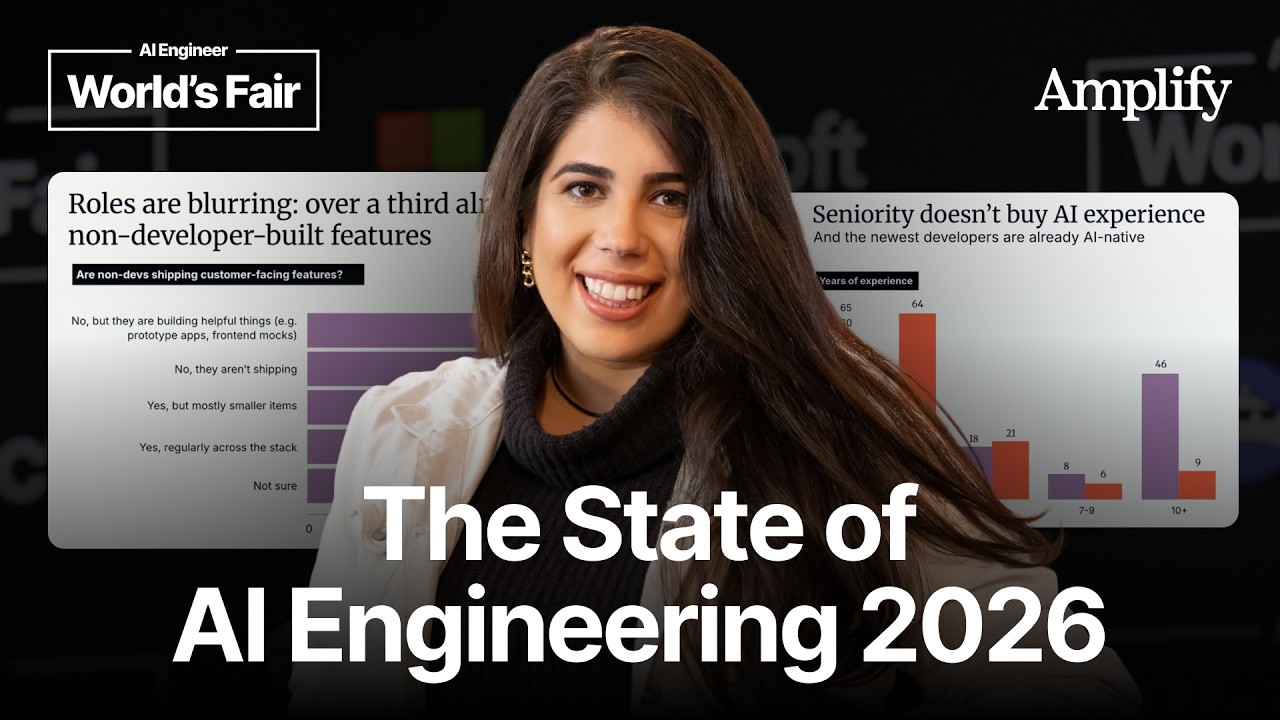
2026 State of AI Engineering — Barr Yaron, Amplify Partners

The state of AI engineering is characterized by rapid maturity and increased complexity. Survey data from 1,048 respondents indicates that while open-weight models augment closed systems, the primary drivers for model choice are quality, agentic capabilities (like tool calling), and cost. Cost has become a 'first-class engineering constraint,' forcing teams to manage usage carefully. Furthermore, agents are rapidly evolving from summarization tools to systems with write access, necessitating robust control layers and sophisticated evaluation (eval) processes.

Key takeaways

  1. AI Experience is Democratizing 0:03

    The AI engineering workforce is maturing quickly; the median new engineer has nearly as much AI experience as a 10-year software veteran, indicating that AI skills are becoming foundational to modern development.

  2. Cost is a Primary Constraint 0:08

    Three out of four respondents report adjusting their AI usage based on cost, establishing 'cost' as a first-class engineering constraint alongside quality and capability.

  3. Agents are Taking Action 0:11

    Agentic workflows have shifted significantly: they are no longer limited to reading or summarizing, but are increasingly taking actions inside systems. Write access for agents has increased dramatically (from 52% to 89%).

  4. Evaluation Remains the Biggest Challenge 0:12

    Across all layers of the stack, 'eval' (evaluation) remains the number one biggest challenge reported by engineers.

Watch on YouTube Full article

· 28:43

Katie Roberts - Stop Maintaining, Start Evolving: Applying AI-Native Practices to Brownfield Codebas

This talk addresses the challenge of modernizing complex, legacy 'brownfield' codebases—systems that are highly successful but burdened by accumulated technical debt and tribal knowledge. The speaker outlines how to apply AI-Native Engineering practices not for adding new features, but for architectural reclamation. Key strategies include using established patterns like the Strangler Fig Pattern and Branch by Extraction, coupled with structured processes (e.g., creating a 'plan skill') to systematically pay down technical debt while maintaining continuous function.

Key takeaways

  1. AI should be used for paying down technical debt, not adding to it. 17:33

    Autonomous agents deployed without strict guardrails can cause havoc through over-optimization or generating 'dark code,' undermining implicit architectural constraints and creating new hidden technical debt. Safety and bounded scopes are paramount.

  2. Adopt a structured approach to brownfield modernization. 20:05

    Instead of starting with the code, begin by conducting forensic investigations using developer input (eyewitness accounts) and creating objective data visualizations (e.g., value vs. complexity graphs) to identify high-priority areas for improvement.

  3. Prioritize planning over immediate migration. 25:32

    In brownfield environments, the planning phase is critical. Focus on creating a structured roadmap and defining clear contracts (specs) before writing code to ensure the right thing is built.

  4. Use AI-assisted skills for process automation. 26:30

    Implement multi-agent flows ('skills') that automate tasks like generating PRDs from documentation, creating Jira tickets, and performing detailed code mapping. This accelerates development cycles (e.g., reducing 6 months of work to 8 weeks).

Watch on YouTube Full article

· 28:03

Podcast Crossover: AIE, AGI, frontier lab strategy with ​ ⁨@matthew_berman⁩ and @swyxtv

The discussion explores the current state and future architectural challenges of frontier AI models. Key technical points covered include specialized hardware (e.g., Etched) optimizing for post-transformer workloads, the limitations of Large Language Models (LLMs) in achieving true recursive self-improvement (RSI), and the necessity for 'Agent Labs' to build model-agnostic applications that solve complex, last-mile problems.

Key takeaways

  1. The Value Proposition of AI Engineering Conferences 5:20

    AI conferences are becoming crucial neutral grounds where multiple frontier labs (like OpenAI) can compete on an even playing field, which is highly beneficial for engineers and competitive for the labs themselves. This contrasts with single-vendor events.

  2. Hardware Specialization vs. General Purpose AI 10:20

    New generation chips (like Etched) are optimizing specifically for post-transformer workloads and architectures (post RGBT), moving beyond the general focus of older specialized hardware like Cerebras.

  3. Architectural Limitations of LLMs 22:30

    LLMs are limited in their recursion because they tend to explore variations within known data distributions. True innovation and discovering 'unknown unknowns' still require dedicated research, suggesting a need for new architectural paradigms beyond current transformer models.

  4. The Future of Application Development 25:20

    Founders should focus on building 'Agent Labs'—being the AI layer for specific industries (e.g., lawyers, dentists). This strategy is resilient to model generalization and capability overhangs because it solves persistent, last-mile problems.

Watch on YouTube Full article

· 30:13

How to Go From Data Scientist to AI Engineer (I Did This)

This roadmap guides individuals transitioning from Data Science or Machine Learning into AI Engineering. The core message is that the role shifts focus from statistical modeling in notebooks to becoming a full-stack software engineer capable of building reliable, production-grade AI systems. Key areas covered include closing the software engineering gap (OOP, structured Python projects), mastering LLM backends (FastAPI, Pydantic, Docker), and implementing advanced techniques like Retrieval Augmented Generation (RAG), evaluation (Evals), and guardrails.

Key takeaways

  1. The AI Engineer Shift 0:59

    AI Engineering requires moving beyond Jupyter notebooks to structured Python projects using OOP principles, Git, testing, debugging, logging, and environment management. The focus shifts from pure research to building reliable systems around pre-trained models.

  2. Data Science Advantage 2:00

    Individuals with a DS/ML background have an advantage because they are trained in statistical thinking (distributions, error analysis) which is critical for making non-deterministic LLM outputs reliable in production.

  3. The Importance of Production Backends 5:29

    To build deployable systems, learn to use FastAPI and Pydantic for API creation. Containerization using Docker and persistent data storage with PostgreSQL are essential steps.

  4. Advanced AI Techniques 7:30

    Mastering RAG (Retrieval Augmented Generation) requires understanding vector databases (e.g., using the PGvector extension in PostgreSQL). Furthermore, implementing Evals and Guardrails is crucial for quantifying performance and preventing issues like prompt injection.

Watch on YouTube Full article

· 16:33

The Best AI Automation Stack to Learn in 2026

The video outlines a comprehensive five-layer stack for building production-ready AI automation and engineering solutions. The recommended architecture emphasizes foundational software engineering principles—backend, database, frontend, AI models, and infrastructure—rather than relying solely on high-level no-code tools. Core technologies include Python/FastAPI/Celery for the backend, Postgres/Supabase for data storage, React/Vite/ShadCN UI for the frontend, and cloud providers (AWS, Azure, GCP) or specialized services for model integration and deployment.

Key takeaways

  1. Focus on Foundational Layers

    To build a career in AI engineering, understanding how to integrate core components—backend, database, frontend, AI layer, and infrastructure—is more valuable than mastering specific high-level tools.

  2. Backend Core Stack

    Python is the recommended language. FastAPI serves as the API entry point (handling GET/POST/PUT/DELETE webhooks), while Celery manages background workers and scheduled cron jobs, ensuring robustness and scalability.

  3. Database Recommendation 7:15

    Postgres is recommended as the primary database layer. Supabase is suggested as a wrapper around Postgres that simplifies authentication and provides an out-of-the-box admin GUI.

  4. Frontend Stack 12:00

    The recommended frontend stack is React (industry standard UI library), Vite (development server/bundler), and ShadCN UI (a component library for rapid, customizable development).

  5. Deployment Strategy

    For custom deployments, the industry standard is using Docker. For ease of use, platforms like Railway are recommended to simplify deployment setup (e.g., deploying FastAPI/Celery and React code). Advanced options include container services from major cloud providers or dedicated VPS hosting.

Watch on YouTube Full article

· 3:51:50

Build a Full-Stack GenAI Project in 4 Hours (FastAPI, React, Supabase)

This tutorial provides an end-to-end guide for building a production-grade Retrieval Augmented Generation (RAG) application—a Document Copilot. The project uses SEC filings data and demonstrates the complete AI engineering workflow: from initial client brief analysis to setting up the full stack (FastAPI, React/TypeScript, Supabase Postgres with pgvector). Key phases covered include database schema design using SQLAlchemy/Alembic, implementing user authentication via Supabase Auth, building a front-end chat interface, and establishing a robust document ingestion pipeline that converts messy HTM files into structured Markdown chunks for vector embedding.

Key takeaways

  1. Full Stack GenAI Architecture 30:45

    The system is designed as a mono repo using FastAPI (backend) and React/TypeScript (frontend), connected via Supabase Postgres, which utilizes the pgvector extension for efficient vector storage and retrieval.

  2. Data Ingestion Pipeline 3:44:09

    Raw SEC filings (HTM format) are processed using Dockling to convert them into clean Markdown. This structured data is then chunked, embedded via OpenAI, and stored in the database for RAG retrieval.

  3. Database Management

    The project utilizes SQLAlchemy and Alembic for defining models (Users, Documents, Chunks, Messages) and managing schema migrations, ensuring a structured development process.

Watch on YouTube Full article