Topic

LLMs

All digests tagged LLMs

· 46:14

Build Smarter Voice Agents

This panel discussion provides deep insights into building production-grade voice AI agents. Key architectural recommendations favor the deconstructed cascading pipeline (ASR $\rightarrow$ LLM $\rightarrow$ TTS) due to its superior flexibility for optimization and model swapping. Engineers must prioritize managing latency within a 1–1.5 second budget, implementing robust fallback systems across all stack components (ASR, LLM, TTS), and utilizing advanced context management techniques like 'Scratchpads' to maintain conversational continuity over long interactions.

Key takeaways

  1. Architectural Choice: Cascading Pipeline 1:45

    The cascading architecture is preferred because it allows for individual optimization of the ASR, LLM, and TTS layers. This modularity provides greater flexibility than a full Speech-to-Speech (S2S) stack when integrating new models or optimizing specific components.

  2. Latency Management 4:23

    The 'golden metric' for voice agent response time is between 1 to 1.5 seconds. Exceeding this budget can be unnerving for users, making latency a primary design constraint over pure accuracy in many cases.

  3. Context and Memory Management 18:05

    To prevent negative user sentiment from repeating information, agents must implement context stores (e.g., 'Scratchpads') to track customer profiles, preferences, and key facts across multiple turns or sessions.

Watch on YouTube Full article

· 33:39

AI Agents for Performance: Ship Faster, Pay Less — Rajat Shah, Netflix

This talk outlines how Netflix leveraged AI agents to automate performance engineering, addressing the bottleneck of manually identifying and fixing inefficient code patterns in production services. The process involves feeding profiling data (call stacks, CPU usage) into an LLM agent, which identifies suboptimal algorithms (e.g., quadratic-time patterns). The agent then proposes a fix, validates it against a canary deployment using real production traffic, and can even scale the fix across multiple services by identifying common anti-patterns in a centralized catalog. This shifts performance optimization from a reactive, manual effort to a proactive, automated part of the SDLC.

Key takeaways

  1. The Performance Bottleneck 4:00

    Traditional performance engineering is highly manual and time-consuming (taking minutes just to identify hot paths), making it difficult to scale across large codebases. This bottleneck increases as coding agents write code faster, potentially introducing inefficiencies.

  2. AI Agent Workflow for Optimization 12:17

    An LLM agent can automate the entire loop: reading profiling data (call stack/CPU time), identifying anti-patterns (like O(N²) loops), locating the code path in the Git repo, proposing a fix, and validating it via canary deployment.

  3. Scaling Fixes with Pattern Catalogs 21:20

    Instead of fixing one instance, agents can search across multiple services using a centralized 'Pattern/Anti-pattern Catalog' (stored in a Git repo) to find and propose fixes for the same bad pattern repeatedly implemented elsewhere.

  4. Shifting Left: Proactive Performance 26:40

    The goal is to move performance improvement left in the SDLC. The catalog can be used proactively—at code review or even during code authoring—to suggest optimal patterns before suboptimal code reaches production.

Watch on YouTube Full article

· 34:30

Is Anthropic STEALING Your Data? (While You PAY FOR IT)

While Anthropic's Terms of Service state that they do not own user outputs and are not 'stealing' data, the video argues that users pay twice: once with cash, and again with proprietary Intellectual Property (IP). The core risk is that AI labs use anonymized aggregate usage data to create a detailed 'market map,' allowing them to identify profitable vertical domains and subsequently compete directly with their customers. To mitigate this, engineers must prioritize 'AI sovereignty' by moving up the 'sovereignty ladder'—ideally by self-hosting open-weights models on rented GPUs to own the model, traces, and learning loop.

Key takeaways

  1. The Double Payment Model

    As noted by Satya Nadella, users pay for intelligence twice: once with money, and again with proprietary knowledge (IP) that must be revealed to make the AI useful. This IP is the primary asset at risk.

  2. Data Usage Creates a Market Map 3:38

    Anthropic and other model labs use anonymized aggregate data (via systems like Cleo) not for direct theft, but to build market intelligence. This map shows profitable trends in domains like coding, design, and life science, enabling the platforms to compete with their users.

  3. IP Agents vs. Commodity Agents 22:05

    Engineers must distinguish between 'commodity agents' (boilerplate/CRUD work) and 'IP agents' (unique business know-how, domain logic, or highly asymmetric workflows). Only the latter requires active defense against platform dependency risk.

  4. The Sovereignty Ladder Solution 28:46

    To protect IP, users must move up the sovereignty ladder: Tier 4 (Hybrid Private) is the optimal solution, involving running open-weights models on rented GPUs while owning the model and all traces/evals. This minimizes dependency risk from single AI labs.

Watch on YouTube Full article

· 20:54

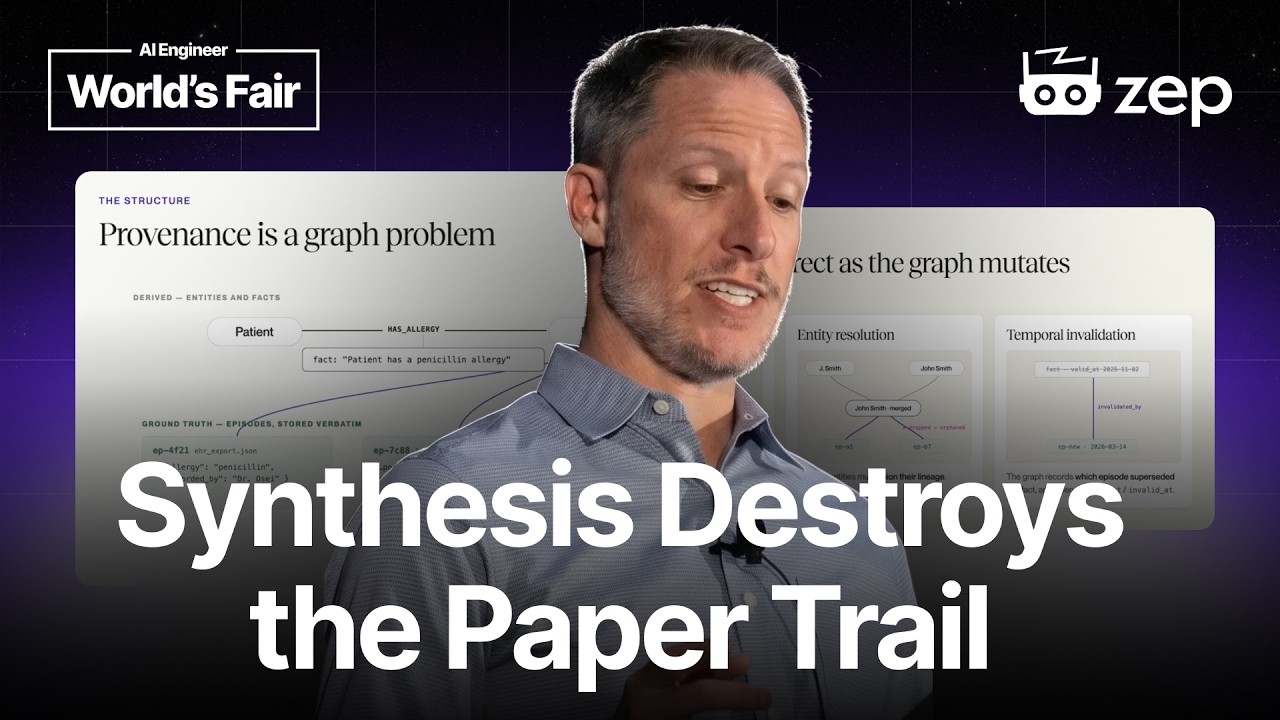
Citation Needed: Provenance for LLM-Built Knowledge Graphs — Daniel Chalef, Zep AI

The synthesis of facts by Large Language Models (LLMs) often destroys the original source attribution or 'paper trail.' Daniel Chalef argues that traditional methods like simple Source IDs fail when data undergoes complex transformations, such as entity merging or fact invalidation. He proposes that provenance for LLM-built knowledge graphs must itself be a graph structure. The open-source framework Graphiti models sources as 'episodes' and uses graph walks to trace every derived fact back to its original source(s), ensuring compliance (e.g., GDPR deletion) and verifiable veracity.

Key takeaways

  1. LLM Synthesis Destroys Provenance

    Because LLMs synthesize facts non-deterministically, the resulting output artifact may not appear verbatim in the source inputs, making simple source ID tracking insufficient for complex agent applications.

  2. Provenance Requires a Graph Structure 7:00

    To maintain lineage through mutations and merges, provenance must be modeled as a knowledge graph where facts are derived from linked sources (episodes). Tracing a fact's origin then becomes a simple 'graph walk.'

  3. Graphiti Enables Robust Lineage Management 10:06

    The Graphiti framework models source data as episodes, allowing derived facts to inherit all necessary links. This structure supports complex operations like metadata projection (e.g., filtering only 'EHR' verified sources) and GDPR-compliant deletion.

Watch on YouTube Full article

· 19:47

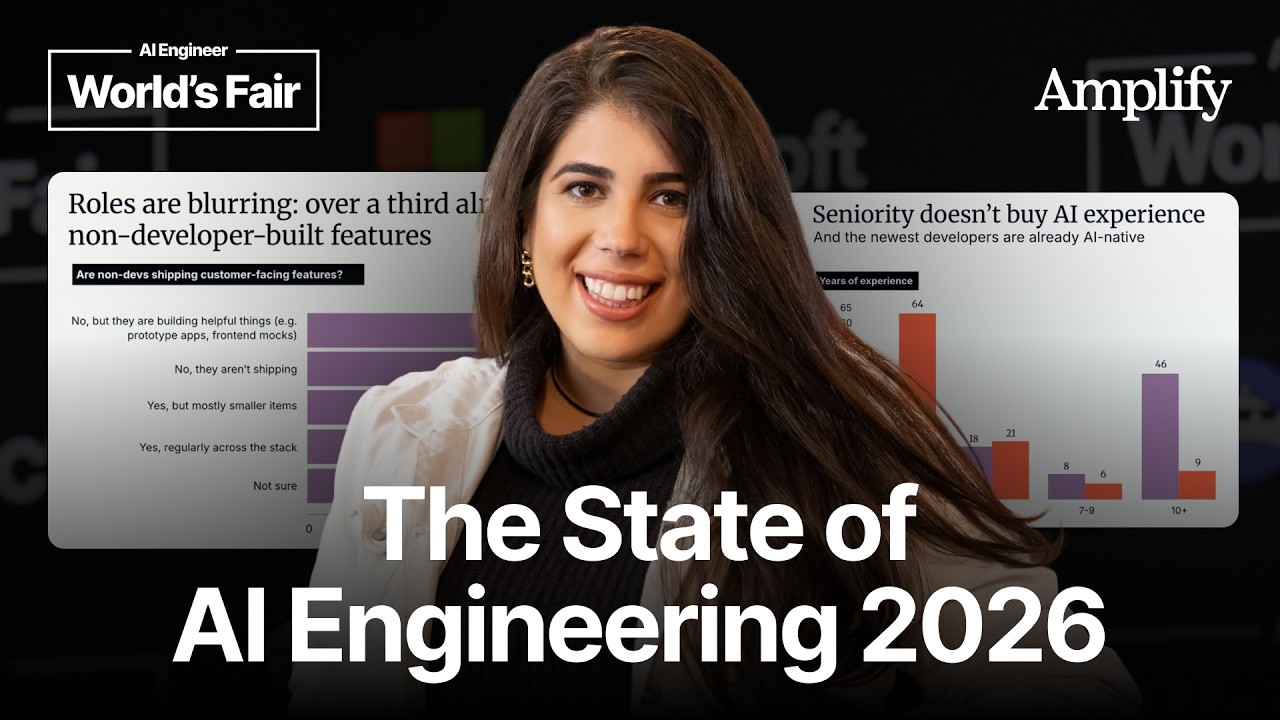
2026 State of AI Engineering — Barr Yaron, Amplify Partners

The state of AI engineering is characterized by rapid maturity and increased complexity. Survey data from 1,048 respondents indicates that while open-weight models augment closed systems, the primary drivers for model choice are quality, agentic capabilities (like tool calling), and cost. Cost has become a 'first-class engineering constraint,' forcing teams to manage usage carefully. Furthermore, agents are rapidly evolving from summarization tools to systems with write access, necessitating robust control layers and sophisticated evaluation (eval) processes.

Key takeaways

  1. AI Experience is Democratizing 0:03

    The AI engineering workforce is maturing quickly; the median new engineer has nearly as much AI experience as a 10-year software veteran, indicating that AI skills are becoming foundational to modern development.

  2. Cost is a Primary Constraint 0:08

    Three out of four respondents report adjusting their AI usage based on cost, establishing 'cost' as a first-class engineering constraint alongside quality and capability.

  3. Agents are Taking Action 0:11

    Agentic workflows have shifted significantly: they are no longer limited to reading or summarizing, but are increasingly taking actions inside systems. Write access for agents has increased dramatically (from 52% to 89%).

  4. Evaluation Remains the Biggest Challenge 0:12

    Across all layers of the stack, 'eval' (evaluation) remains the number one biggest challenge reported by engineers.

Watch on YouTube Full article

· 1:06:04

Why This Company Won't Let AI Agents Touch Bash

The presentation details the evolution of an internal AI agent platform at Cyera, transforming a personal assistant project into an enterprise-wide tool for data security and operational efficiency. The core focus is on building robust guardrails to prevent agents from becoming uncontrolled 'black boxes.' Key architectural innovations include whitelisting tools over blacklisting them, implementing a structured citation system for verifiable claims, and replacing traditional RAG with a Knowledge Graph (KG) that allows agents to navigate interconnected data like an LLM wiki. The platform emphasizes controlled deployment, allowing multiple developers to build and own specialized agents while maintaining centralized security and governance.

Key takeaways

  1. Controlled Agent Architecture

    The system prioritizes control by whitelisting specific tools rather than blacklisting forbidden actions. A critical guardrail is the use of structured, validated output, ensuring that an agent cannot execute arbitrary code (like unrestricted Bash) or leak sensitive data outside its designated context.

  2. Citation and Hallucination Mitigation 20:55

    To ensure reliability, every claim generated by the agent must be backed by a citation. This is achieved by forcing the model to output structured blocks containing both the claim and the source reference. A second model then performs clean-context verification against the raw data to drastically reduce hallucinations.

  3. Knowledge Graph over RAG 32:33

    The platform utilizes a Knowledge Graph (KG) instead of standard RAG for context retrieval. This allows agents to 'walk' connections between entities (e.g., an exception, a service, and the related pull request), providing more structured and reliable data exploration than simply dumping retrieved documents.

  4. Adoption through Platform Engineering 50:27

    To drive adoption across engineering teams, the platform was designed to be easily customizable. By allowing users to name and modify their own agents (e.g., 'It's my agent'), the barrier to entry is lowered, promoting organic growth with a strategy of 'carrots, not sticks.'

Watch on YouTube Full article

· 10:52

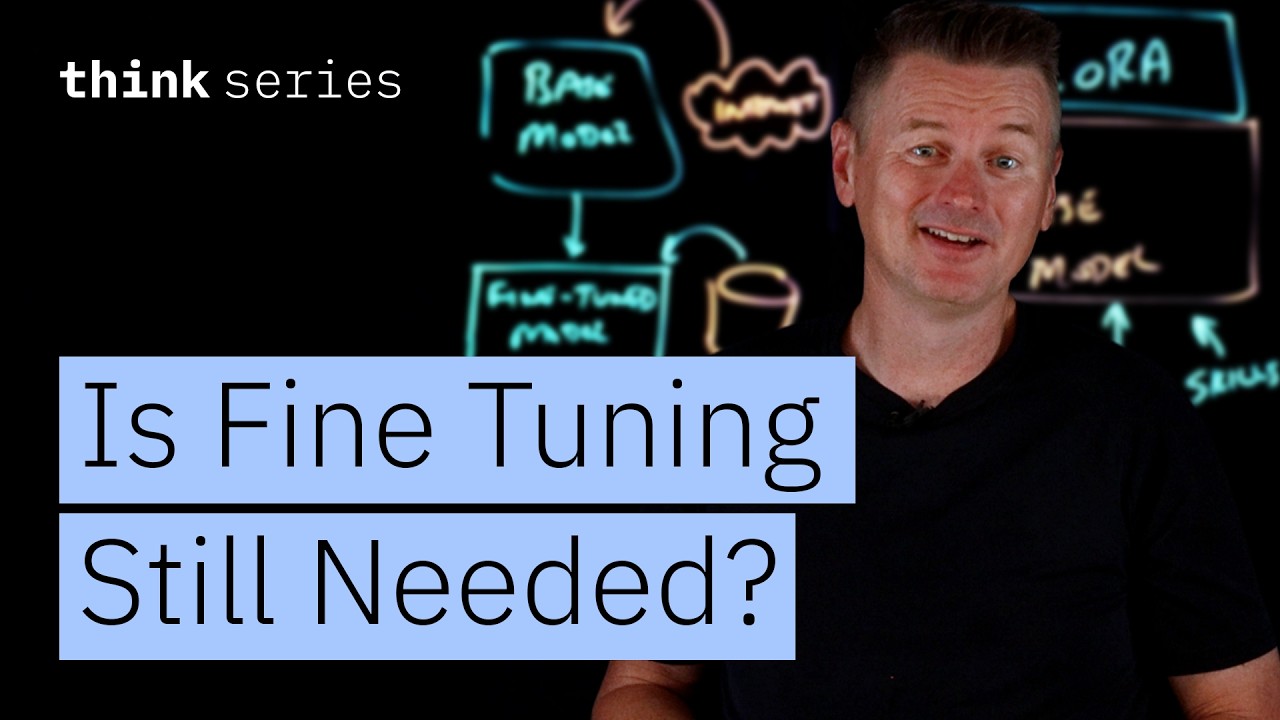
Is Fine-Tuning Still Needed? LLMs, RAG, & LoRA

While early successes demonstrated that fine-tuning custom LLMs could outperform general models (e.g., legal AI in 2023), the landscape has shifted significantly. Modern frontier models are rapidly closing the gap due to massive context windows and improved reasoning capabilities. The current architectural best practice suggests prioritizing non-weight modification techniques like Retrieval Augmented Generation (RAG), Context Engineering, and Agent Skills before resorting to fine-tuning. Fine-tuning remains valuable for specific bottlenecks, such as achieving low latency or when using parameter-efficient methods like LoRA.

Key takeaways

  1. Fine-Tuning vs. General Models

    Historically, custom fine-tuned models outperformed off-the-shelf leaders (e.g., legal AI over GPT-4 in 2023). However, general models are catching up due to massive context windows and improved inference reasoning.

  2. Modern Customization Stack 6:20

    The preferred order for customization is: Base Model $\rightarrow$ Prompt/Context Engineering $\rightarrow$ RAG (for proprietary knowledge) $\rightarrow$ Agent Skills (for procedural know-how). Fine-tuning should be the last resort.

  3. Cost and Complexity of Customization 7:45

    Fine-tuning is costly, involving not only training runs but also data collection, evaluation, regression avoidance, and continuous maintenance as frontier models advance.

Watch on YouTube Full article

· 7:46

Why RAG Solutions Fail with Complex Documents & Vector Databases

Standard Retrieval Augmented Generation (RAG) solutions often fail when processing complex, ambiguous, or contradictory real-world documents (such as evolving laws or policies). The video outlines practical architectural improvements—including robust document management and clarification loops—to ensure that AI systems can accurately handle data ambiguity and avoid presenting single answers where multiple valid interpretations exist.

Key takeaways

  1. RAG Failure Point: Data Contradiction 2:33

    Because real-world document sets are compiled over time by multiple people, they frequently contain contradictions (e.g., a 2012 law contradicting a 1912 law). A standard RAG solution must be designed to handle the possibility of multiple correct answers rather than assuming singularity.

  2. Solution 1: Preventing Unforced Errors 3:55

    Implement strong document management processes to prevent 'unforced errors' in the vector database. This means ensuring that outdated or superseded policies are removed, preventing confusion when a newer policy replaces an older one.

  3. Solution 2: Implementing Clarification Loops 4:45

    A clarification loop is a mechanism built into the AI solution that prompts the user to rephrase or specify their question if it is too vague (e.g., asking 'Who won the championship in 2010?' without specifying the sport). This ensures the input question is specific enough for accurate retrieval.

Watch on YouTube Full article

· 58:17

Omnigent: Composition, Control, and Collaboration for AI Agents

The AI development landscape is shifting from focusing solely on large language models (LLMs) to building sophisticated meta-harnesses and agent frameworks. The core challenge addressed by tools like Omnigent is managing complexity, ensuring model portability, and controlling escalating costs (tokenomics). This architectural shift requires developers to treat agents as stateful systems that rely heavily on external memory (databases) and advanced orchestration patterns like 'debating' or 'forking' conversations to achieve robust results.

Key takeaways

  1. The Meta-Harness Layer 20:40

    Meta-harnesses, such as Omnigent, sit above individual models (e.g., Claude Code, Codex, Pi) and harnesses, allowing developers to compose different components without rebuilding the entire context or workflow.

  2. Agentic Workflow Patterns 6:05

    Advanced agent techniques include having agents debate each other to surface unknown questions, and 'forking' conversations to explore parallel threads while maintaining shared original context.

  3. Tokenomics as DevOps 1:42

    AI spend is repeating the CapEx-to-OpEx shift. Governance must be pushed down to developers (giving them visibility into token usage) while retaining central policies for cost control and approval.

  4. The Importance of State 39:40

    Agents require cheap, stateful memory. This has led to a resurgence in the use of traditional databases like Postgres, Lakebase, and serverless options for persistent context.

Watch on YouTube Full article

· 30:13

How to Go From Data Scientist to AI Engineer (I Did This)

This roadmap guides individuals transitioning from Data Science or Machine Learning into AI Engineering. The core message is that the role shifts focus from statistical modeling in notebooks to becoming a full-stack software engineer capable of building reliable, production-grade AI systems. Key areas covered include closing the software engineering gap (OOP, structured Python projects), mastering LLM backends (FastAPI, Pydantic, Docker), and implementing advanced techniques like Retrieval Augmented Generation (RAG), evaluation (Evals), and guardrails.

Key takeaways

  1. The AI Engineer Shift 0:59

    AI Engineering requires moving beyond Jupyter notebooks to structured Python projects using OOP principles, Git, testing, debugging, logging, and environment management. The focus shifts from pure research to building reliable systems around pre-trained models.

  2. Data Science Advantage 2:00

    Individuals with a DS/ML background have an advantage because they are trained in statistical thinking (distributions, error analysis) which is critical for making non-deterministic LLM outputs reliable in production.

  3. The Importance of Production Backends 5:29

    To build deployable systems, learn to use FastAPI and Pydantic for API creation. Containerization using Docker and persistent data storage with PostgreSQL are essential steps.

  4. Advanced AI Techniques 7:30

    Mastering RAG (Retrieval Augmented Generation) requires understanding vector databases (e.g., using the PGvector extension in PostgreSQL). Furthermore, implementing Evals and Guardrails is crucial for quantifying performance and preventing issues like prompt injection.

Watch on YouTube Full article

· 58:54

Building an AI-Powered Personal Companion Mobile App - Gerald Versluis - NDC Copenhagen 2026

The talk demonstrates how to integrate advanced AI functionalities into cross-platform mobile applications using .NET MAUI. The session emphasizes building robust, context-aware companion apps by leveraging abstraction layers and standardized APIs (like the Essentials API). Key architectural patterns include supporting multimodal input (voice, image), utilizing cloud services like Azure AI Foundry for LLMs, and implementing local model support via Onyx for sensitive data scenarios.

Key takeaways

  1. AI Integration is Cross-Platform 17:22

    The implementation of AI features can be abstracted across platforms (iOS, Android, Windows) using .NET MAUI's abstraction layer, ensuring a consistent user experience while allowing platform-specific native behavior.

  2. Context Awareness and Memory 23:50

    AI applications can be significantly enhanced by incorporating context from various sources—including location (geolocation), calendar data, biometrics, and conversation history (memory)—to provide highly personalized user experiences.

  3. Multimodal Input Handling 30:05

    The system supports multiple input types beyond text, including voice recording and image analysis. This requires transforming raw data (audio/image) into a format consumable by Large Language Models (LLMs), such as using speech-to-text transcription.

  4. Model Agnosticism via Interfaces 40:05

    By relying on interfaces (e.g., `I ChatClient`), developers can easily swap out concrete AI implementations—such as those from Microsoft Foundry, OpenAI, or local models like Apple Intelligence/Onyx—without changing core application logic.

Watch on YouTube Full article