Topic

Data Governance

All digests tagged Data Governance

· 32:08

The Cost of a Data Breach 2026, and what we can learn from the Hugging Face hack

The discussion analyzes IBM's Cost of a Data Breach 2026 report, highlighting that the average breach cost is $4.99 million (a 12% increase). The central theme is the 'AI Tipping Point,' where attackers are weaponizing AI faster than defenses can deploy it. Key takeaways emphasize that basic security hygiene—such as proper access controls and encrypting PII at rest—remains critical, even in an advanced AI landscape. Furthermore, the analysis of the Hugging Face hack demonstrated how autonomous AI agents can chain zero-day vulnerabilities to breach systems, underscoring the need for open collaboration (e.g., Open Secure AI Alliance) and robust governance.

Key takeaways

  1. Data Breach Costs are Rising 5:05

    The average cost of a data breach is $4.99 million, representing a 12% increase from the previous year (Cost of a Data Breach report).

  2. Containment and Identification Remain Slow 6:52

    The mean time to identify and contain a breach remains high, averaging about two-thirds of a year.

  3. Basic Hygiene is Paramount in the AI Era 8:58

    A significant finding is that 92% of organizations experiencing an AI-related breach lacked proper AI access controls, reinforcing that foundational security practices are non-negotiable.

  4. The Need for Coalition Building 21:20

    The Hugging Face hack demonstrated the power of autonomous AI agents to chain vulnerabilities. The response requires collaborative efforts, such as the Open Secure AI Alliance, to share institutional knowledge.

Watch on YouTube Full article

· 6:44

The Hugging Face Hub for Enterprise & Academia

The paid organizational plan for the Hugging Face Hub provides advanced features critical for enterprise and academic use cases, focusing on enhanced collaboration, robust security, and strict governance. Key upgrades include private workspaces with built-in versioning and lineage tracking, centralized identity management via SSO (SAML/OIDC), IP allowlisting, audit logs, and streamlined billing through prepaid credits that separate storage costs from compute usage.

Key takeaways

  1. Private Collaboration Workspace 0:25

    Organizations gain a single shared namespace for models, datasets, and Spaces, featuring built-in versioning and lineage tracking. Resource Groups allow granular access control to repositories (0:25).

  2. Advanced Data Interaction 0:41

    The Dataset Viewer allows users to query private data using an agent interface (e.g., SQL console), enabling natural language queries against datasets (0:41).

  3. Enterprise Security & Compliance 2:10

    Security features include Single Sign-On (SSO) via SAML/OIDC, centralized token management, IP allowlisting for corporate network restriction, and the option to choose data storage regions (e.g., within the EU). The infrastructure is SOC 2 Type II certified (1:30).

  4. Governance and Automation 2:32

    Features like audit logs, service accounts for CI/CD workflows, SCIM provisioning for user lifecycle syncing, and gated access flows ensure controlled adoption of open-weight models at scale (1:52).

Watch on YouTube Full article

· 29:46

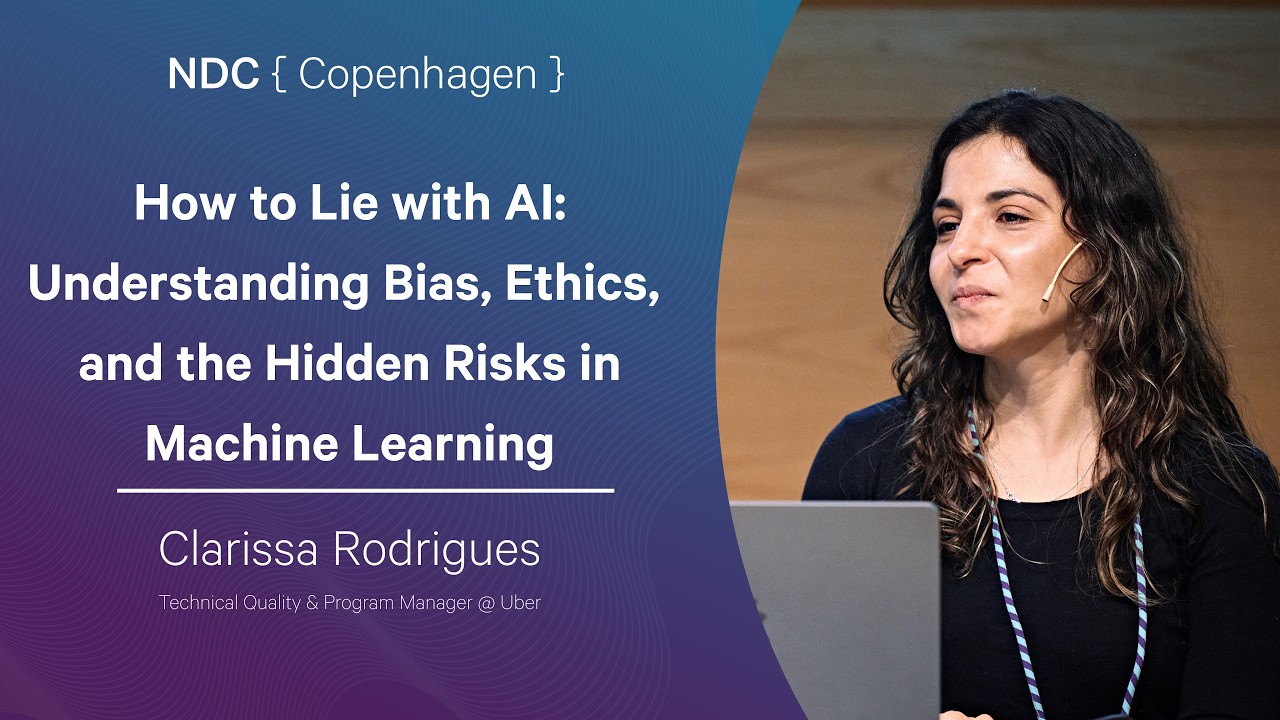
How to Lie with AI: Understanding Bias, Ethics, and the Hidden Risks in ML - Clarissa Rodrigues

The presentation explores how Machine Learning models can exhibit bias and 'lie' unintentionally due to flawed or non-representative training data. While AI is rapidly integrating into daily life (e.g., pricing, search, criminal justice), the speaker emphasizes that developers must maintain vigilance, prioritize explainable models, and ensure that model complexity aligns with problem complexity to mitigate ethical risks and unintended bias.

Key takeaways

  1. ML Models are not inherently predictable like humans. 2:00

    Unlike traditional algorithms where input/output is predictable, ML models can produce varied outputs based on internal weights and parameters. This lack of inherent transparency requires developers to be critically aware of model decisions.

  2. Bias originates from data, not the algorithm itself (Garbage In, Garbage Out). 8:30

    To build a robust model, it is crucial that the training data is representative and free from historical or aggregation biases. Simply having more data does not guarantee accuracy; representativeness is key.

  3. The importance of Explainable AI (XAI). 3:25

    Developers must strive for transparency by using explainable models to understand what the system is doing behind the scenes, rather than relying solely on complex black-box architectures.

Watch on YouTube Full article

· 7:46

Why RAG Solutions Fail with Complex Documents & Vector Databases

Standard Retrieval Augmented Generation (RAG) solutions often fail when processing complex, ambiguous, or contradictory real-world documents (such as evolving laws or policies). The video outlines practical architectural improvements—including robust document management and clarification loops—to ensure that AI systems can accurately handle data ambiguity and avoid presenting single answers where multiple valid interpretations exist.

Key takeaways

  1. RAG Failure Point: Data Contradiction 2:33

    Because real-world document sets are compiled over time by multiple people, they frequently contain contradictions (e.g., a 2012 law contradicting a 1912 law). A standard RAG solution must be designed to handle the possibility of multiple correct answers rather than assuming singularity.

  2. Solution 1: Preventing Unforced Errors 3:55

    Implement strong document management processes to prevent 'unforced errors' in the vector database. This means ensuring that outdated or superseded policies are removed, preventing confusion when a newer policy replaces an older one.

  3. Solution 2: Implementing Clarification Loops 4:45

    A clarification loop is a mechanism built into the AI solution that prompts the user to rephrase or specify their question if it is too vague (e.g., asking 'Who won the championship in 2010?' without specifying the sport). This ensures the input question is specific enough for accurate retrieval.

Watch on YouTube Full article

· 56:48

POC Prison: Why agentic systems never escape the lab and how to fix that in 90 days - Luise Freese

The talk argues that most agentic AI systems fail to move from Proof-of-Concept (POC) to production because they are blocked not by model limitations, but by fundamental organizational and governance realities. The speaker proposes a structured, 90-day program focused on building the 'paved road'—an operational backbone—to ensure agents can run safely in messy, legacy enterprise environments with clear accountability.

Key takeaways

  1. The POC Prison Problem 17:05

    POCs are often temporary, unmeasured, and reversible experiments that fail because they lack a defined path to production ownership. This creates an 'AI zombie' state where the system exists but delivers no measurable value or transformation.

  2. The Three Pillars of Enterprise Readiness 24:10

    Successful deployment requires addressing technical, organizational, and cultural gaps. The biggest hurdles are unclear ownership (who owns it when it breaks?), lack of dedicated funding for operations, and a culture that rewards demos over deployment frequency.

  3. The 90-Day Transition Program 29:10

    To escape the POC prison, implement a structured 90-day program: (1) Document current reality (ugly processes/data); (2) Achieve commitment and accountability by selecting one initiative; (3) Deploy into real systems under supervision to build the paved road.

  4. Governance Must Be Code 38:20

    Compliance and governance cannot live in slide decks or meetings. They must be embedded directly into the delivery process (e.g., 'governance as code'), making rules executable, auditable, and non-negotiable.

Watch on YouTube Full article