Topic

Agentic AI

All digests tagged Agentic AI

· 41:28

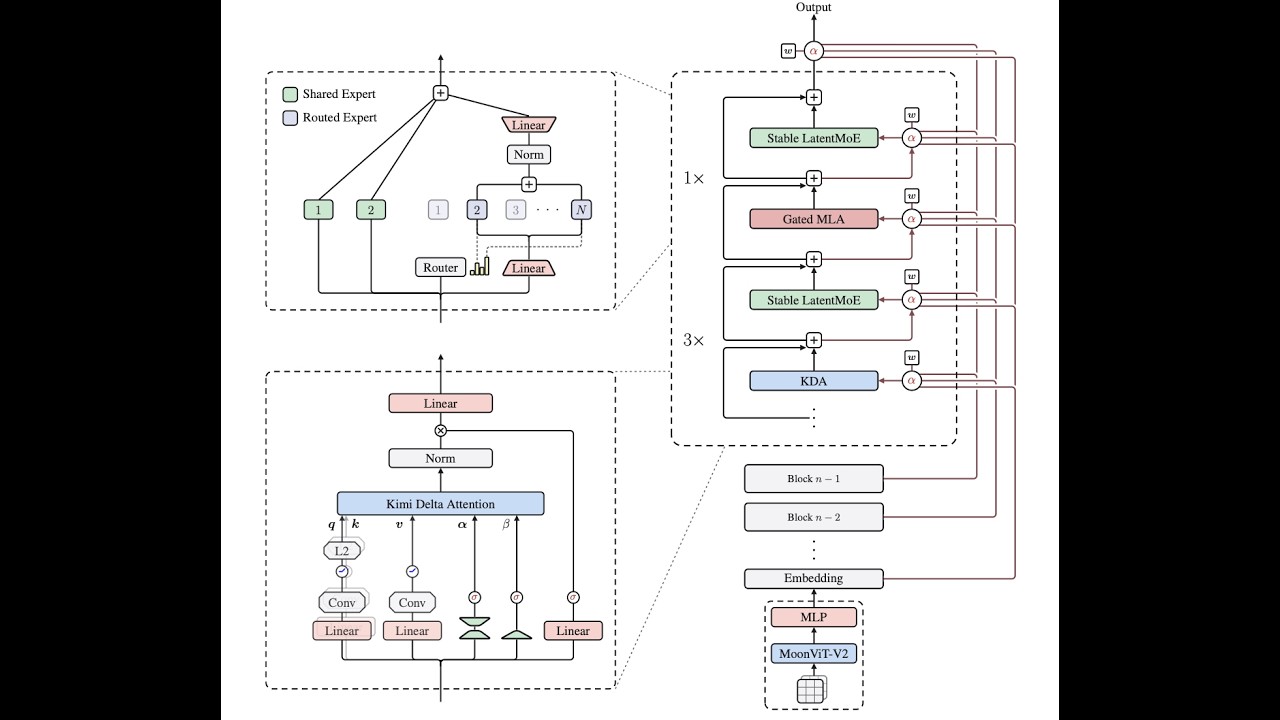
Hugging Face Journal Club: Kimi K3

The discussion summarizes the Kimi K3 tech report, detailing a highly complex and scaled training pipeline for large language models. Key innovations include specialized agentic structures (general, deep research, coding), multi-tier on-policy distillation across nine domain experts, and advanced infrastructure techniques like partial rollout schemes and dynamic resource scheduling. The talk emphasizes that the model's performance is achieved through sophisticated engineering efforts rather than a single breakthrough concept.

Key takeaways

  1. Multi-Tier Expert Specialization 2:00

    The training pipeline involves generating nine specialized domain experts (3 reasoning levels: low, high, max) for three general domains (general tasks, deep research, coding). These are combined using multi-tier on-policy distillation into a single student model.

  2. Partial Rollout Scheme 4:08

    A novel RL technique where the system samples $k$ rollouts from $n$ prompts. It uses an additional parameter $\lambda$ to measure completed rollouts within a budget, updating weights on that subset and pushing incomplete rollouts into subsequent iterations.

  3. Extensible Chat Template 6:42

    The Kimi K3 model utilizes an 'extensible token markup language' for its chat template. This design aims to be easy to learn during SFT while remaining flexible enough to accommodate future modalities without re-engineering the core template.

  4. Advanced Infrastructure Scaling 30:35

    The system employs sophisticated resource management, including a dynamic rollout auto throttling scheduler based on KV cache pressure and a method for collocating RL training and inference by automatically balancing GPU resources between the two tasks.

Watch on YouTube Full article

· 17:48

Forward Deployed Engineering 101 — Kevin Bai, Anthropic, ex Palantir & Rippling Founding FDE

Forward Deployed Engineering (FDE) is a go-to-market model where companies sell an 'outcome' rather than just a product or service. This involves loaning specialized engineers who build bespoke solutions on top of the company's core platform. FDE is necessary when selling highly technical platforms to non-technical, large enterprise buyers (e.g., Fortune 500 clients). To scale this model successfully, the underlying technology must be built upon a reusable platform with shared primitives, preventing the function from devolving into an unmaintainable 'dev shop.'

Key takeaways

  1. FDE Focuses on Outcomes, Not Products/Services 5:14

    The goal is to sell the final business outcome (e.g., higher throughput of sales) rather than selling a piece of software or the time of an engineer. This model allows companies to land large contracts that self-serve motions cannot reach.

  2. FDE is Required for Specific Situations 6:58

    An FDE function is only necessary when selling something very technical (like an app building platform) to a non-technical buyer. If the product is simple or the buyer is highly technical, other GTM strategies may suffice.

  3. Platform Reusability Prevents Failure 11:56

    To scale FDE successfully, engineers must build on a platform of shared primitives. If every engineer builds entirely from scratch for each customer, the function becomes an unmaintainable 'dev shop,' leading to massive maintenance costs.

  4. AI Accelerates FDE Adoption

    The current shift toward agentic and customizable platforms means that nearly all companies may face the situation of selling complex solutions to non-technical customers, making FDE a more common motion.

Watch on YouTube Full article

· 17:31

The Messy Reality of Scale: Synthetic Data and Pre-Training — Marah Abdin & Robert McHardy, poolside

The presentation details how poolside scaled their LLM training from smaller models (Laguna M/XS) to a massive 118 billion parameter model for agentic coding. The core strategy involves creating sophisticated synthetic data pipelines—which complement organic data by exposing implicit rationale and structure—and implementing extreme rigor in the pre-training process. Key technical challenges addressed include catching silent failures like broken GPUs, numerical precision loss during tensor parallel accumulation (BF16 to FP32 fixes), and race conditions via weight hashing checks. The resulting model, Laguna S, demonstrates competitive performance against industry leaders on coding benchmarks.

Key takeaways

  1. Synthetic Data for Feature Extraction 10:37

    Synthetic data is used not to replace organic data but to complement it by extracting and projecting implicitly hidden features (e.g., implicit rationale, planning, structure). Pipelines are modular, allowing complex tasks to be broken down into stages like multi-stage workflows, cross-domain porting (e.g., math problems to code), or multi-turn chats.

  2. Rigorous Training Validation: Trust Nothing 15:03

    To ensure correctness at scale, the team implemented model replica hashing checks; if hashes over weights do not match across distributed replicas, training is immediately halted. Failures observed include silent data corruption from broken GPUs and gradient corruption due to race conditions.

  3. Scaling Success: The 118B Parameter Model

    The final model, Laguna S (118B parameters), was trained on 30 trillion tokens across 4,000 GPUs. Early results show strong performance in agentic coding benchmarks (e.g., SWEETbench), outperforming models like GLM 4.5 Air.

Watch on YouTube Full article

· 56:48

POC Prison: Why agentic systems never escape the lab and how to fix that in 90 days - Luise Freese

The talk argues that most agentic AI systems fail to move from Proof-of-Concept (POC) to production because they are blocked not by model limitations, but by fundamental organizational and governance realities. The speaker proposes a structured, 90-day program focused on building the 'paved road'—an operational backbone—to ensure agents can run safely in messy, legacy enterprise environments with clear accountability.

Key takeaways

  1. The POC Prison Problem 17:05

    POCs are often temporary, unmeasured, and reversible experiments that fail because they lack a defined path to production ownership. This creates an 'AI zombie' state where the system exists but delivers no measurable value or transformation.

  2. The Three Pillars of Enterprise Readiness 24:10

    Successful deployment requires addressing technical, organizational, and cultural gaps. The biggest hurdles are unclear ownership (who owns it when it breaks?), lack of dedicated funding for operations, and a culture that rewards demos over deployment frequency.

  3. The 90-Day Transition Program 29:10

    To escape the POC prison, implement a structured 90-day program: (1) Document current reality (ugly processes/data); (2) Achieve commitment and accountability by selecting one initiative; (3) Deploy into real systems under supervision to build the paved road.

  4. Governance Must Be Code 38:20

    Compliance and governance cannot live in slide decks or meetings. They must be embedded directly into the delivery process (e.g., 'governance as code'), making rules executable, auditable, and non-negotiable.

Watch on YouTube Full article