Topic

Anthropic

All digests tagged Anthropic

· 22:30

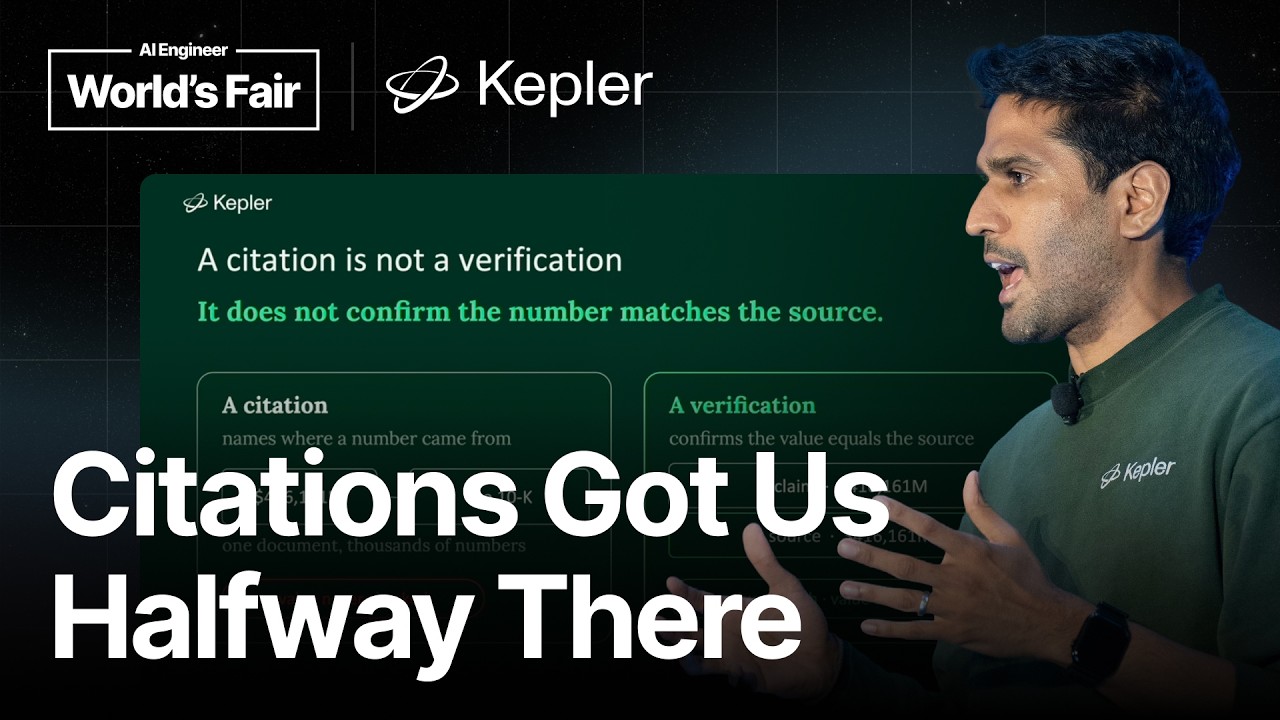
How Kepler Built Verifiable AI for Financial Services — Vinoo Ganesh

The talk details how Kepler built a verifiable AI system for financial services, addressing the core limitation that Large Language Models (LLMs) are inherently non-deterministic probability machines. To achieve reliable work product—such as DCF models or investment memos—the system must augment the LLM with a deterministic substrate. This architecture enforces three tenets: Atomic Provenance (tracking every number's source), Scope Determinism (separating reasoning from computation), and Reconciliation/Derivation Chains (ensuring numerical accuracy through verifiable steps). The goal is to shift AI's edge from content generation to verifiable, traceable output.

Key takeaways

  1. LLMs are Probability Machines, Not Deterministic Calculators 4:17

    AI models excel at next token prediction (writing) but fail when deterministic accuracy is required, such as arithmetic or pulling specific figures from filings. Using LLMs for verification alone is insufficient because they are non-deterministic.

  2. The Need for Verifiability in Finance 7:07

    In finance, information must be traceable to its source (provenance). The challenge is moving beyond simple citation (an after-the-fact audit) to true deterministic verification of a number's correctness.

  3. The Three Tenets of Verifiable AI 15:26

    Kepler’s platform ensures numerical accuracy through three mechanisms: Atomic Provenance (writing references instead of numbers), Scope Determinism (separating the model's reasoning from deterministic computation), and Reconciliation/Derivation Chains (tracking every step to produce a final number).

  4. AI Must Be Modeled Like a Portfolio Manager (PM) 20:01

    The system must not let the LLM perform computation. Instead, it uses deterministic tools to calculate figures and pull data from structured sources like XBRL or filings, ensuring the model only dictates *what* needs to be computed, not *how*. This is crucial for producing reliable work product.

Watch on YouTube Full article

· 17:48

Forward Deployed Engineering 101 — Kevin Bai, Anthropic, ex Palantir & Rippling Founding FDE

Forward Deployed Engineering (FDE) is a go-to-market model where companies sell an 'outcome' rather than just a product or service. This involves loaning specialized engineers who build bespoke solutions on top of the company's core platform. FDE is necessary when selling highly technical platforms to non-technical, large enterprise buyers (e.g., Fortune 500 clients). To scale this model successfully, the underlying technology must be built upon a reusable platform with shared primitives, preventing the function from devolving into an unmaintainable 'dev shop.'

Key takeaways

  1. FDE Focuses on Outcomes, Not Products/Services 5:14

    The goal is to sell the final business outcome (e.g., higher throughput of sales) rather than selling a piece of software or the time of an engineer. This model allows companies to land large contracts that self-serve motions cannot reach.

  2. FDE is Required for Specific Situations 6:58

    An FDE function is only necessary when selling something very technical (like an app building platform) to a non-technical buyer. If the product is simple or the buyer is highly technical, other GTM strategies may suffice.

  3. Platform Reusability Prevents Failure 11:56

    To scale FDE successfully, engineers must build on a platform of shared primitives. If every engineer builds entirely from scratch for each customer, the function becomes an unmaintainable 'dev shop,' leading to massive maintenance costs.

  4. AI Accelerates FDE Adoption

    The current shift toward agentic and customizable platforms means that nearly all companies may face the situation of selling complex solutions to non-technical customers, making FDE a more common motion.

Watch on YouTube Full article

· 49:13

Stanford MS&E435 Economics of the AI Supercycle | Spring 2026 | Applications, AI in Life Sciences

The discussion details how Artificial Intelligence is poised to fundamentally transform drug discovery and life sciences R&D by creating an end-to-end acceleration platform. Speakers from Anthropic and Chai argue that AI models (like Claude and specialized foundation models) can dramatically compress the current 10–15 year timeline for drug development, addressing bottlenecks in target identification, molecular design, clinical trials, and regulatory processes. The value is shifting from merely selling drugs to building scalable, integrated AI tools and platforms.

Key takeaways

  1. AI Accelerates Drug Development Timelines 23:49

    The current median time for drug development (from idea to market) is 10–15 years. AI has the potential to compress this timeline, with estimates suggesting a reduction to the five-year range or less by optimizing preclinical and clinical phases.

  2. Value Shifts from Drugs to Tools 36:00

    The industry value is expected to shift from traditional drug sales (revenue stream) to the tools, platforms, and foundational models that enable discovery. This makes tool developers highly valuable.

  3. AI's Role in Molecular Design 17:22

    Companies are building Computer-Aided Design (CAD) suites for molecules, aiming for 'zero shot' drug design—the ability to generate patient-ready molecules directly from the computer, bypassing much of the traditional trial-and-error process.

  4. The Platform Approach 20:40

    Anthropic's vision is to train Claude for end-to-end life science R&D acceleration, covering basic research, drug development, clinical trials, and regulatory strategy (e.g., designing clinical protocols).

Watch on YouTube Full article