Topic

Financial Technology (FinTech)

All digests tagged Financial Technology (FinTech)

· 1:05:19

From complex docs to decision ready context for agentic financial workflows

The webinar details how LlamaIndex enables the creation of sophisticated document agents for financial services by transforming complex, unstructured data (PDFs, images, etc.) into accurate, decision-ready context. The platform provides a comprehensive workflow—including parsing, extraction, and indexing—to automate historically manual processes in areas like Private Equity deal analysis, corporate lending, and mortgage servicing. Key features include advanced layout analysis for tables/charts, cross-document reconciliation, and robust human-in-the-loop validation.

Key takeaways

  1. Context is the foundation of agentic workflows 3:55

    Successful AI agents are highly dependent on accurate context. The platform's mission is to make previously untapped, unstructured data accessible by providing high accuracy and low cost in document processing.

  2. Three core financial use cases demonstrated 10:30

    The solution covers Private Equity (LBO modeling from deal room dumps), Corporate Lending (processing credit packets like ABL agreements and financials), and Mortgage Servicing (analyzing loan packages including deeds of trust, appraisals, and disclosures).

  3. Workflow relies on multi-stage processing 11:45

    The process moves from document arrival through intelligent classification/splitting $\rightarrow$ optimal parsing (LlamaParse) $\rightarrow$ targeted extraction (LlamaExtract) $\rightarrow$ cross-validation and grounding, culminating in a structured output for downstream modeling.
Watch on YouTube Full article

· 22:30

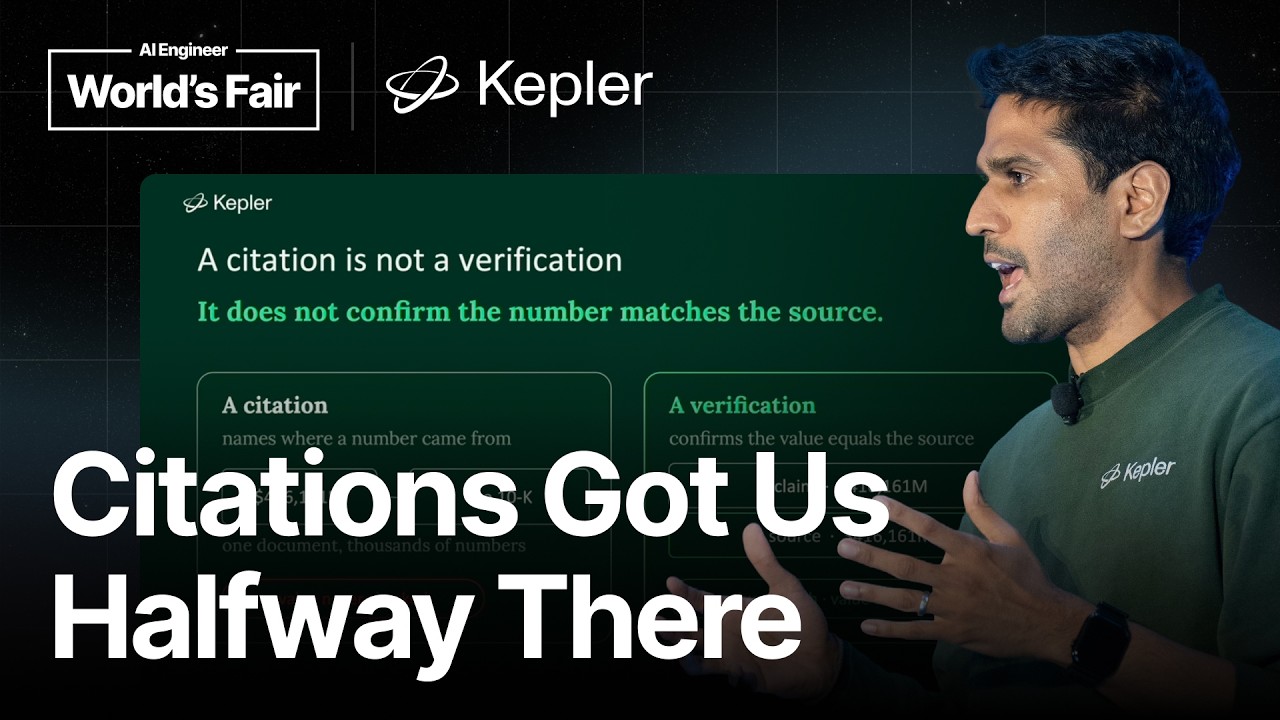
How Kepler Built Verifiable AI for Financial Services — Vinoo Ganesh

The talk details how Kepler built a verifiable AI system for financial services, addressing the core limitation that Large Language Models (LLMs) are inherently non-deterministic probability machines. To achieve reliable work product—such as DCF models or investment memos—the system must augment the LLM with a deterministic substrate. This architecture enforces three tenets: Atomic Provenance (tracking every number's source), Scope Determinism (separating reasoning from computation), and Reconciliation/Derivation Chains (ensuring numerical accuracy through verifiable steps). The goal is to shift AI's edge from content generation to verifiable, traceable output.

Key takeaways

  1. LLMs are Probability Machines, Not Deterministic Calculators 4:17

    AI models excel at next token prediction (writing) but fail when deterministic accuracy is required, such as arithmetic or pulling specific figures from filings. Using LLMs for verification alone is insufficient because they are non-deterministic.

  2. The Need for Verifiability in Finance 7:07

    In finance, information must be traceable to its source (provenance). The challenge is moving beyond simple citation (an after-the-fact audit) to true deterministic verification of a number's correctness.

  3. The Three Tenets of Verifiable AI 15:26

    Kepler’s platform ensures numerical accuracy through three mechanisms: Atomic Provenance (writing references instead of numbers), Scope Determinism (separating the model's reasoning from deterministic computation), and Reconciliation/Derivation Chains (tracking every step to produce a final number).

  4. AI Must Be Modeled Like a Portfolio Manager (PM) 20:01

    The system must not let the LLM perform computation. Instead, it uses deterministic tools to calculate figures and pull data from structured sources like XBRL or filings, ensuring the model only dictates *what* needs to be computed, not *how*. This is crucial for producing reliable work product.

Watch on YouTube Full article