Topic

Generative AI

All digests tagged Generative AI

· 1:05:19

From complex docs to decision ready context for agentic financial workflows

The webinar details how LlamaIndex enables the creation of sophisticated document agents for financial services by transforming complex, unstructured data (PDFs, images, etc.) into accurate, decision-ready context. The platform provides a comprehensive workflow—including parsing, extraction, and indexing—to automate historically manual processes in areas like Private Equity deal analysis, corporate lending, and mortgage servicing. Key features include advanced layout analysis for tables/charts, cross-document reconciliation, and robust human-in-the-loop validation.

Key takeaways

  1. Context is the foundation of agentic workflows 3:55

    Successful AI agents are highly dependent on accurate context. The platform's mission is to make previously untapped, unstructured data accessible by providing high accuracy and low cost in document processing.

  2. Three core financial use cases demonstrated 10:30

    The solution covers Private Equity (LBO modeling from deal room dumps), Corporate Lending (processing credit packets like ABL agreements and financials), and Mortgage Servicing (analyzing loan packages including deeds of trust, appraisals, and disclosures).

  3. Workflow relies on multi-stage processing 11:45

    The process moves from document arrival through intelligent classification/splitting $\rightarrow$ optimal parsing (LlamaParse) $\rightarrow$ targeted extraction (LlamaExtract) $\rightarrow$ cross-validation and grounding, culminating in a structured output for downstream modeling.
Watch on YouTube Full article

· 14:05

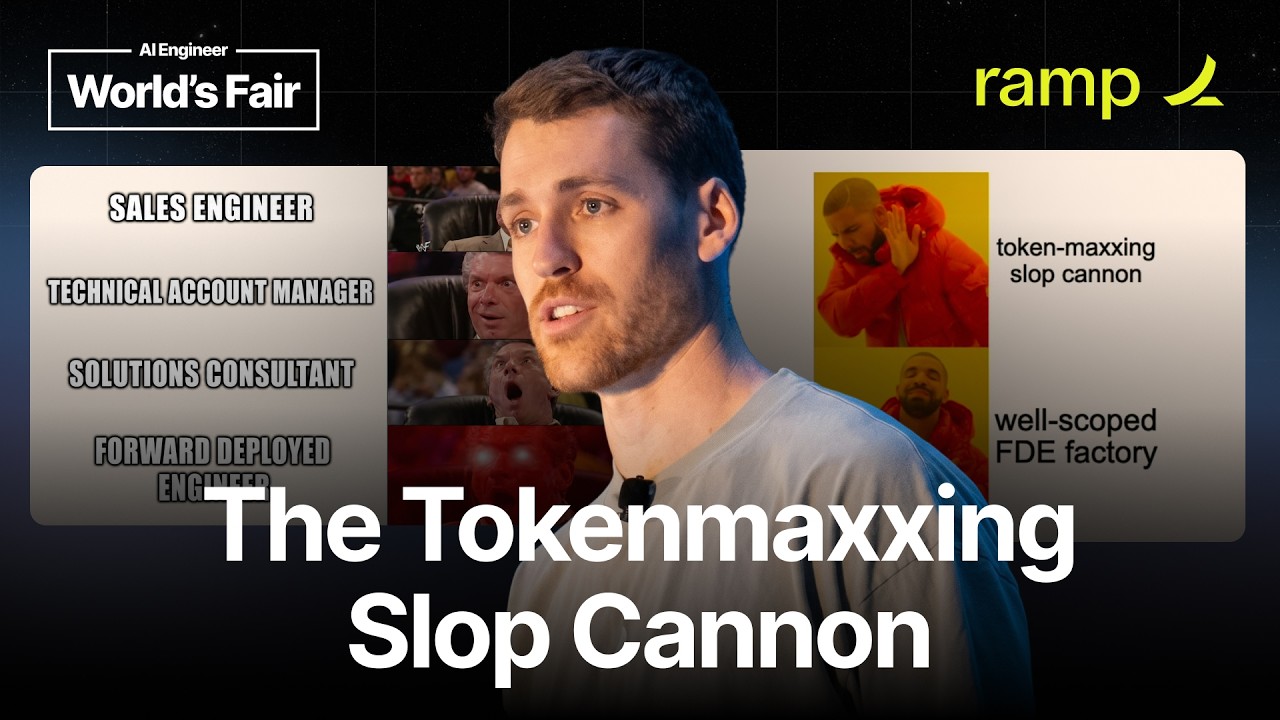
How Forward Deployed Engineering is done at Ramp — Leo Mehr

The talk outlines two core principles for Forward Deployed Engineering (FDE): always scoping and scaling with tokens. FDE teams must resist the urge to simply say 'yes' to every request; instead, they must rigorously scope requirements by asking context-gathering questions to ensure the right product is built. To scale this function, the entire FDE pipeline—from initial intake to spec writing—must be automated using AI agents (scaling with tokens). This requires building robust agent harnesses and implementing validation loops using evals, rubrics, and human feedback.

Key takeaways

  1. Always Scope First 5:16

    FDEs must pause before accepting urgent requests (e.g., SAP S/4HANA integrations) to gather context and determine what is truly necessary for the customer's success, rather than simply fulfilling the immediate ask.

  2. Scale with Tokens 8:24

    The future of FDE requires automating every stage of the request lifecycle—from gathering context to writing a spec—by replacing manual work with AI agents and model capabilities.

  3. Hybrid Approach is Key

    Effective modern FDE needs both human judgment (for taste and final validation) and agent volume/automation to handle the sheer scale of incoming requests.

Watch on YouTube Full article

· 18:22

State of Data — Sean Cai, Independent / State of Data

The data market is undergoing a structural shift from relying on sheer quantity of annotated images (the 'least interesting part') to capturing high-quality, process-based expertise. Data's value lies in the trajectory and reasoning trace—not just the final output. The speaker argues that while model improvement requires balancing compute, data, and talent, data remains the most underfunded leg. Successful companies must pivot from being mere 'data businesses' to becoming infrastructure providers (neo-labs) that build robust pipelines into real-world work.

Key takeaways

  1. Data Shift: From State to Process 2:08

    The most valuable data is process-based data—the reasoning trace or sequence of decisions, rather than state-based data (e.g., rows in an ERP). Type one data (pure capture of real workflows like GitHub commits) offers superior realism compared to type two data (contrived examples manufactured by experts).

  2. The Importance of Verifiability 5:50

    A task's ease of training is proportional to its verifiability, which depends on three axes: asymmetry of verification (decomposability into checkable steps), veracity of verification (consensus on what 'correct' means), and proliferation of verification (availability of fresh examples). Coding scored highly because it solved all three.

  3. The Builder's Moat is the Pipeline 13:10

    For data companies, the durable value accrues to the services and application layer of actual work. The true moat for builders is not the raw data itself, but the pipeline into real-world work and the infrastructure required to keep retraining as models improve.

Watch on YouTube Full article

· 19:29

How Evals and Prompts Shape Agent Behavior — Preetika Bhateja & Daniel Bump, YouTube Ads

Building reliable AI agents requires a comprehensive evaluation loop that extends far beyond prompt engineering. The process involves optimizing foundational tools, establishing rigorous evaluation workflows (Evals), and iteratively refining behavior using feedback signals rather than simple scorecards. Key strategies include starting with small-scale, intuition-based evaluations to identify failure patterns early, analyzing agent trace logs for reasoning failures, and focusing on systemic patterns of error rather than isolated instances.

Key takeaways

  1. Agent Reliability Loop

    Agent behavior is a function of its capabilities, guardrails, and the evaluation process. The system relies on an iterative loop: Prompts $\rightarrow$ Evals $\rightarrow$ Iteration $\rightarrow$ Feedback.

  2. Foundational Optimization

    Before large-scale agent evals, optimize the core set of LLM-friendly tools. Consider implementing an independent critique agent with a remediation loop to fill gaps in base tool limitations.

  3. Starting Small (Vibing) 3:35

    Instead of immediately building comprehensive, scalable evals, start with an intuition-based approach ('vibing'). This allows for quick iteration and radical architectural changes without being hindered by strict scalability requirements.

  4. Deep Failure Analysis 7:50

    To understand failures, analyze agent trace logs to see the reasoning behind a conclusion (e.g., why an agent removed a disclaimer despite explicit instructions). This is more valuable than simple pass/fail metrics.

  5. Scaling Evals and Consensus 10:10

    When involving human raters (scale raiders), provide clear rubrics, detailed examples, and train the team on expected outcomes. For complex systems, collect explanations from raters rather than just a binary pass/fail rating.

  6. Focusing on Patterns 15:30

    When diagnosing model performance degradation (regressions), focus on identifying systemic patterns of failure across the entire golden set, rather than hyper-fixingating on single, isolated examples.

Watch on YouTube Full article

· 13:40

I Deleted 5 Things From This File Before ChatGPT Saw It. It Still Found The Problem.

The video addresses the critical challenge of using powerful AI models on highly sensitive internal documents without violating data privacy. The speaker argues that traditional advice ('don't upload') is insufficient because useful work requires context. A proposed solution involves a workflow—demonstrated by the tool Airlock—that strips unnecessary Personally Identifiable Information (PII) and confidential details, then rebuilds a clean, sanitized copy of the file. This ensures the model receives only the minimum necessary context required to complete a specific task, keeping the original sensitive data local.

Key takeaways

  1. AI requires minimal, targeted context

    Instead of uploading entire files, define the job first and determine the absolute minimum information needed for the AI to perform the task. The model needs an operating plan, not PII like home addresses or API keys.

  2. Redaction is insufficient; rebuilding is necessary 6:43

    Simply blacking out sensitive data (redacting) can leave behind metadata and structural issues in file containers (like Word comments/track changes). The safer approach is to rebuild the approved material into a separate, clean document.

  3. Define protected terms for context 2:05

    Tools must allow users to define 'protected terms' (e.g., internal product codes) that are confidential but may not look like standard PII, giving the AI necessary contextual understanding.

Watch on YouTube Full article

· 10:35

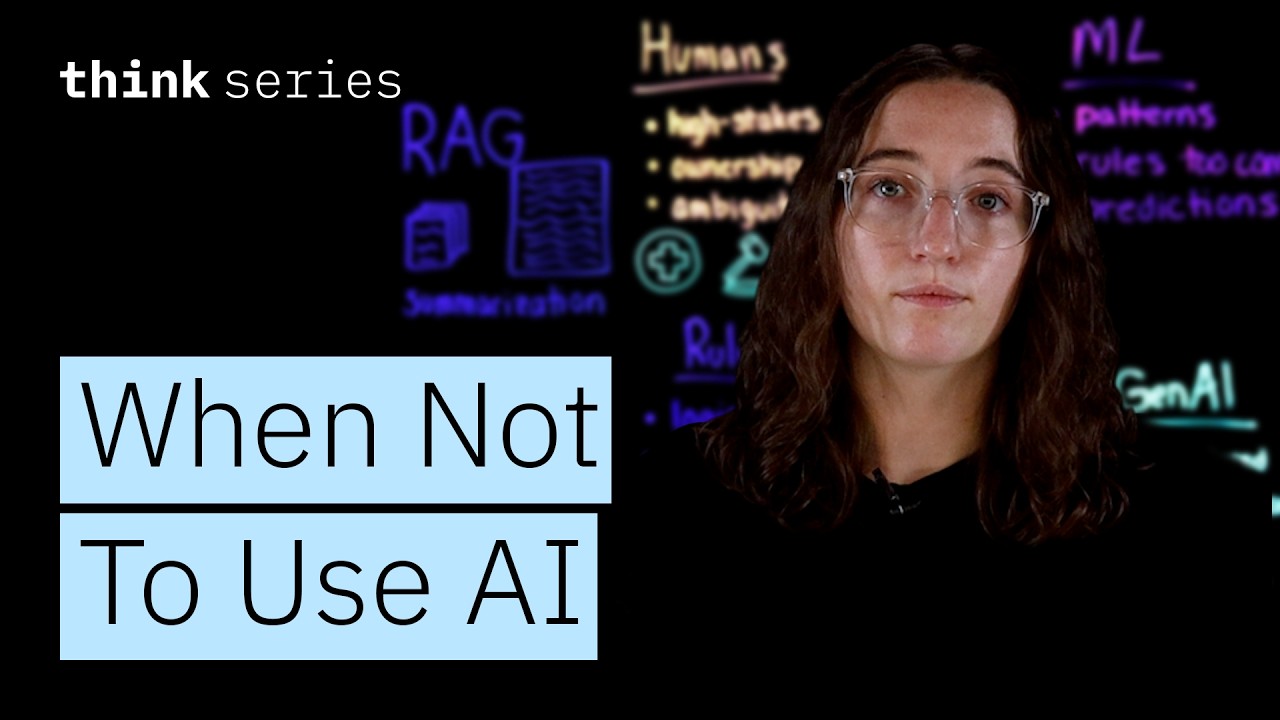
Knowing When Not to Use AI: AI Agents vs Rules vs ML

System design requires disciplined choices regarding intelligence types—Human judgment, Rules/Code, Machine Learning, or Generative AI—rather than defaulting to AI agents for every problem. The choice must balance trade-offs across accuracy, cost, complexity, and risk. Successful modern systems are typically hybrid, combining the determinism of code with the pattern recognition of ML and the flexibility of LLMs.

Key takeaways

  1. Human Judgment 2:00

    Best for high-stakes decisions, ambiguity, ethical considerations, or situations requiring accountability (e.g., medical diagnosis, legal interpretation). Trade-offs include being expensive, slow, and difficult to scale.

  2. Rules/Code-Based Solutions 3:00

    Ideal for tasks requiring clear, stable logic, consistent exact outputs, and zero error tolerance (e.g., payment processing, input validation, security access control). Code is fast, cheap, reliable, and highly interpretable.

  3. Machine Learning (ML) 4:10

    Excels at finding patterns in structured data and making probabilistic predictions when rules are too complex to define manually (e.g., fraud detection, customer churn prediction). Requires monitoring for model drift.

  4. Generative AI (LLMs/Agents) 5:40

    Best used when inputs are unstructured (text, documents) and tasks require reasoning or transformation. Flexibility is prioritized over precision, and some error is tolerated (e.g., summarization, intent understanding). Trade-offs include non-determinism and higher cost at scale.

Watch on YouTube Full article

· 10:52

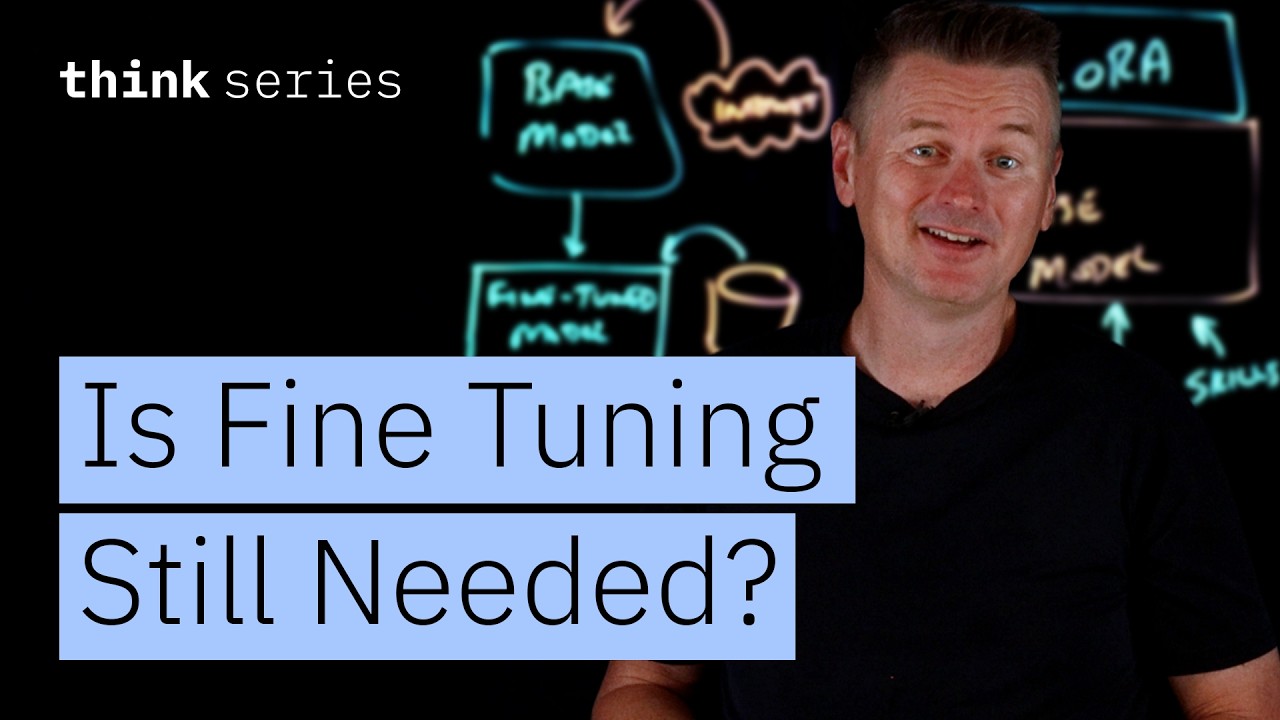
Is Fine-Tuning Still Needed? LLMs, RAG, & LoRA

While early successes demonstrated that fine-tuning custom LLMs could outperform general models (e.g., legal AI in 2023), the landscape has shifted significantly. Modern frontier models are rapidly closing the gap due to massive context windows and improved reasoning capabilities. The current architectural best practice suggests prioritizing non-weight modification techniques like Retrieval Augmented Generation (RAG), Context Engineering, and Agent Skills before resorting to fine-tuning. Fine-tuning remains valuable for specific bottlenecks, such as achieving low latency or when using parameter-efficient methods like LoRA.

Key takeaways

  1. Fine-Tuning vs. General Models

    Historically, custom fine-tuned models outperformed off-the-shelf leaders (e.g., legal AI over GPT-4 in 2023). However, general models are catching up due to massive context windows and improved inference reasoning.

  2. Modern Customization Stack 6:20

    The preferred order for customization is: Base Model $\rightarrow$ Prompt/Context Engineering $\rightarrow$ RAG (for proprietary knowledge) $\rightarrow$ Agent Skills (for procedural know-how). Fine-tuning should be the last resort.

  3. Cost and Complexity of Customization 7:45

    Fine-tuning is costly, involving not only training runs but also data collection, evaluation, regression avoidance, and continuous maintenance as frontier models advance.

Watch on YouTube Full article

· 8:51

Get started with the Interactions API

The Interactions API is now generally available and serves as a unified interface for interacting with various Gemini models and agents. It simplifies complex interactions—ranging from synchronous model calls to multi-step agent workflows in remote environments—by providing a single API endpoint. The API supports stateful operations by allowing users to pass the previous interaction ID, enabling iterative refinement of outputs (e.g., image editing) without re-uploading source data.

Key takeaways

  1. Unified Model Access 0:10

    The Interactions API provides easy access to all Gemini models and agents through a single interface, simplifying development across various Google AI capabilities.

  2. Stateful Interactions 4:05

    The API is stateful; developers can pass the previous interaction ID to build upon prior results, which is crucial for iterative processes like image editing or complex data processing.

  3. Advanced Capabilities 0:18

    New features include managed agents, background execution tool improvements, Deep Research, and media generation (e.g., Nano banana for images, Lyriq 3 for music, TTS for speech).

Watch on YouTube Full article

· 39:02

Thinking Machines Lab drops Inkling & Meta’s Muse Spark 1.1

The AI landscape is shifting its focus from pure benchmark performance to customizable intelligence and architectural efficiency. This analysis covers three major model releases: Thinking Machines' open-weight Inkling (emphasizing customization via fine-tuning), Meta’s Muse Spark 1.1 (targeting cost-efficient agent workloads for enterprise use), and OpenAI's GPT-5.6 Sol, which showed progress on the challenging ARC-AGI-3 benchmark. Furthermore, Anthropic's J-space paper introduces a novel method to view internal model processing, offering potential new avenues for AI safety and control in agent development.

Key takeaways

  1. Shift from Benchmarks to Customization

    The industry debate is moving away from which closed model is the 'best' toward utilizing open base models combined with robust fine-tuning platforms (e.g., Inkling/Tinker API) for tailored, customizable intelligence.

Watch on YouTube Full article

· 36:51

Daniel Jones & Tomasz Maj - More software, faster - Odevo's AI Native transformation - AI DevCon '26

Odevo details its AI-native transformation journey, moving from a highly heterogeneous tech landscape across multiple acquisitions and time zones. The core message is that adopting generative/agentic coding practices requires more than just providing licenses; it demands fundamental improvements in organizational processes, including robust CI/CD pipelines, standardized coding guidelines, and cultural shifts toward 'boldness' and experimentation. By systematizing training and focusing on failure modes, Odevo achieved significant metrics increases, such as 94% AI adoption among developers.

Key takeaways

  1. AI Adoption Requires Process Maturity 20:03

    Adopting agentic coding is not simple. Success hinges on foundational elements like having a reliable CI/CD platform, standardized coding practices, and comprehensive testing protocols. Without these fundamentals, generating code quickly will only expose bottlenecks elsewhere.

  2. The Importance of Discovery and Workshops 23:50

    Successful AI transformation requires a 'discovery' phase to understand the current state (the 'lay of the land') and using workshops (e.g., employing techniques like TRIZ) to address employee fears, reduce hesitancy, and build consensus on necessary improvements.

  3. Focus on Failure Modes 27:10

    Training should not focus only on the 'happy path.' It is crucial to teach developers about failure modes (e.g., context management, hallucination) and how agents operate in complex environments.

  4. The Biggest Impact is Boldness 32:10

    The most significant outcome of the AI transformation was not just increased efficiency but a cultural shift toward 'boldness'—the willingness to try ambitious, end-to-end agentic workflows and rewrite large systems quickly.

Watch on YouTube Full article

· 1:41:04

🔬 RL with Verifiable Rewards, but the Verifier is a Lab — Lila Sciences

Lila Sciences proposes that the next frontier of data generation—the 'next internet-scale dataset'—will come from running the scientific method as a closed-loop Reinforcement Learning (RL) process. The wet lab acts as the verifier and data source for training general AI models. This approach aims to create an 'infinite token generator' by synthesizing knowledge across biology, chemistry, and materials science into a single reasoning model, which is then offered via a scalable 'zero-FTE startup' platform.

Key takeaways

  1. The Lab as Data Center 20:30

    The future scientific facility must function like a data center, prioritizing dense packing and energy efficiency. The infrastructure uses planar motor systems and a physical transport layer (analogized to a PCI bus) to connect instruments for seamless, automated operation.

  2. Scientific Superintelligence via RL 40:50

    The core thesis is that science can be an 'infinite token generator.' By using the scientific method and nature as verifiers in a closed-loop system, models generate verifiable reasoning tokens (e.g., 10 trillion tokens across multiple domains) that improve general intelligence, proving that 'breadth gives us depth.'

  3. The Zero-FTE Startup Model 1:18:20

    Lila Sciences commercializes its platform by allowing external partners to run entire scientific programs (e.g., CAR-T development or novel material synthesis) over a short period using the model and automated lab infrastructure, without needing to build their own physical facility.

Watch on YouTube Full article

· 53:45

Build Small Winners Reveal

The Build Small Hackathon winners reveal celebrated projects that emphasize building highly functional applications using small, efficient models and local/on-device processing. The community demonstrated a strong focus on 'local first' AI solutions, achieving impressive metrics like 64% of apps running fully offline. Winning projects showcased practical utility—such as scam defense (Jawbreaker) or specialized coaching (Posify)—proving that powerful, real-world impact can be achieved with tiny model footprints.

Key takeaways

  1. Focus on Local and Small Models 18:05

    The hackathon emphasized building small apps using sub-32 billion parameter models. Key metrics showed that 64% of submissions ran fully offline, highlighting the viability of 'local first' AI architectures.

  2. High Utility in Niche Applications 27:20

    Winning projects demonstrated significant real-world utility. Examples include Jawbreaker (a private scam defense tool for suspicious text/emails) and Agenda Parser (breaking down dense local government agendas), proving the value of small, focused solutions.

  3. Advanced Technical Implementation 30:30

    Winners utilized advanced techniques like WebGPU for browser-based real-time games (Parry) and quantization methods (GGUF) to drastically reduce cold boot times, demonstrating high technical polish.

  4. Open Source Model Ecosystem 22:20

    The most popular model family used was Qwen (288 spaces), followed by MiniCPM OpenBMB and Nematron, confirming the community's reliance on diverse open-source models.

Watch on YouTube Full article

· 1:02:16

Platform Engineering in the age of Generative AI -

The talk argues that while Generative AI tools significantly accelerate code generation and development speed, they are not a 'silver bullet.' To harness AI effectively, organizations must first establish robust platform engineering foundations. The core focus is on implementing comprehensive 'harnessing'—a system of controls (guides and sensors) that ensure consistent behavior, mitigate security vulnerabilities, and guide agents toward high-quality outcomes. Key strategies include adopting open standards like those from the Aentic AI Foundation, utilizing Spec Driven Development (SDD), and treating the entire development environment as a codified, observable artifact.

Key takeaways

  1. Platform Engineering's Goal: Reducing Cognitive Overload 10:40

    Platform engineering should aim to make it the 'path of least resistance' for developers by building internal mechanisms and golden paths. This reduces cognitive overload, allowing teams to focus on delivering value rather than managing complex compliance, security, or deployment processes.

  2. AI is an Amplifier, Not a Solution 20:00

    Generative AI amplifies existing engineering quality. If foundational practices (like documentation and consistent tooling) are weak, AI will amplify those weaknesses, leading to basic security failures or unreliable code.

  3. The Importance of Agentic Standards 30:00

    The Aentic AI Foundation is establishing open standards (MCP servers, agent MD files, and agent skills) to standardize how agents interact with tools. MCP servers are described as a 'USB-C for AI agents,' providing a standard protocol layer.

  4. Harness Engineering: Controlling the Agent 40:00

    A robust 'harness' is the system surrounding the LLM model. It uses two types of controls: **Feed-forward guides** (anticipating and steering behavior, e.g., Agent MD files) and **Feedback sensors** (observing after action, e.g., linters, unit tests, or an 'LLM as a judge' pattern).

Watch on YouTube Full article

· 1:48:40

🔬 "The Most Innovative Diffusion Research Is Happening in Drug Discovery, Not Image Generation"

The video discusses the shift of advanced AI research from image generation into complex biological domains, specifically drug discovery and protein-ligand interaction modeling. Genesis Molecular AI introduces PEARL, a foundation model that uses diffusion techniques to predict how proteins flex to accommodate ligands (induced fit). The discussion highlights that modern drug design requires multi-parameter prediction (ADMET) and sophisticated agentic systems (SAPPHIRE) capable of reasoning like a chemist, moving far beyond simple structural predictions. Achieving high accuracy (sub-Angstrom resolution) is crucial for these models to be useful in physical chemistry workflows.

Key takeaways

  1. Diffusion Models in 3D Structure Prediction 1:42

    Diffusion techniques are proving to be a highly effective primitive for 3D structure prediction, particularly in modeling protein-ligand complexes. This represents a major advancement over previous methods like GANs and is central to Genesis's PEARL model.

  2. PEARL Model Capabilities 9:30

    The PEARL model predicts not only where a ligand binds but also models the conformational flexibility of the protein itself (induced fit). It demonstrated strong zero-shot performance on the OpenBind benchmark against notoriously difficult targets.

  3. Agentic Drug Discovery Systems 10:10

    Genesis's SAPPHIRE system represents an agentic approach to drug discovery. This AI agent is designed to mimic a chemist by reasoning about poses, forming hypotheses, reading literature, and proposing the next round of candidates.

  4. The Need for High Resolution 10:40

    Traditional benchmarks like 2Å RMSD are considered insufficient because they lack the resolution needed to discern critical details (e.g., aromatic ring flips) required for accurate physical chemistry predictions, necessitating a focus on sub-Angstrom accuracy.

Watch on YouTube Full article