Topic

Machine Learning Operations (MLOps)

All digests tagged Machine Learning Operations (MLOps)

· 20:07

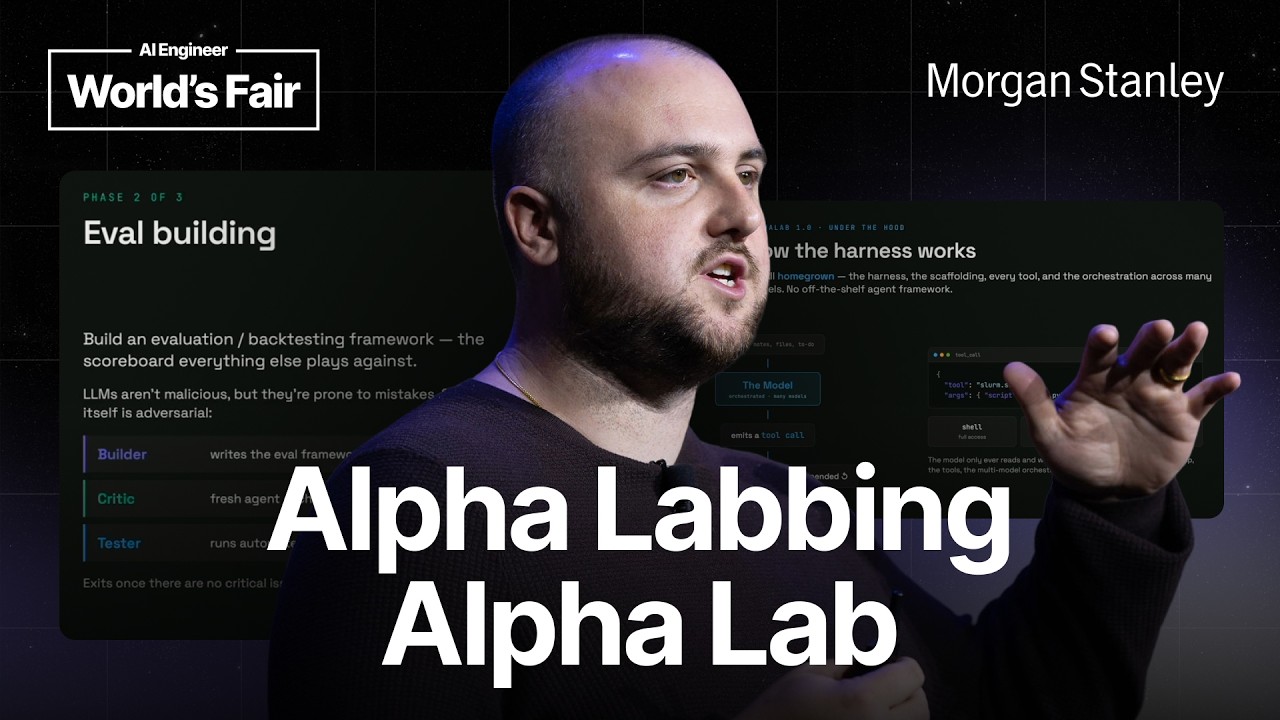
Morgan Stanley's ALPHALAB: Multi-Agent Research Across Optimization Domains — Brendan Rappazzo

Morgan Stanley's AlphaLab is a multi-agent research system designed to automate quantitative finance research by managing the entire experimental lifecycle. Unlike simple code generation, AlphaLab accepts a problem in plain language and autonomously handles hypothesis formation, backtesting setup, cluster job submission (using tools like Slurm), statistical testing, and iterative refinement. The core innovation lies in its focus on building proprietary, verifiable evaluation environments—treating them as critical data inputs—allowing the system to self-improve and encode deep enterprise knowledge.

Key takeaways

  1. Full Research Automation Cycle

    AlphaLab operates in three phases: 1) Research (building context/hypotheses), 2) Evaluation Building (creating robust backtests, involving multiple critic agents to prevent forward leakage), and 3) Mass Experimentation. This allows the system to move from a natural language goal to a suite of trained models.

  2. Architecture: Strategist and Workers 15:36

    The process is managed via a Kanban/Jira-like board. A 'Strategist' agent proposes experiments, which are then assigned to 'Worker' agents responsible for writing code, configuring Slurm jobs (e.g., requiring 4 H100s), submitting the job, and performing postmortem analysis.

  3. The Value of Verifiable Environments

    The system's robustness hinges on building custom evaluation environments (evals) that mimic a private Kaggle competition. This strict format, which includes held-out validation sets, is crucial for measuring performance and encoding proprietary enterprise knowledge.

  4. Self-Improving Meta-Harness

    The ultimate goal (AlphaLab 2.0) is a self-improving system where the LLM performs meta-optimization, analyzing results and improving the harness itself, rather than just executing tasks within it.


Watch on YouTube Full article

· 18:22

State of Data — Sean Cai, Independent / State of Data

The data market is undergoing a structural shift from relying on sheer quantity of annotated images (the 'least interesting part') to capturing high-quality, process-based expertise. Data's value lies in the trajectory and reasoning trace—not just the final output. The speaker argues that while model improvement requires balancing compute, data, and talent, data remains the most underfunded leg. Successful companies must pivot from being mere 'data businesses' to becoming infrastructure providers (neo-labs) that build robust pipelines into real-world work.

Key takeaways

  1. Data Shift: From State to Process 2:08

    The most valuable data is process-based data—the reasoning trace or sequence of decisions, rather than state-based data (e.g., rows in an ERP). Type one data (pure capture of real workflows like GitHub commits) offers superior realism compared to type two data (contrived examples manufactured by experts).

  2. The Importance of Verifiability 5:50

    A task's ease of training is proportional to its verifiability, which depends on three axes: asymmetry of verification (decomposability into checkable steps), veracity of verification (consensus on what 'correct' means), and proliferation of verification (availability of fresh examples). Coding scored highly because it solved all three.

  3. The Builder's Moat is the Pipeline 13:10

    For data companies, the durable value accrues to the services and application layer of actual work. The true moat for builders is not the raw data itself, but the pipeline into real-world work and the infrastructure required to keep retraining as models improve.

Watch on YouTube Full article

· 21:11

Everything Is a Rollout — Alex Shaw + Ryan Marten, Terminal-Bench, Harbor, Laude Institute

Alex Shaw introduces Harbor, a framework designed for evaluating and optimizing AI agents. The talk argues that agent development should be viewed through the lens of machine learning rather than traditional software engineering. This requires treating agent performance as a 'blackbox artifact' and managing it via empirical evaluation—a process formalized by 'rollouts.' Harbor provides the necessary infrastructure (sandboxes, standardized environments) to execute these complex evaluations in parallel.

Key takeaways

  1. Agent Development vs. Software Engineering 5:15

    Unlike traditional software engineering where behavior is predictable before execution, agentic coding and AI agents are best treated as blackbox artifacts whose performance requires empirical evaluation (e.g., 'Generated code is best treated as a blackbox artifact').

  2. The Role of Rollouts in Agent Evaluation 10:30

    Agent evaluation relies on 'rollouts' within sandboxed environments. This process involves passing the sandbox to the agent, collecting a trajectory, and then passing it to a verifier which produces rewards. Harbor standardizes this universal process.

  3. Harbor as an Interoperable Standard 12:20

    Harbor is presented as a common language and open-source framework for specifying agentic environments, allowing interoperability across different agents, models (e.g., GPT 5.5), and sandboxes to maximize data velocity.

  4. Diverse Evaluation Use Cases 17:30

    Evaluation can be highly specialized, including assessing how well agents build products (e.g., RampBench), how they use a product's headless mode, or automating internal processes.

Watch on YouTube Full article

· 31:44

Brian Douglas - The beginners guide to training AI on your own code - AI Native DevCon June 2026

This talk outlines a closed-loop system for training AI agents using proprietary code execution traces. The core concept involves capturing every agent interaction (telemetry) via an open-source proxy (tapes.dev), structuring this data into a content-addressable Merkle DAG. This raw trace data is then processed by streaming tools like Kafka and Flink SQL to detect anomalies, which feeds back into the agent's next run—creating a 'self-healing loop.' The captured traces are used for supervised fine-tuning (SFT) or Direct Preference Optimization (DPO) to embed learned skills directly into local models, eliminating reliance on external training data.

Key takeaways

  1. Closed-Loop Agent Training 3:50

    Agents generate data by running in an environment; this telemetry is captured and used immediately for model improvement. This creates a self-healing infrastructure loop, allowing agents to learn from failures (anomalies) and successes.

  2. Data Capture Infrastructure 10:30

    The open-source proxy, tapes.dev, intercepts LLM API calls to build a content-addressable Merkle DAG of every conversation turn, requiring zero instrumentation.

  3. Anomaly Detection and Feedback 2:00

    Streaming pipelines (Kafka/Flink SQL) run continuous anomaly detection on session data (e.g., stuck loops, token spikes). Alerts generated by Flink are read by the agent before its next execution, enabling self-correction.

  4. Knowledge Transfer Methods 22:00

    Captured traces can be used for Specialized Fine-Tuning (SFT) or Direct Preference Optimization (DPO). SFT embeds skills into the model, while DPO uses preference data derived from successful vs. failed sessions.

Watch on YouTube Full article

· 17:11

The Unreasonable Effectiveness of Separating the Task from the Model — Maxime Rivest, DSPy

The talk introduces DSPy, an open-source Python framework designed to bring software engineering principles—reusability, composability, and testability—to AI programs. The core philosophy is the 'unreasonable effectiveness of separating the task from the model' by defining tasks strictly through a programmatic interface called the Signature. This approach allows developers to focus on the business logic (the contract) while keeping the underlying implementation flexible for experimentation with different models, weights, and techniques.

Key takeaways

  1. The Power of the Signature

    By defining a task's inputs and outputs (the Signature) first, developers create an abstraction layer that allows them to swap out underlying implementations (models, prompts, etc.) without changing the core workflow. This provides significant agility for AI engineering.

  2. Three Pillars of Task Specification 8:00

    To fully specify an AI task, DSPy advocates using three components: 1) Instructions (what should happen), 2) Constraints/Code (what must happen, enforced by code like self-recheck or chaining), and 3) Evaluation Metrics (what good looks like).

  3. Future Direction: Automation and Learning 10:35

    DSPy is evolving toward automating implementation details. Future versions, including DSPy 4.0, aim to allow models to write code beneath a signature and enable programs to learn directly from user interactions while respecting the defined inputs/outputs.

Watch on YouTube Full article

· 1:56:13

Poolside’s Model Factory, Laguna S, Open Models, and the Race to AGI — Eiso Kant, Poolside AI

The discussion centers on the engineering systems required for achieving AGI, arguing that model building is fundamentally a process of infrastructure and data management rather than pure intelligence. Poolside details its 'Model Factory,' an end-to-end system enabling rapid iteration (from six months to eight weeks) by treating model development as an industrialized process. Key technical advancements include streaming data directly into training, ensuring perfect reproducibility via immutable data layers, and leveraging agentic systems that write code and manage jobs. The consensus emphasizes that future progress relies on improving compute efficiency through low-precision methods (e.g., FP8) and focusing on behavioral traits like persistence and reasoning over sheer model size.

Key takeaways

  1. Model Building is 90% Engineering 20:30

    The core challenge in foundation model development lies in building robust, scalable infrastructure. The Model Factory manages the entire lifecycle—from raw data ingestion and filtering to large-scale distributed training and post-training refinement.

  2. The Importance of Reproducibility 26:40

    Achieving scientific rigor requires treating data as an immutable layer, versioning code, and ensuring perfect reproducibility. This allows researchers to track and trace every experiment down to the single token.

  3. Shift from Tool Calls to Code Writing 29:10

    The industry is moving beyond simple tool calls (e.g., stuffing 50 tools in a system prompt) toward models writing complex, conditional code scripts that interact with an internal virtual machine environment.

  4. Focus on Behavior and Efficiency 1:00:00

    The gains seen in smaller models (like Laguna S) come less from raw intelligence and more from improved behaviors, such as persistence, verification, and backtracking. This suggests that the peak performance for knowledge work may be at much lower parameter counts than previously assumed.

Watch on YouTube Full article

· 5:16

CoreWeave ARIA: The autoresearch loop for continuous improvement

CoreWeave ARIA is an AI Research and Iteration Agent designed to automate the full autoresearch loop for continuous model and agent improvement. The demonstration shows how ARIA autonomously forms hypotheses, analyzes prior run results (including raw system metrics and plots), sets filters, and executes new training jobs via Weights & Biases Launch, allowing human users to focus on high-level problem definition.

Key takeaways

  1. Autonomous Research Loop

    ARIA autonomously manages the research process by forming hypotheses, running experiments, evaluating results, and executing optimal next actions without constant human intervention. This capability helps models and agents improve continuously.

  2. Run Analysis and Filtering 1:44

    ARIA can analyze complex run data—including plots, tables, and raw system metrics—to determine what worked best. It can also set UI filters based on previous sweeps (e.g., setting a filter for 'auto research runs').

  3. Parallel Experimentation 1:18

    Users can run multiple ARIA instances in parallel to accelerate the workflow, allowing simultaneous management of different research tracks (e.g., running two distinct ARIA variants).

Watch on YouTube Full article