Topic

Automation

All digests tagged Automation

· 20:07

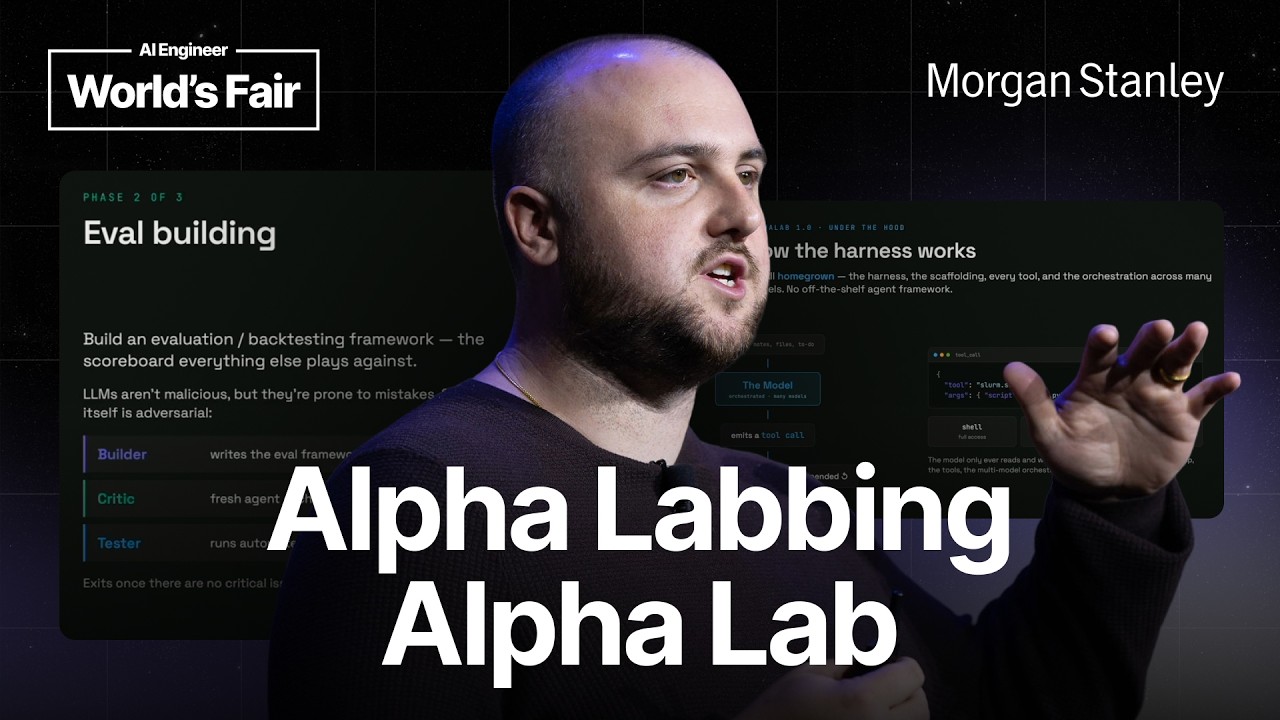
Morgan Stanley's ALPHALAB: Multi-Agent Research Across Optimization Domains — Brendan Rappazzo

Morgan Stanley's AlphaLab is a multi-agent research system designed to automate quantitative finance research by managing the entire experimental lifecycle. Unlike simple code generation, AlphaLab accepts a problem in plain language and autonomously handles hypothesis formation, backtesting setup, cluster job submission (using tools like Slurm), statistical testing, and iterative refinement. The core innovation lies in its focus on building proprietary, verifiable evaluation environments—treating them as critical data inputs—allowing the system to self-improve and encode deep enterprise knowledge.

Key takeaways

  1. Full Research Automation Cycle

    AlphaLab operates in three phases: 1) Research (building context/hypotheses), 2) Evaluation Building (creating robust backtests, involving multiple critic agents to prevent forward leakage), and 3) Mass Experimentation. This allows the system to move from a natural language goal to a suite of trained models.

  2. Architecture: Strategist and Workers 15:36

    The process is managed via a Kanban/Jira-like board. A 'Strategist' agent proposes experiments, which are then assigned to 'Worker' agents responsible for writing code, configuring Slurm jobs (e.g., requiring 4 H100s), submitting the job, and performing postmortem analysis.

  3. The Value of Verifiable Environments

    The system's robustness hinges on building custom evaluation environments (evals) that mimic a private Kaggle competition. This strict format, which includes held-out validation sets, is crucial for measuring performance and encoding proprietary enterprise knowledge.

  4. Self-Improving Meta-Harness

    The ultimate goal (AlphaLab 2.0) is a self-improving system where the LLM performs meta-optimization, analyzing results and improving the harness itself, rather than just executing tasks within it.

Watch on YouTube Full article

· 32:17

Jack Wotherspoon - Humans vs. Slop: Rewriting the Rules of Open-Source - AI Native DevCon

The rise of powerful AI agents is fundamentally changing open-source development by making code generation nearly free and abundant, leading to a flood of low-quality contributions ('AI slop'). This shift threatens the traditional human-to-human social contract of open source. Maintainers must implement new governance models—such as requiring issues before pull requests (PRs), rate limiting external contributors, and utilizing automation—to manage the influx of code while preserving quality and accountability.

Key takeaways

  1. The Open Source Shift 2:00

    Open-source development is moving from a human-to-human experience to one involving AI agents. The core challenge is that while generating code is cheap (sometimes free), reviewing, maintaining, and trusting the generated code remains expensive and difficult.

  2. Guardrails Against Slop 6:25

    To combat 'drive-by PRs' (where users submit fixes without prior discussion) and uncontrolled agent activity, maintainers should require contributors to file an Issue before submitting a Pull Request. This is cited as eliminating approximately 90% of drive-by PRs.

  3. Rate Limiting Contributions 7:00

    Implement rate limits on external contributors (e.g., limiting the number of active PRs) to prevent automated swarms of nonsensical code submissions, which can overwhelm maintainers.

  4. Trust and Governance Systems 9:40

    New systems are emerging to restore trust: 'Vouch' acts as a referral system for contributors, while 'Open Source Vacation' allows projects or solo maintainers to temporarily halt contributions when needed. Projects should also use context files (like `agents.md`) to guide all AI tools.

  5. Codifying Best Practices with Skills 11:20

    Implementing 'agent skills' (e.g., PR creator, docs writer) into the repository helps enforce best practices—such as running tests and following templates—for both human and AI contributors, thereby raising the overall quality bar.

Watch on YouTube Full article