Topic

GitHub

All digests tagged GitHub

· 20:07

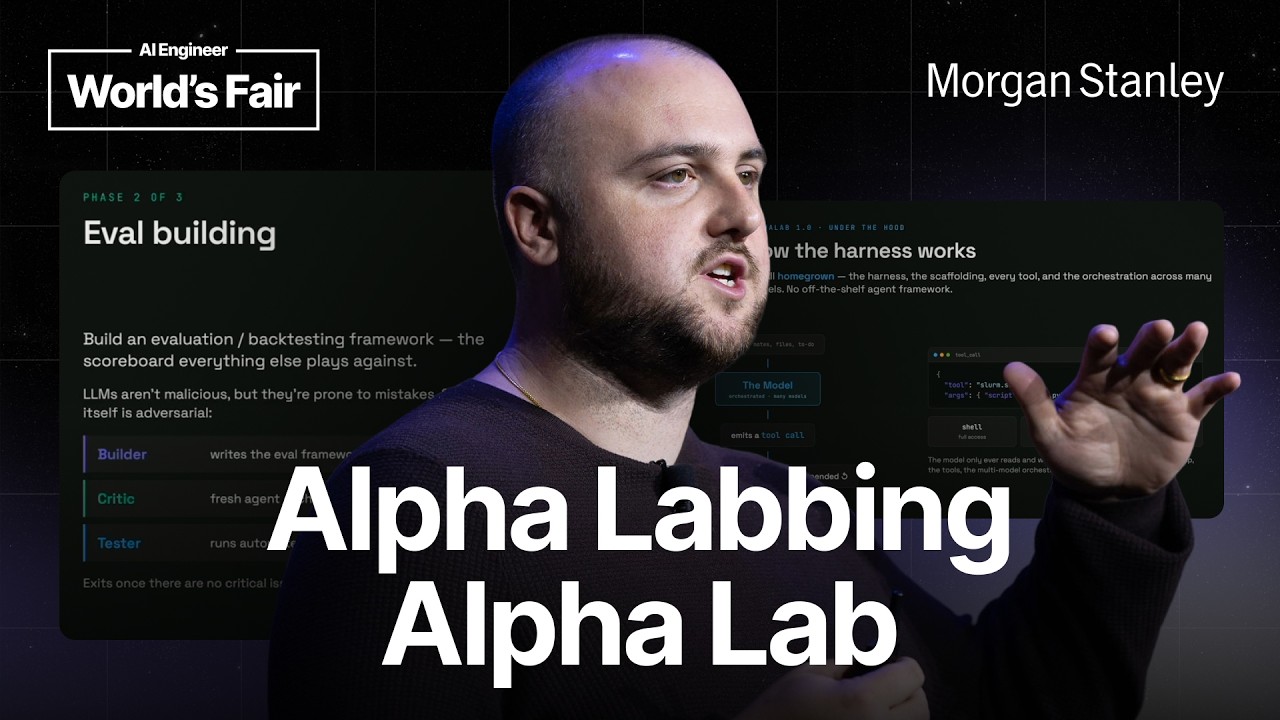
Morgan Stanley's ALPHALAB: Multi-Agent Research Across Optimization Domains — Brendan Rappazzo

Morgan Stanley's AlphaLab is a multi-agent research system designed to automate quantitative finance research by managing the entire experimental lifecycle. Unlike simple code generation, AlphaLab accepts a problem in plain language and autonomously handles hypothesis formation, backtesting setup, cluster job submission (using tools like Slurm), statistical testing, and iterative refinement. The core innovation lies in its focus on building proprietary, verifiable evaluation environments—treating them as critical data inputs—allowing the system to self-improve and encode deep enterprise knowledge.

Key takeaways

  1. Full Research Automation Cycle

    AlphaLab operates in three phases: 1) Research (building context/hypotheses), 2) Evaluation Building (creating robust backtests, involving multiple critic agents to prevent forward leakage), and 3) Mass Experimentation. This allows the system to move from a natural language goal to a suite of trained models.

  2. Architecture: Strategist and Workers 15:36

    The process is managed via a Kanban/Jira-like board. A 'Strategist' agent proposes experiments, which are then assigned to 'Worker' agents responsible for writing code, configuring Slurm jobs (e.g., requiring 4 H100s), submitting the job, and performing postmortem analysis.

  3. The Value of Verifiable Environments

    The system's robustness hinges on building custom evaluation environments (evals) that mimic a private Kaggle competition. This strict format, which includes held-out validation sets, is crucial for measuring performance and encoding proprietary enterprise knowledge.

  4. Self-Improving Meta-Harness

    The ultimate goal (AlphaLab 2.0) is a self-improving system where the LLM performs meta-optimization, analyzing results and improving the harness itself, rather than just executing tasks within it.

Watch on YouTube Full article

· 31:25

Robert Overweg - One Brain, No Filtering - AI Native DevCon June 2026

The presentation details a 'One Brain' concept—a centralized, AI-native knowledge management layer designed to eliminate information silos and improve decision-making by weaving together research, client context, and operational data. The system uses an orchestrator (OpenClaw) and structured vaults to allow agents to access and synthesize organizational knowledge in real time, shifting focus from manual file retrieval to idea generation and proactive insights.

Key takeaways

  1. Shift from File Search to Idea Synthesis 5:40

    The core value lies in moving beyond searching for specific files; the system allows users to search for 'ideas' or 'contacts.' Agents can interpret natural language queries (e.g., asking about CI/CD steps) and provide contextually accurate answers based on stored knowledge.

  2. Structured Knowledge Flow 7:10

    Knowledge is categorized into 'company knowledge' (new developments, research wikis) and the 'creation pipeline.' Information must be promoted to a central vault from various sources (e.g., Obsidian notes, meeting transcripts) to gain grounding in reality before being shared widely.

  3. Scaling and Security Challenges 17:32

    While the system is powerful, scaling remains a challenge, particularly regarding data segregation (permissions) across different client or team buckets. The local setup on one person's laptop was initially used for testing, but enterprise rollout requires careful consideration of security boundaries.

Watch on YouTube Full article

· 15:36

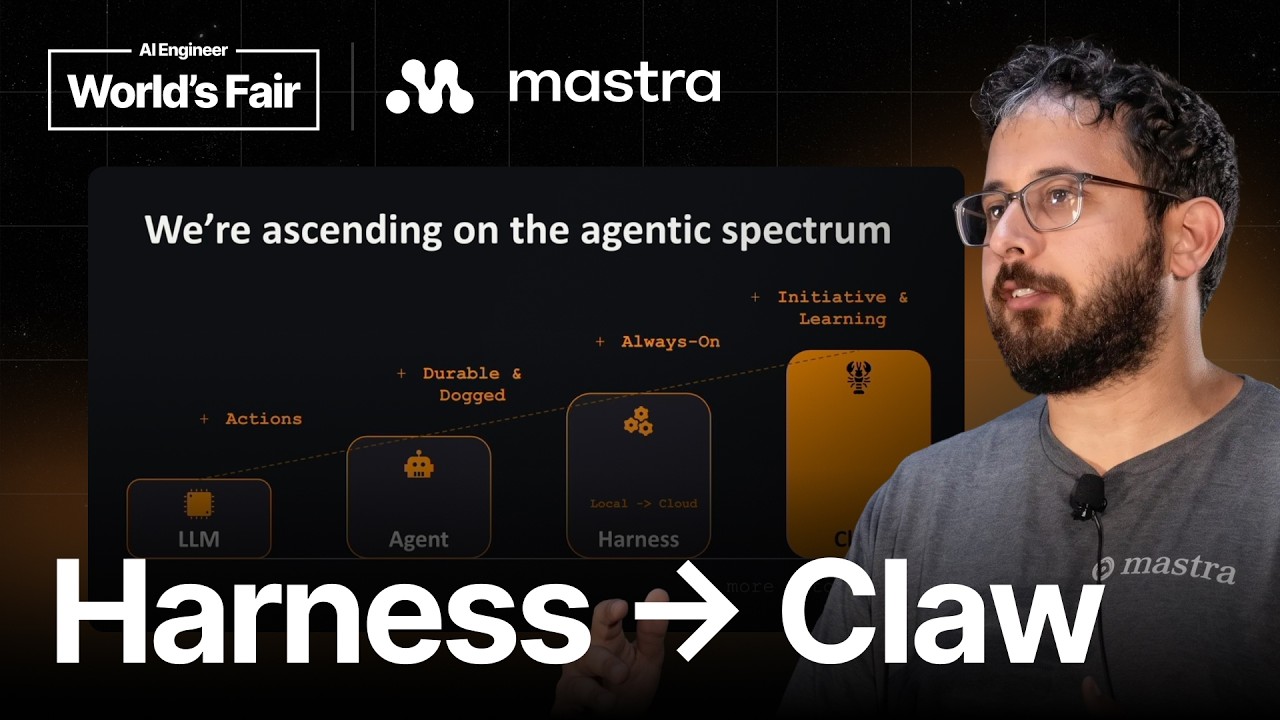
Every Harness Will Become A Claw — Sam Bhagwat, Mastra

The evolution of AI agents is moving from localized 'Harnesses'—tools used for coding and task execution—to persistent, always-on services called 'Claws.' This transition involves imbuing agents with initiative, external connectivity (like a heartbeat), and continual learning capabilities. The speaker proposes Steinberger's law: every harness will expand until it becomes a Claw, driven by the desire for powerful, integrated developer experiences.

Key takeaways

  1. Harnesses are evolving into Claws 1:42

    The next generation of agents moves beyond local execution to become always-on services that listen to external events (e.g., Slack, mobile apps) and maintain a persistent 'heartbeat.'

  2. Agentic Spectrum Advancement 0:49

    Agents are advancing through stages: Agent $ ightarrow$ Harness $ ightarrow$ Claw. Key technical advancements include durability, doggedness, planning mode, and parallel subagents.

  3. Cloud vs. Local Architecture 1:48

    The shift from local harnesses to cloud harnesses provides greater parallelism and resources but necessitates a different distributed system architecture.

Watch on YouTube Full article

· 32:39

James Moss - Using skills to pay the bills: graduating from solo hacks to a team workflow - DevCon26

The talk addresses the challenge of 'skill sprawl'—the uncontrolled proliferation and management of AI coding agent skills within large organizations. While skills are powerful because they encode domain-specific logic into an agent's context, their current lack of standardized versioning, review, and centralized governance creates significant technical debt. The speaker advocates for treating skills as first-class software assets, requiring dedicated practices like decomposition, mandatory registries, automated reviews, and formal lifecycle management (CDLC) to ensure reliability and scalability.

Key takeaways

  1. Manage Skill Sprawl with a Centralized Registry 17:33

    Due to the low barrier to entry for creating skills, organizations face an 'insane amount' of them (2 million+ on GitHub alone). A centralized registry is crucial for visibility, preventing overlap, and ensuring all teams use approved versions. This also helps mitigate non-technical users needing access without requiring full developer seats.

  2. Adopt the Context Development Life Cycle (CDLC) 27:50

    Just as code requires a Software Development Lifecycle (SDLC), skills and context require their own CDLC. Practices like skill reviews, automated testing, and version control must be applied to maintain quality and prevent 'rot' (skills going out of sync with the codebase).

  3. Decompose Skills for Modularity 20:40

    Instead of creating monolithic skills, break complex functionality into smaller, interconnected plugins. This allows agents to activate specific components and makes the skill set easier to maintain and debug.

  4. Enforce Governance via Registries 22:30

    Using a registry provides a single source of truth, allowing organizations to enforce policies (e.g., 'approved skills only,' minimum release age) and integrate security scanning tools like Snyk.

Watch on YouTube Full article