Topic

Snyk

All digests tagged Snyk

· 32:16

BONUS EPISODE: 76 Malicious AI Skills Were Hiding in Plain Sight

The security landscape for AI coding agents is rapidly evolving, shifting focus from traditional code vulnerabilities to risks introduced by 'Skills' and context management. The presentation details findings from Snyk’s ToxicSkills research, which uncovered 76 malicious skills containing malware or prompt injection vectors in open agent repositories. To mitigate these threats, organizations must adopt secure-by-default practices, implement governance through private skill registries (like Tessl), and utilize advanced scanning tools that analyze natural language context alongside code.

Key takeaways

  1. The Shift to Agent Security 6:38

    AI agents are changing developer workflows from reviewing lines of code to managing a 'team of agents.' This necessitates securing the inputs (context) and artifacts produced by these agents, making agent security paramount.

  2. Malicious Skills Threat 17:55

    Research found that third-party skills can contain purely malicious code or prompt injection attacks. These threats are difficult for traditional scanners to detect because they operate by influencing the agent's context rather than just being visible malware.

  3. Governance and Scanning Solutions 23:58

    Implementing secure skill registries (e.g., Tessl) that integrate security scanning (Snyk) is crucial. This allows organizations to scan skills for potential prompt injection, malware, and versioning issues before deployment.

  4. Secure-by-Default Stack 27:50

    Best practices include scanning third-party skills *before* use and running security scanners on custom-authored skills to identify potential vulnerabilities, such as mishandling or passing secrets in plaintext.
Watch on YouTube Full article

· 23:29

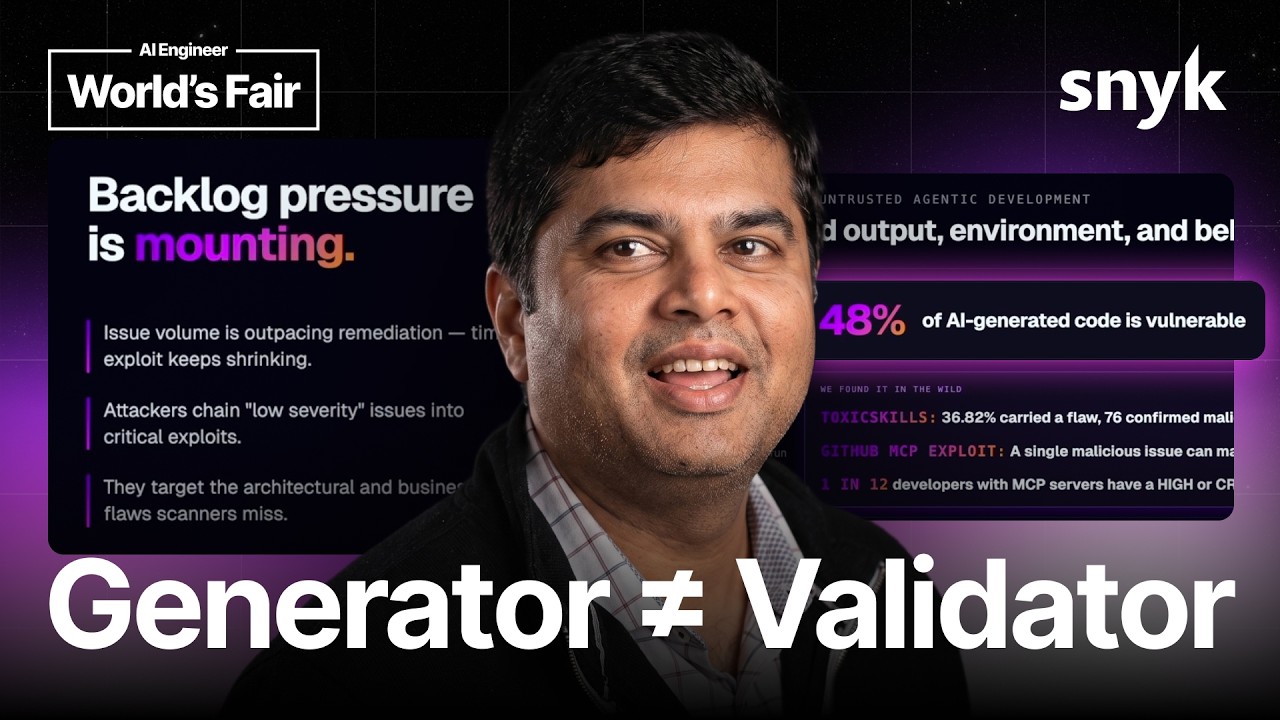
Through the AI Fog: The Architectural Decision Agentic Security Depends On — Manoj Nair, Snyk

As autonomous agents and frontier LLMs accelerate development speed, they simultaneously create a novel and expanding attack surface. The core security challenge is that probabilistic systems (like large models) cannot be trusted to police themselves. Data shows significant growth in the security backlog (108% quarter over quarter). To build safe, agentic software at scale, organizations must move beyond relying solely on model intelligence and implement deterministic verification layers that validate agent output, skills, and environment interactions.

Key takeaways

  1. The Generator vs. Validator Problem 0:03

    A fundamental security principle is questioned: Can the system generating code (the generator) also be the system verifying it (the validator)? The answer, according to real-world data, is no.

  2. Exponential Vulnerability Growth 0:07

    The security backlog for customers grew by 108% quarter over quarter (QoQ), indicating that the rate of vulnerability creation is outpacing remediation efforts.

  3. New Attack Vectors in Agentic Systems 0:08

    Threats include 'toxic skills' (where a third or more of all available skills contain malware), insecure connections via MCP servers, and agents quietly copying PII into untrusted databases.

  4. Deterministic Verification is Essential 22:06

    When testing for vulnerabilities, the latest frontier models found only 75% of issues in red team attacks, compared to a deterministic checker which achieved at least a 40% F1 score. This highlights that probabilistic systems require supplementary validation.

Watch on YouTube Full article

· 32:39

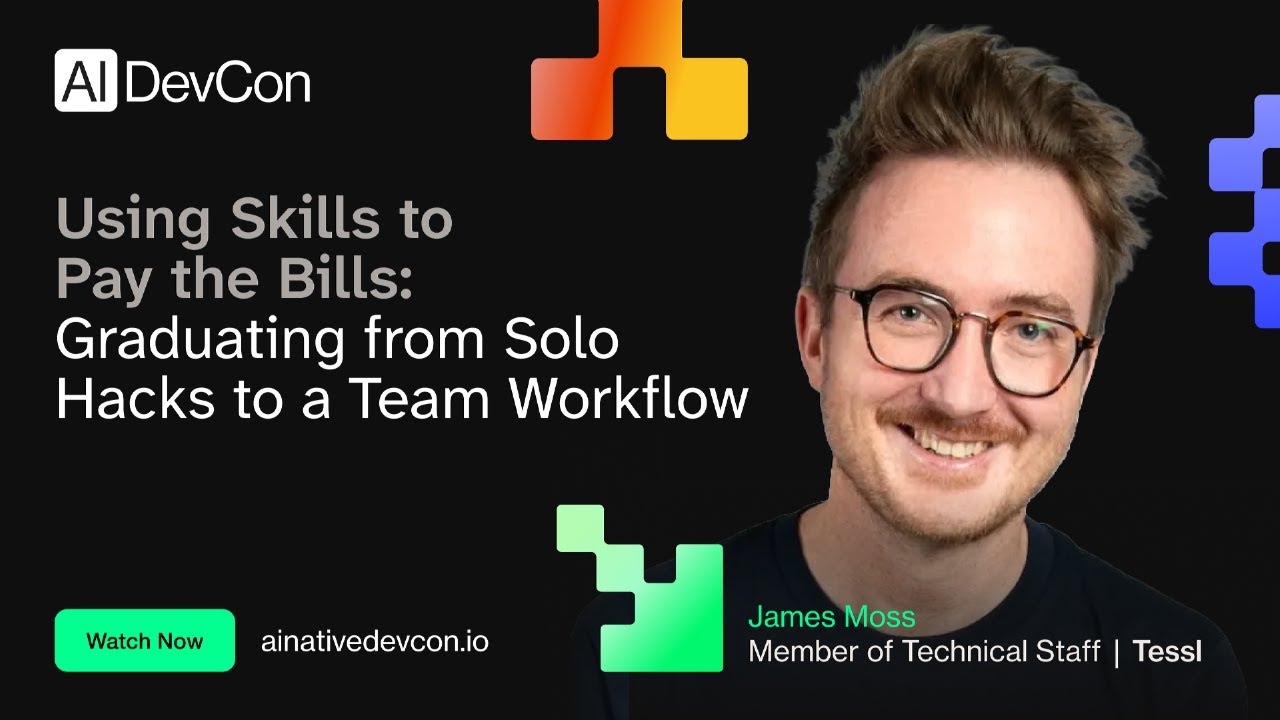
James Moss - Using skills to pay the bills: graduating from solo hacks to a team workflow - DevCon26

The talk addresses the challenge of 'skill sprawl'—the uncontrolled proliferation and management of AI coding agent skills within large organizations. While skills are powerful because they encode domain-specific logic into an agent's context, their current lack of standardized versioning, review, and centralized governance creates significant technical debt. The speaker advocates for treating skills as first-class software assets, requiring dedicated practices like decomposition, mandatory registries, automated reviews, and formal lifecycle management (CDLC) to ensure reliability and scalability.

Key takeaways

  1. Manage Skill Sprawl with a Centralized Registry 17:33

    Due to the low barrier to entry for creating skills, organizations face an 'insane amount' of them (2 million+ on GitHub alone). A centralized registry is crucial for visibility, preventing overlap, and ensuring all teams use approved versions. This also helps mitigate non-technical users needing access without requiring full developer seats.

  2. Adopt the Context Development Life Cycle (CDLC) 27:50

    Just as code requires a Software Development Lifecycle (SDLC), skills and context require their own CDLC. Practices like skill reviews, automated testing, and version control must be applied to maintain quality and prevent 'rot' (skills going out of sync with the codebase).

  3. Decompose Skills for Modularity 20:40

    Instead of creating monolithic skills, break complex functionality into smaller, interconnected plugins. This allows agents to activate specific components and makes the skill set easier to maintain and debug.

  4. Enforce Governance via Registries 22:30

    Using a registry provides a single source of truth, allowing organizations to enforce policies (e.g., 'approved skills only,' minimum release age) and integrate security scanning tools like Snyk.

Watch on YouTube Full article