Through the AI Fog: The Architectural Decision Agentic Security Depends On — Manoj Nair, Snyk
Summary
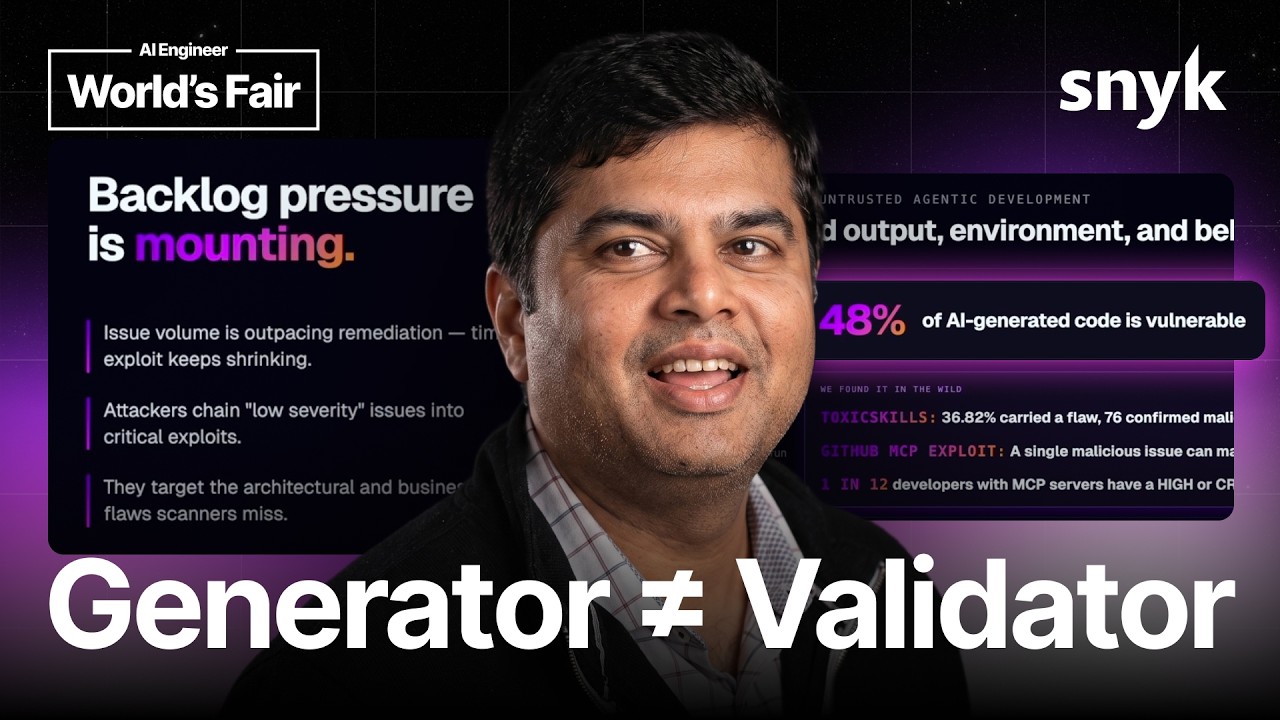
As autonomous agents and frontier LLMs accelerate development speed, they simultaneously create a novel and expanding attack surface. The core security challenge is that probabilistic systems (like large models) cannot be trusted to police themselves. Data shows significant growth in the security backlog (108% quarter over quarter). To build safe, agentic software at scale, organizations must move beyond relying solely on model intelligence and implement deterministic verification layers that validate agent output, skills, and environment interactions.
Key takeaways
-
The Generator vs. Validator Problem
0:03
A fundamental security principle is questioned: Can the system generating code (the generator) also be the system verifying it (the validator)? The answer, according to real-world data, is no.
-
Exponential Vulnerability Growth
0:07
The security backlog for customers grew by 108% quarter over quarter (QoQ), indicating that the rate of vulnerability creation is outpacing remediation efforts.
-
New Attack Vectors in Agentic Systems
0:08
Threats include 'toxic skills' (where a third or more of all available skills contain malware), insecure connections via MCP servers, and agents quietly copying PII into untrusted databases.
-
Deterministic Verification is Essential
22:06
When testing for vulnerabilities, the latest frontier models found only 75% of issues in red team attacks, compared to a deterministic checker which achieved at least a 40% F1 score. This highlights that probabilistic systems require supplementary validation.
Technical details
-
Agentic Code Risk
1036s
The risk is not limited to model output; agents introduce an entirely new threat surface. For every model found in a repository, there are three times more agentic components (in tools and skills) that must be assessed.
-
Vulnerability Chaining
928s
Novel exploits often do not require novel vulnerabilities. Instead, they chain together existing low-severity issues to create a much larger blast radius.
-
Security Tools and Remediation
1250s
The Snyk package health check tool is recommended for assessing open-source dependencies, determining if they are actively maintained (healthy) or merely vulnerability-free. The 'Evo' product offers agentic dev security by monitoring environment, output, skills, and MCP servers in real time.
Mentioned resources
- Snyk
- Evo
Channel & topics
Watch on YouTube · Back to latest
This independent, AI-assisted summary is provided for commentary and informational purposes. It may contain errors or omit important context. Please watch the original video for the creator's complete presentation. Video, thumbnail, and related copyrights belong to their respective owners.