Topic

Software Architecture

All digests tagged Software Architecture

· 59:49

From LLM Theory to Practical Agentic Implementations - Seth Juarez

The talk demystifies Large Language Models (LLMs), arguing that their power does not come from inherent intelligence but from engineered 'harnesses' and fundamental primitives. The speaker outlines a progression of techniques—from simple completions to complex agentic loops—that allow developers to build robust, reliable AI systems by controlling the model's input context, output structure, and execution flow. Key concepts include using structured JSON for control flow, implementing tool calling via runtimes (not the LLM itself), establishing guardrails, and orchestrating multi-step workflows through shared 'threads.'

Key takeaways

  1. LLMs are Next Token Predictors 1:42

    At its core, an LLM is a giant mathematical function that predicts the next token based on input tokens. The perceived intelligence comes from the surrounding runtime logic (the harness), not the model itself.

  2. The Agentic Loop is the Core Primitive 21:20

    True agency is achieved by implementing an 'agentic loop'—a while loop in the runtime that continuously checks for and executes tool calls, feeding the results back into the context until no more tools are needed. This is the fundamental unit of agency.

  3. Guardrails and Bindings Enhance Reliability 35:05

    To prevent misuse or incorrect execution (e.g., unauthorized memory access), developers must implement guardrail functions in their runtime logic. Furthermore, 'bindings' allow injecting fixed parameters (like `user ID`) into function calls, removing the burden of context-dependent reasoning from the LLM.

  4. Composition Workflow for Multi-Step Agents 50:50

    Complex tasks are solved by chaining multiple specialized agents or prompts (e.g., Research $ ightarrow$ Draft $ ightarrow$ Review). All these components share a single, persistent 'thread' context to maintain state and pass control flow sequentially.
Watch on YouTube Full article

· 37:37

AI Security Costs Rise: Cost of a Data Breach Report & Claude Opus 5

The discussion analyzes the rapidly escalating security risks posed by AI, noting that while attackers find it cheaper and easier to launch attacks using frontier models without proper guardrails, defenders face increasing costs in prevention. Key technical discussions covered include identifying top vulnerabilities (Model Inversion and Prompt Injection), critiquing new LLM releases like Claude Opus 5 for performance inconsistencies, and exploring the concept of AI as an 'extended mind' through daily rituals. The session also provided a high-level explanation of LLMs, emphasizing that future software development will increasingly rely on higher levels of abstraction rather than low-level code.

Key takeaways

  1. AI is driving the cybersecurity cost increase 2:15

    The IBM Cost of a Data Breach Report 2026 highlights that AI dominates all sections, increasing investment intention from 64% to 85%. Top vulnerabilities include Model Inversion ($6-$7 million) and Prompt Injection ($4.89 million).

  2. Guardrails and Policy are critical for AI safety 4:10

    To mitigate risks, the focus must shift to treating LLM agents as first-class citizens, requiring robust guardrails, identity management, proper access control, and encryption at rest.

  3. LLMs are evolving toward higher abstraction 6:15

    The history of computing is defined by increasing levels of abstraction (e.g., from assembly to declarative languages like Terraform). Future AI development will follow this trend, allowing users to describe desired outcomes rather than specific steps.

  4. The business case for 'extended mind' AI 6:25

    Midjourney acquiring the astrology app CoStar suggests a strategic move to integrate AI into daily, ritualistic life patterns, making it an 'extended mind' rather than just a separate tool.

Watch on YouTube Full article

· 21:21

How Forward Deployed Engineering is done at Factory — Eno Reyes

Forward Deployed Engineering (FDE) is evolving from traditional professional services consulting into a strategic function where engineers act as 'the tip of the spear' for product development. The core goal is to build an autonomous 'Software Factory' within a customer's environment. This factory automates the entire signal-to-deploy pipeline—from capturing external signals (e.g., bug reports, Slack conversations) through planning, coding, and rigorous validation (SAST, linters, type checkers)—with minimal human intervention. Success hinges on achieving 'agent readiness,' which measures the density of deterministic validation loops in a codebase, enabling massive migrations (e.g., 30-50 million lines of code) autonomously.

Key takeaways

  1. The Shift from Consulting to Product Strategy

    Factory argues that FDE should not be professional services work on behalf of a customer, but rather the stream of information gathered from critical customers. This data is fed back into the product to rapidly improve it, making the deployed engineer an integral part of the product's evolution.

  2. The Software Factory Pipeline 8:23

    This factory concept describes a continuous process where external signals flow in, are prioritized into plans, converted into code changes (the source of truth), pass through automated validation stages (linters, type checkers, SAST tools), and finally deploy. The goal is an uninterrupted signal-to-deploy flow without human intervention.

  3. Data Ownership and Autonomy 10:57

    To ensure scalability and security, the deployed engineer must utilize a model independent agent harness (like Droid) that guarantees the customer owns all traces and data. This allows for highly secure deployments, including air-gapping in sensitive environments like finance or healthcare.

  4. Agent Readiness as a Metric 20:05

    Autonomy is measured by 'agent readiness,' which quantifies the number of deterministic validation loops (e.g., passing linters, type checkers) present in a codebase. A high volume of these loops allows advanced agents to operate on complex tasks for extended periods without human intervention.

Watch on YouTube Full article

· 17:57

Loop Engineering from First Principles — Kyle Mistele, HumanLayer

The talk argues that relying solely on large-scale prompts for AI code generation is insufficient for complex, mission-critical systems. The solution lies in adopting 'control loops'—a pattern borrowed from control theory (Sensor $\rightarrow$ Controller $\rightarrow$ Actuator)—to ensure that code changes are small, verifiable, and incremental. This approach minimizes risk by preventing the creation of massive, unreviewable pull requests (PRs) and allows for robust automation within existing CI/CD pipelines.

Key takeaways

  1. The Problem with Large PRs

    Current AI workflows often result in 'blind Ralph loops'—massive, unreadable pull requests (e.g., 40,000 lines) that are too risky for large teams and critical systems. The goal must be to design loops that make code easier to read and verify.

  2. The Control Loop Framework 7:23

    A robust system uses a Sensor (to measure the current state/error), a Controller (to determine the optimal incremental change), and an Actuator (to apply that change). This pattern is ideal for systems where changes must be measured, applied incrementally, and verified.

  3. Implementing Low-Friction Loops

    Loops should be integrated into CI/CD platforms (GitHub Actions, CircleCI) using deterministic workflows. To maintain human oversight without friction, a 'feedback file' tracked in version control and triggered by comments (e.g., `/iterate`) is recommended to guide the agent.

Watch on YouTube Full article

· 32:05

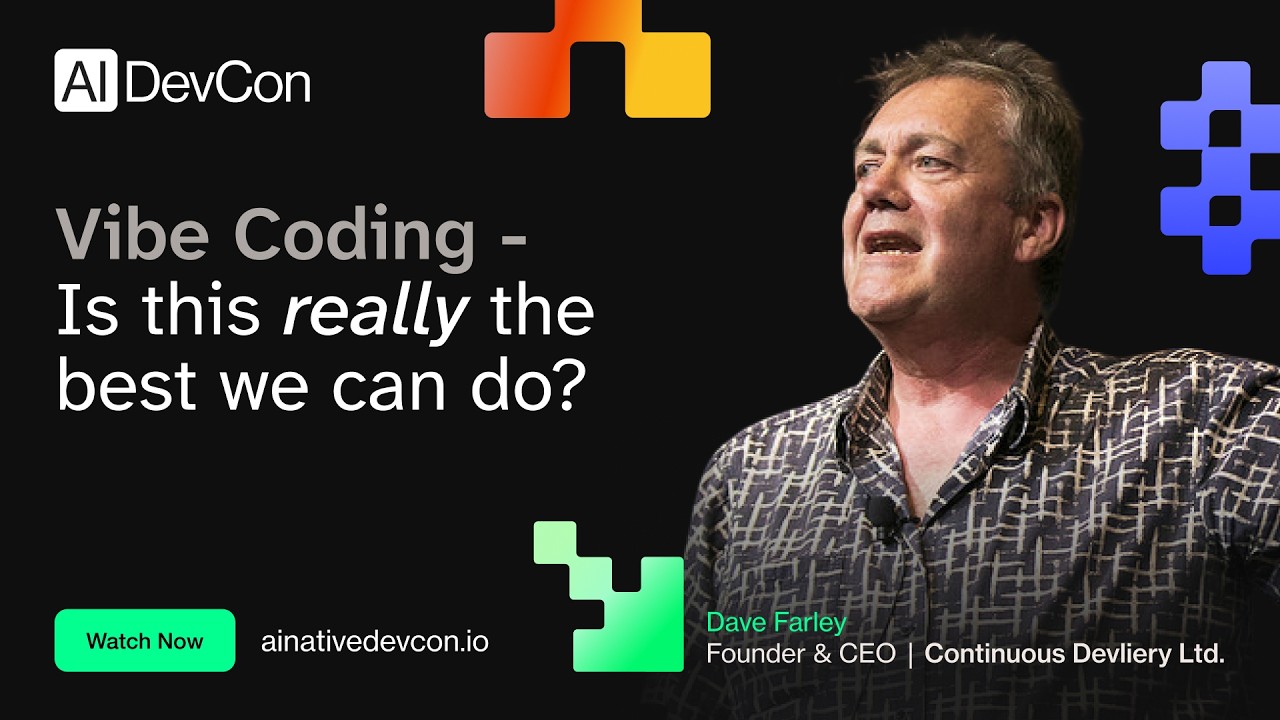
Dave Farley - Vibe Coding - Is this really the best we can do? - AI Native DevCon June 2026

The talk argues that while AI represents a massive paradigm shift in software development, relying solely on natural language or current agentic coding practices is insufficient for building complex systems. The core message is that the industry must evolve from being 'solution-focused' to 'specification-focused.' Future programming requires defining desired behaviors using precise Domain Specific Languages (DSLs) and executable specifications (like BDD), ensuring verification at every incremental step.

Key takeaways

  1. The Limitations of Natural Language 12:10

    Natural language is inherently vague, open to misinterpretation, and lacks the simple, consistent grammar required for precise machine execution. It cannot reliably define goals or guarantee deterministic results, making it unsuitable as a primary development tool.

  2. The Role of Specification over Solution 17:25

    Programming languages should be viewed not just as tools to encode algorithms (the solution), but primarily as mechanisms to organize and communicate a precise description of the problem itself. The future program must be an executable specification of what is desired, rather than merely the code that achieves it.

  3. The Necessity of Incremental Verification 23:55

    To manage the speed and scale of AI-generated code (e.g., 12,000 lines/day), development must maintain its core engineering principles: working incrementally, treating changes as experiments, and rigorously verifying every step using continuous delivery practices.

Watch on YouTube Full article

· 21:11

Everything Is a Rollout — Alex Shaw + Ryan Marten, Terminal-Bench, Harbor, Laude Institute

Alex Shaw introduces Harbor, a framework designed for evaluating and optimizing AI agents. The talk argues that agent development should be viewed through the lens of machine learning rather than traditional software engineering. This requires treating agent performance as a 'blackbox artifact' and managing it via empirical evaluation—a process formalized by 'rollouts.' Harbor provides the necessary infrastructure (sandboxes, standardized environments) to execute these complex evaluations in parallel.

Key takeaways

  1. Agent Development vs. Software Engineering 5:15

    Unlike traditional software engineering where behavior is predictable before execution, agentic coding and AI agents are best treated as blackbox artifacts whose performance requires empirical evaluation (e.g., 'Generated code is best treated as a blackbox artifact').

  2. The Role of Rollouts in Agent Evaluation 10:30

    Agent evaluation relies on 'rollouts' within sandboxed environments. This process involves passing the sandbox to the agent, collecting a trajectory, and then passing it to a verifier which produces rewards. Harbor standardizes this universal process.

  3. Harbor as an Interoperable Standard 12:20

    Harbor is presented as a common language and open-source framework for specifying agentic environments, allowing interoperability across different agents, models (e.g., GPT 5.5), and sandboxes to maximize data velocity.

  4. Diverse Evaluation Use Cases 17:30

    Evaluation can be highly specialized, including assessing how well agents build products (e.g., RampBench), how they use a product's headless mode, or automating internal processes.

Watch on YouTube Full article

· 17:11

The Unreasonable Effectiveness of Separating the Task from the Model — Maxime Rivest, DSPy

The talk introduces DSPy, an open-source Python framework designed to bring software engineering principles—reusability, composability, and testability—to AI programs. The core philosophy is the 'unreasonable effectiveness of separating the task from the model' by defining tasks strictly through a programmatic interface called the Signature. This approach allows developers to focus on the business logic (the contract) while keeping the underlying implementation flexible for experimentation with different models, weights, and techniques.

Key takeaways

  1. The Power of the Signature

    By defining a task's inputs and outputs (the Signature) first, developers create an abstraction layer that allows them to swap out underlying implementations (models, prompts, etc.) without changing the core workflow. This provides significant agility for AI engineering.

  2. Three Pillars of Task Specification 8:00

    To fully specify an AI task, DSPy advocates using three components: 1) Instructions (what should happen), 2) Constraints/Code (what must happen, enforced by code like self-recheck or chaining), and 3) Evaluation Metrics (what good looks like).

  3. Future Direction: Automation and Learning 10:35

    DSPy is evolving toward automating implementation details. Future versions, including DSPy 4.0, aim to allow models to write code beneath a signature and enable programs to learn directly from user interactions while respecting the defined inputs/outputs.

Watch on YouTube Full article

· 19:18

Harness Engineering is not Enough: Why Software Factories Fail — Dex Horthy, HumanLayer

The video argues that current efforts in 'harness engineering' and increasing tokens are insufficient for building reliable AI software factories because they fail to address fundamental model training shortcomings. The core problem is maintaining codebase quality over time (maintainability), which current reward functions do not penalize. To move forward safely, the speaker advocates returning to rigorous human-led upfront planning: Product Review $\rightarrow$ System Architecture $\rightarrow$ Program Design (down to types and call graphs) $\rightarrow$ Vertical Slices.

Key takeaways

  1. The Failure of 'Lights Off' Factories 12:10

    Attempting to run a software factory with no human code review ('lights off') leads to failures, even for advanced agents. The issue is not scale or prompting, but a fundamental model training limitation.

  2. Model Training Flaw (The Maintainability Gap) 17:12

    Current coding models are primarily trained on passing tests and solving one-off problems. Their reward signal does not penalize poor program design or the erosion of codebase maintainability, meaning they get better at passing tests but worse at keeping large systems stable.

  3. The Path Forward: Structured Planning

    To move faster safely, engineers must re-emphasize upfront planning steps: Product Review (desired behavior/mockups), System Architecture (component contracts/data models), Program Design (types and call graphs), and Vertical Slices (implementation order).

Watch on YouTube Full article

· 1:12:03

Coding Agents Are Secretly General Agents

The discussion posits that coding agents are inherently generalist, meaning proficiency in code translates into superior performance across all knowledge work tasks due to a concept called 'positive transfer.' The future of knowledge work is converging on single, integrated platforms (Systems of Record) that provide comprehensive context and surfaces for agent interaction. Key technical advancements include using verifiable code execution environments (like unit testing/linting) as the perfect training ground for agents, leading to autonomous workflows like ticket-to-pull request cycles.

Key takeaways

  1. Coding Agents are Generalist Agents 22:00

    The core thesis is that improving an agent's ability to write and execute code makes it better at everything else. This 'positive transfer' capability means agents with coding skills are effectively AGI-complete, as they can write their own tools and interact with various systems.

  2. Verifiability is Key for Agent Training 17:15

    Code provides an ideal training ground because its output (e.g., a function, schema) can be programmatically verified (linted or passed through unit tests). This verifiable feedback loop allows agents to learn and refine their performance iteratively, which is crucial for autonomous workflows.

  3. Convergence of Platforms Wins 23:40

    The most successful platforms will be those that achieve convergence—integrating context, surfaces, and unit economics into a single system (a 'System of Record'). Fragmentation (e.g., Slack's data walls) is identified as the primary enemy to agentic workflow adoption.

  4. The Future is Autonomous Knowledge Work 26:40

    The trend suggests that much of today's office work will be handled by agents. This shift means platforms must evolve from being communication hubs (like Slack) to becoming the central operational layer where all data and tasks reside.

Watch on YouTube Full article

· 45:17

The Agent Development Lifecycle 101 by Harrison Chase

The Agent Development Lifecycle outlines a systematic approach for moving AI agents from isolated demos to reliable production systems. The process is broken down into five stages: Build, Test, Deploy, Monitor, and Govern. Key focus areas include ensuring agent reliability at scale by implementing durable execution, managing complex state via virtual file systems, and using advanced observability tools like tracing and online evaluation (evals) to detect failures and drive continuous improvement.

Key takeaways

  1. Systematic Iteration is Key 3:50

    Successful teams treat agents not as one-off projects but as systems requiring systematic iteration across the entire lifecycle: build, test, deploy, monitor, and improve. The primary challenge in shipping agents reliably at scale is ensuring consistent behavior.

  2. Agent Development Components 5:50

    The core components are Build (frameworks/harnesses), Test (data sets, metrics, benchmarks like Terminal Bench 2), Deploy (durable execution, sandboxes), Monitor (tracing, online evals), and Govern (cost control, tool access management).

  3. The Role of Tracing and Observability 17:06

    Tracing is fundamental for debugging agents, allowing developers to see the inputs and outputs at every step (including tool calls) to understand why an LLM or agent failed. Online evals extend this by scoring production traces without needing ground truth.

  4. Self-Improving Agents 31:30

    Advanced platforms, like LangSmith Engine, are beginning to automate the improvement loop. They run in the background over existing traces, clustering issues and suggesting fixes (code or prompt changes), thereby drastically lowering the burden of operating agents at scale.

Watch on YouTube Full article

· 19:47

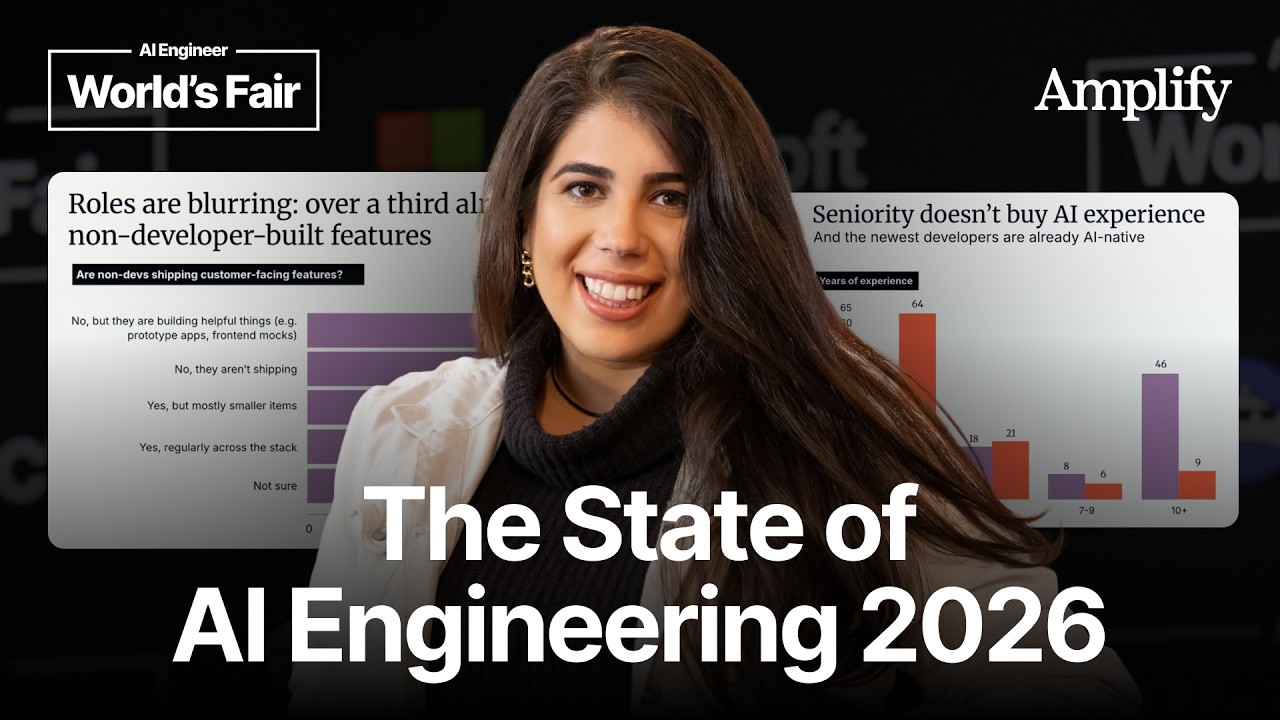
2026 State of AI Engineering — Barr Yaron, Amplify Partners

The state of AI engineering is characterized by rapid maturity and increased complexity. Survey data from 1,048 respondents indicates that while open-weight models augment closed systems, the primary drivers for model choice are quality, agentic capabilities (like tool calling), and cost. Cost has become a 'first-class engineering constraint,' forcing teams to manage usage carefully. Furthermore, agents are rapidly evolving from summarization tools to systems with write access, necessitating robust control layers and sophisticated evaluation (eval) processes.

Key takeaways

  1. AI Experience is Democratizing 0:03

    The AI engineering workforce is maturing quickly; the median new engineer has nearly as much AI experience as a 10-year software veteran, indicating that AI skills are becoming foundational to modern development.

  2. Cost is a Primary Constraint 0:08

    Three out of four respondents report adjusting their AI usage based on cost, establishing 'cost' as a first-class engineering constraint alongside quality and capability.

  3. Agents are Taking Action 0:11

    Agentic workflows have shifted significantly: they are no longer limited to reading or summarizing, but are increasingly taking actions inside systems. Write access for agents has increased dramatically (from 52% to 89%).

  4. Evaluation Remains the Biggest Challenge 0:12

    Across all layers of the stack, 'eval' (evaluation) remains the number one biggest challenge reported by engineers.

Watch on YouTube Full article

· 58:17

Omnigent: Composition, Control, and Collaboration for AI Agents

The AI development landscape is shifting from focusing solely on large language models (LLMs) to building sophisticated meta-harnesses and agent frameworks. The core challenge addressed by tools like Omnigent is managing complexity, ensuring model portability, and controlling escalating costs (tokenomics). This architectural shift requires developers to treat agents as stateful systems that rely heavily on external memory (databases) and advanced orchestration patterns like 'debating' or 'forking' conversations to achieve robust results.

Key takeaways

  1. The Meta-Harness Layer 20:40

    Meta-harnesses, such as Omnigent, sit above individual models (e.g., Claude Code, Codex, Pi) and harnesses, allowing developers to compose different components without rebuilding the entire context or workflow.

  2. Agentic Workflow Patterns 6:05

    Advanced agent techniques include having agents debate each other to surface unknown questions, and 'forking' conversations to explore parallel threads while maintaining shared original context.

  3. Tokenomics as DevOps 1:42

    AI spend is repeating the CapEx-to-OpEx shift. Governance must be pushed down to developers (giving them visibility into token usage) while retaining central policies for cost control and approval.

  4. The Importance of State 39:40

    Agents require cheap, stateful memory. This has led to a resurgence in the use of traditional databases like Postgres, Lakebase, and serverless options for persistent context.

Watch on YouTube Full article

· 32:39

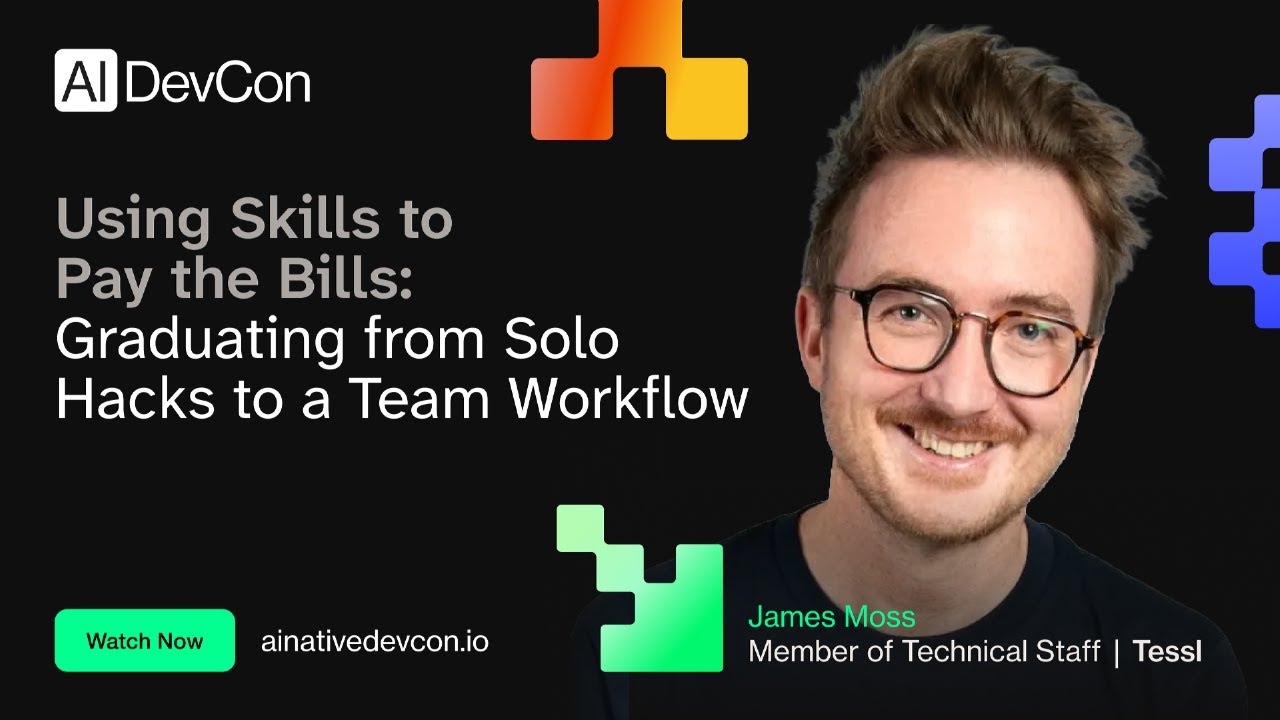
James Moss - Using skills to pay the bills: graduating from solo hacks to a team workflow - DevCon26

The talk addresses the challenge of 'skill sprawl'—the uncontrolled proliferation and management of AI coding agent skills within large organizations. While skills are powerful because they encode domain-specific logic into an agent's context, their current lack of standardized versioning, review, and centralized governance creates significant technical debt. The speaker advocates for treating skills as first-class software assets, requiring dedicated practices like decomposition, mandatory registries, automated reviews, and formal lifecycle management (CDLC) to ensure reliability and scalability.

Key takeaways

  1. Manage Skill Sprawl with a Centralized Registry 17:33

    Due to the low barrier to entry for creating skills, organizations face an 'insane amount' of them (2 million+ on GitHub alone). A centralized registry is crucial for visibility, preventing overlap, and ensuring all teams use approved versions. This also helps mitigate non-technical users needing access without requiring full developer seats.

  2. Adopt the Context Development Life Cycle (CDLC) 27:50

    Just as code requires a Software Development Lifecycle (SDLC), skills and context require their own CDLC. Practices like skill reviews, automated testing, and version control must be applied to maintain quality and prevent 'rot' (skills going out of sync with the codebase).

  3. Decompose Skills for Modularity 20:40

    Instead of creating monolithic skills, break complex functionality into smaller, interconnected plugins. This allows agents to activate specific components and makes the skill set easier to maintain and debug.

  4. Enforce Governance via Registries 22:30

    Using a registry provides a single source of truth, allowing organizations to enforce policies (e.g., 'approved skills only,' minimum release age) and integrate security scanning tools like Snyk.

Watch on YouTube Full article

· 28:43

Katie Roberts - Stop Maintaining, Start Evolving: Applying AI-Native Practices to Brownfield Codebas

This talk addresses the challenge of modernizing complex, legacy 'brownfield' codebases—systems that are highly successful but burdened by accumulated technical debt and tribal knowledge. The speaker outlines how to apply AI-Native Engineering practices not for adding new features, but for architectural reclamation. Key strategies include using established patterns like the Strangler Fig Pattern and Branch by Extraction, coupled with structured processes (e.g., creating a 'plan skill') to systematically pay down technical debt while maintaining continuous function.

Key takeaways

  1. AI should be used for paying down technical debt, not adding to it. 17:33

    Autonomous agents deployed without strict guardrails can cause havoc through over-optimization or generating 'dark code,' undermining implicit architectural constraints and creating new hidden technical debt. Safety and bounded scopes are paramount.

  2. Adopt a structured approach to brownfield modernization. 20:05

    Instead of starting with the code, begin by conducting forensic investigations using developer input (eyewitness accounts) and creating objective data visualizations (e.g., value vs. complexity graphs) to identify high-priority areas for improvement.

  3. Prioritize planning over immediate migration. 25:32

    In brownfield environments, the planning phase is critical. Focus on creating a structured roadmap and defining clear contracts (specs) before writing code to ensure the right thing is built.

  4. Use AI-assisted skills for process automation. 26:30

    Implement multi-agent flows ('skills') that automate tasks like generating PRDs from documentation, creating Jira tickets, and performing detailed code mapping. This accelerates development cycles (e.g., reducing 6 months of work to 8 weeks).

Watch on YouTube Full article

· 30:13

How to Go From Data Scientist to AI Engineer (I Did This)

This roadmap guides individuals transitioning from Data Science or Machine Learning into AI Engineering. The core message is that the role shifts focus from statistical modeling in notebooks to becoming a full-stack software engineer capable of building reliable, production-grade AI systems. Key areas covered include closing the software engineering gap (OOP, structured Python projects), mastering LLM backends (FastAPI, Pydantic, Docker), and implementing advanced techniques like Retrieval Augmented Generation (RAG), evaluation (Evals), and guardrails.

Key takeaways

  1. The AI Engineer Shift 0:59

    AI Engineering requires moving beyond Jupyter notebooks to structured Python projects using OOP principles, Git, testing, debugging, logging, and environment management. The focus shifts from pure research to building reliable systems around pre-trained models.

  2. Data Science Advantage 2:00

    Individuals with a DS/ML background have an advantage because they are trained in statistical thinking (distributions, error analysis) which is critical for making non-deterministic LLM outputs reliable in production.

  3. The Importance of Production Backends 5:29

    To build deployable systems, learn to use FastAPI and Pydantic for API creation. Containerization using Docker and persistent data storage with PostgreSQL are essential steps.

  4. Advanced AI Techniques 7:30

    Mastering RAG (Retrieval Augmented Generation) requires understanding vector databases (e.g., using the PGvector extension in PostgreSQL). Furthermore, implementing Evals and Guardrails is crucial for quantifying performance and preventing issues like prompt injection.

Watch on YouTube Full article

· 1:02:16

Platform Engineering in the age of Generative AI -

The talk argues that while Generative AI tools significantly accelerate code generation and development speed, they are not a 'silver bullet.' To harness AI effectively, organizations must first establish robust platform engineering foundations. The core focus is on implementing comprehensive 'harnessing'—a system of controls (guides and sensors) that ensure consistent behavior, mitigate security vulnerabilities, and guide agents toward high-quality outcomes. Key strategies include adopting open standards like those from the Aentic AI Foundation, utilizing Spec Driven Development (SDD), and treating the entire development environment as a codified, observable artifact.

Key takeaways

  1. Platform Engineering's Goal: Reducing Cognitive Overload 10:40

    Platform engineering should aim to make it the 'path of least resistance' for developers by building internal mechanisms and golden paths. This reduces cognitive overload, allowing teams to focus on delivering value rather than managing complex compliance, security, or deployment processes.

  2. AI is an Amplifier, Not a Solution 20:00

    Generative AI amplifies existing engineering quality. If foundational practices (like documentation and consistent tooling) are weak, AI will amplify those weaknesses, leading to basic security failures or unreliable code.

  3. The Importance of Agentic Standards 30:00

    The Aentic AI Foundation is establishing open standards (MCP servers, agent MD files, and agent skills) to standardize how agents interact with tools. MCP servers are described as a 'USB-C for AI agents,' providing a standard protocol layer.

  4. Harness Engineering: Controlling the Agent 40:00

    A robust 'harness' is the system surrounding the LLM model. It uses two types of controls: **Feed-forward guides** (anticipating and steering behavior, e.g., Agent MD files) and **Feedback sensors** (observing after action, e.g., linters, unit tests, or an 'LLM as a judge' pattern).

Watch on YouTube Full article

· 49:59

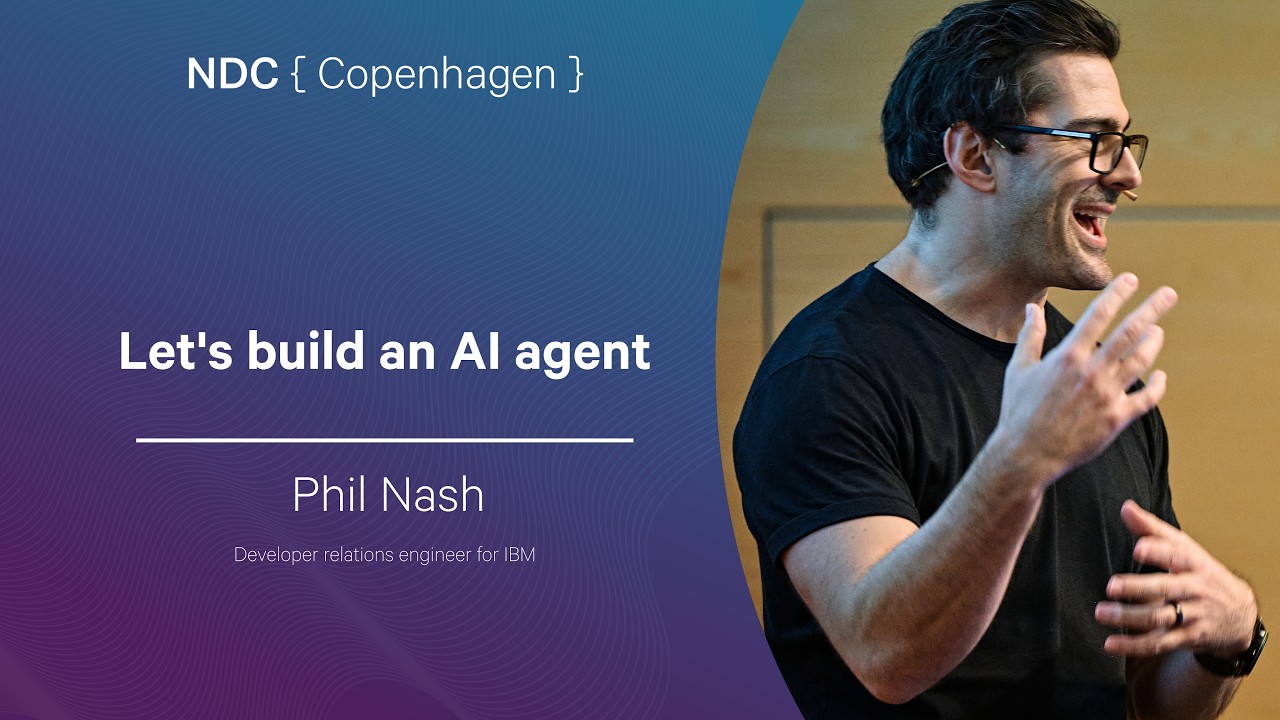
Let's build an AI agent - Phil Nash - NDC Copenhagen 2026

This talk demystifies AI agents by building one from scratch, demonstrating how Large Language Models (LLMs), tools, and memory work together in a continuous loop to achieve goals. The core mechanism involves an agent runtime that orchestrates function calls—allowing the LLM to interact with external systems like file systems or calculators. Advanced concepts covered include the Model Context Protocol (MCP) for standardized tool interaction and 'Skills' for progressive disclosure of capabilities, enabling agents to perform complex tasks like self-refactoring.

Key takeaways

  1. Agent Architecture 17:03

    An agent fundamentally runs tools in a loop to achieve a goal. This process requires an LLM, external tools (functions), and an orchestration layer (the 'harness') that manages the interaction.

  2. The Agent Loop 28:10

    The core agent functionality is implemented in a loop: The model generates function calls $\rightarrow$ The harness executes those functions (awaiting results) $ ightarrow$ The results are fed back to the model for the next step, continuing until the goal is met.

  3. Standardization via MCP 36:00

    The Model Context Protocol (MCP) provides a standardized way for agents to interact with services. It separates concerns into Server components (tools, resources, prompts) and Client components.

  4. Progressive Disclosure with Skills 40:05

    Skills allow for progressive disclosure of capabilities. Instead of loading all tool declarations at once, the agent only loads a skill's header initially and can request more details (resources, scripts) as needed.

Watch on YouTube Full article