Topic

State Management

All digests tagged State Management

· 59:49

From LLM Theory to Practical Agentic Implementations - Seth Juarez

The talk demystifies Large Language Models (LLMs), arguing that their power does not come from inherent intelligence but from engineered 'harnesses' and fundamental primitives. The speaker outlines a progression of techniques—from simple completions to complex agentic loops—that allow developers to build robust, reliable AI systems by controlling the model's input context, output structure, and execution flow. Key concepts include using structured JSON for control flow, implementing tool calling via runtimes (not the LLM itself), establishing guardrails, and orchestrating multi-step workflows through shared 'threads.'

Key takeaways

  1. LLMs are Next Token Predictors 1:42

    At its core, an LLM is a giant mathematical function that predicts the next token based on input tokens. The perceived intelligence comes from the surrounding runtime logic (the harness), not the model itself.

  2. The Agentic Loop is the Core Primitive 21:20

    True agency is achieved by implementing an 'agentic loop'—a while loop in the runtime that continuously checks for and executes tool calls, feeding the results back into the context until no more tools are needed. This is the fundamental unit of agency.

  3. Guardrails and Bindings Enhance Reliability 35:05

    To prevent misuse or incorrect execution (e.g., unauthorized memory access), developers must implement guardrail functions in their runtime logic. Furthermore, 'bindings' allow injecting fixed parameters (like `user ID`) into function calls, removing the burden of context-dependent reasoning from the LLM.

  4. Composition Workflow for Multi-Step Agents 50:50

    Complex tasks are solved by chaining multiple specialized agents or prompts (e.g., Research $ ightarrow$ Draft $ ightarrow$ Review). All these components share a single, persistent 'thread' context to maintain state and pass control flow sequentially.
Watch on YouTube Full article

· 18:26

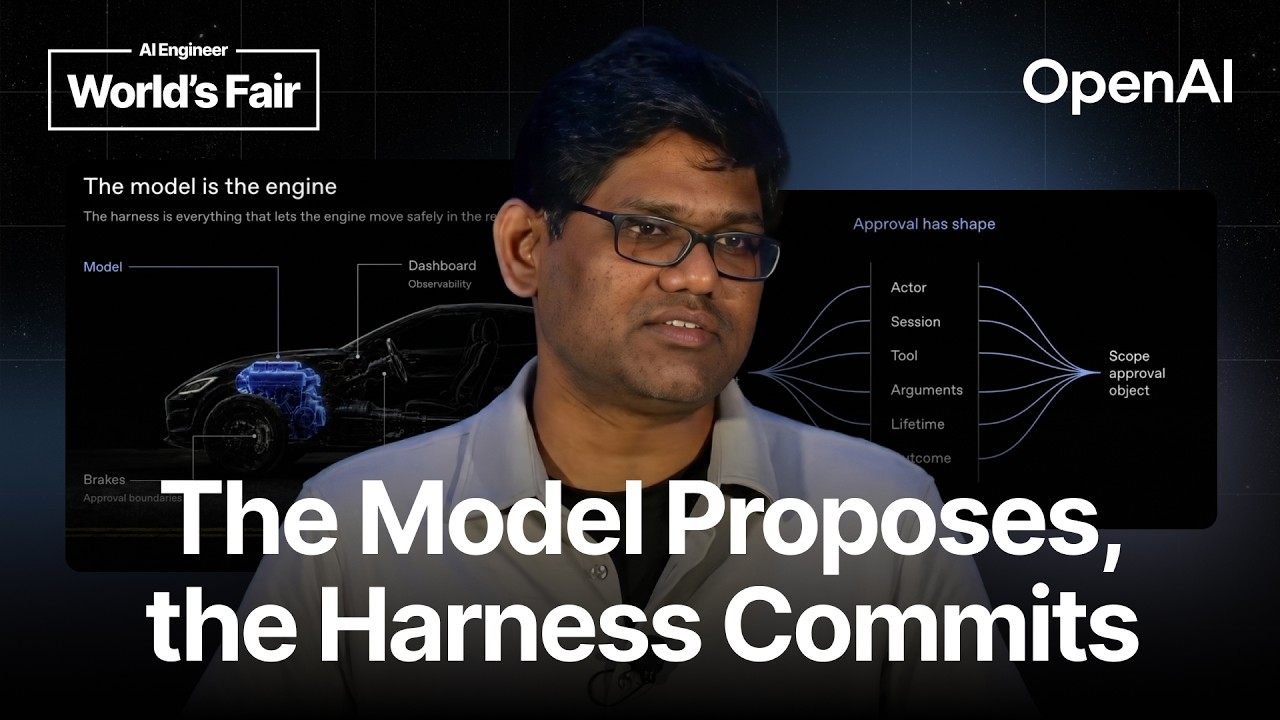
Your Agent Didn't Fail. Your Harness Did. — Vinoth Govindarajan, OpenAI

The talk argues that most production failures in AI agents are not due to model hallucination or poor reasoning, but rather 'harness failures'—flaws in the underlying system architecture. The core principle is establishing a clear boundary: while a model can only propose an action, the surrounding harness must own the state transition, enforce ordered commits, and provide verifiable proof (the receipt) that the action was successfully executed and observed by the user.

Key takeaways

  1. Model Proposes, Harness Commits, Receipt Proves 4:06

    The model generates capability; the harness provides control. The system must own state transitions, enforce ordered mutations, and use a receipt to prove that an action was executed and visible to the user.

  2. Own the State, Order the Mutation, Prove the Action 5:20

    These three principles are critical for reliable agent systems. A fact must have a single owner (system of record) and a clear replay path; mutable state requires one ordered commit path.

  3. The Run Receipt Audit

    To audit an agent system, ask five questions: What woke it up (trigger)? What state did it inherit? Which authority did it use? What executed? And what evidence survived?

Watch on YouTube Full article

· 45:17

The Agent Development Lifecycle 101 by Harrison Chase

The Agent Development Lifecycle outlines a systematic approach for moving AI agents from isolated demos to reliable production systems. The process is broken down into five stages: Build, Test, Deploy, Monitor, and Govern. Key focus areas include ensuring agent reliability at scale by implementing durable execution, managing complex state via virtual file systems, and using advanced observability tools like tracing and online evaluation (evals) to detect failures and drive continuous improvement.

Key takeaways

  1. Systematic Iteration is Key 3:50

    Successful teams treat agents not as one-off projects but as systems requiring systematic iteration across the entire lifecycle: build, test, deploy, monitor, and improve. The primary challenge in shipping agents reliably at scale is ensuring consistent behavior.

  2. Agent Development Components 5:50

    The core components are Build (frameworks/harnesses), Test (data sets, metrics, benchmarks like Terminal Bench 2), Deploy (durable execution, sandboxes), Monitor (tracing, online evals), and Govern (cost control, tool access management).

  3. The Role of Tracing and Observability 17:06

    Tracing is fundamental for debugging agents, allowing developers to see the inputs and outputs at every step (including tool calls) to understand why an LLM or agent failed. Online evals extend this by scoring production traces without needing ground truth.

  4. Self-Improving Agents 31:30

    Advanced platforms, like LangSmith Engine, are beginning to automate the improvement loop. They run in the background over existing traces, clustering issues and suggesting fixes (code or prompt changes), thereby drastically lowering the burden of operating agents at scale.

Watch on YouTube Full article

· 18:05

60% Faster Time-to-Interview: Transforming Hiring with AI Agents with LangChain

LinkedIn details the architecture of a hiring agent built with LangChain and LangGraph that successfully cut time-to-interview by 60% for small businesses. The system evolved from static workflows to an advanced agentic control model utilizing a central planner within a plan-execute-replan loop. Key architectural components include specialized memory types (conversational and experiential), middleware hooks for PII detection, and rigorous 'harness engineering' techniques—such as state flag chaining and one-shot tool guards—to ensure the probabilistic nature of LLMs results in a dependable product.

Key takeaways

  1. Hiring is an Agent Problem

    The hiring process is inherently iterative (plan, act, observe, adapt), requiring continuous adaptation rather than being a one-shot task. This necessitates an agentic approach.

  2. Architectural Evolution to LangGraph 0:03

    The system progressed from hard-coded static workflows (if/then) to sequential LangChain chains, culminating in LangGraph for its true agentic control model featuring a central planner and plan-execute-replan loop.

  3. Choosing LangGraph 0:05

    LinkedIn selected LangGraph over 89 evaluated frameworks because it complements existing infrastructure, builds upon core LangChain primitives (runnables, tools), and allowed for zero rewrite adoption.

  4. Achieving Determinism via Harness Engineering 0:10

    To make the agent dependable, LinkedIn implemented advanced 'harness engineering' techniques, including context management (checkpoint trimming), output format determinism (template confirmation/fallbacks), and node-change determinism (state flag chaining and one-shot tool guards).

Watch on YouTube Full article