Topic

Harbor

All digests tagged Harbor

· 21:11

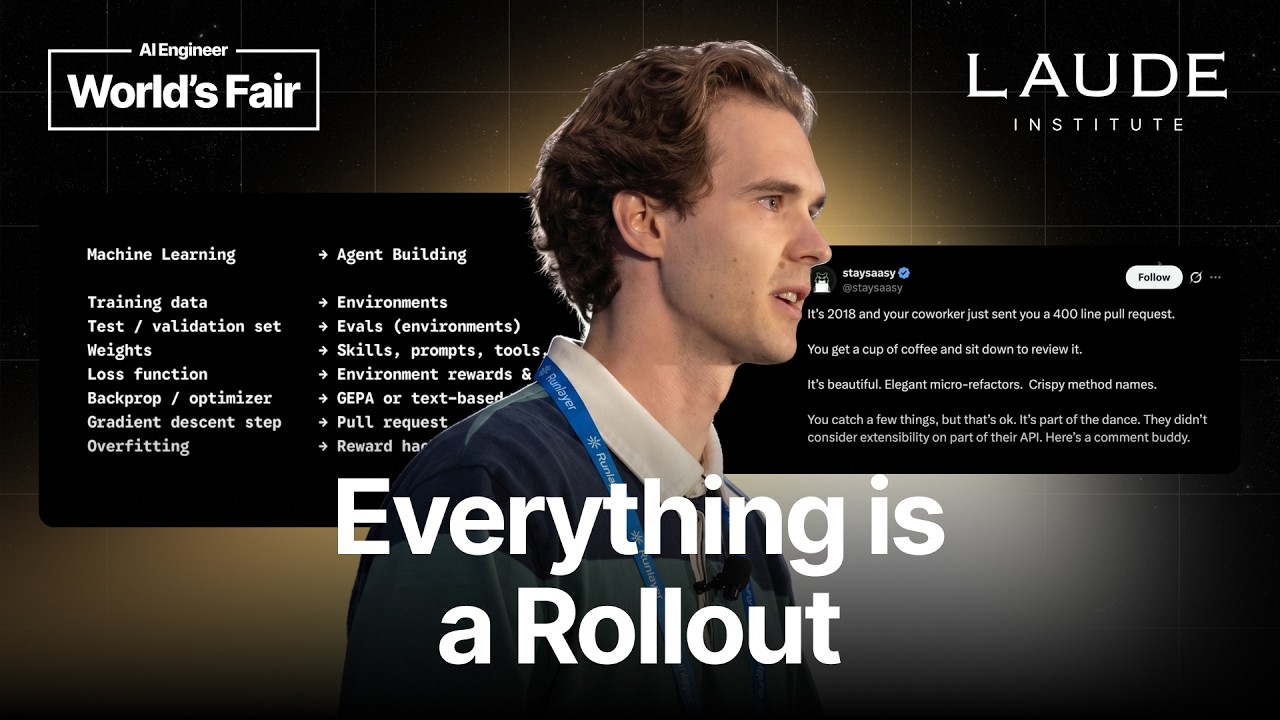
Everything Is a Rollout — Alex Shaw + Ryan Marten, Terminal-Bench, Harbor, Laude Institute

Alex Shaw introduces Harbor, a framework designed for evaluating and optimizing AI agents. The talk argues that agent development should be viewed through the lens of machine learning rather than traditional software engineering. This requires treating agent performance as a 'blackbox artifact' and managing it via empirical evaluation—a process formalized by 'rollouts.' Harbor provides the necessary infrastructure (sandboxes, standardized environments) to execute these complex evaluations in parallel.

Key takeaways

  1. Agent Development vs. Software Engineering 5:15

    Unlike traditional software engineering where behavior is predictable before execution, agentic coding and AI agents are best treated as blackbox artifacts whose performance requires empirical evaluation (e.g., 'Generated code is best treated as a blackbox artifact').

  2. The Role of Rollouts in Agent Evaluation 10:30

    Agent evaluation relies on 'rollouts' within sandboxed environments. This process involves passing the sandbox to the agent, collecting a trajectory, and then passing it to a verifier which produces rewards. Harbor standardizes this universal process.

  3. Harbor as an Interoperable Standard 12:20

    Harbor is presented as a common language and open-source framework for specifying agentic environments, allowing interoperability across different agents, models (e.g., GPT 5.5), and sandboxes to maximize data velocity.

  4. Diverse Evaluation Use Cases 17:30

    Evaluation can be highly specialized, including assessing how well agents build products (e.g., RampBench), how they use a product's headless mode, or automating internal processes.

Watch on YouTube Full article

· 45:17

The Agent Development Lifecycle 101 by Harrison Chase

The Agent Development Lifecycle outlines a systematic approach for moving AI agents from isolated demos to reliable production systems. The process is broken down into five stages: Build, Test, Deploy, Monitor, and Govern. Key focus areas include ensuring agent reliability at scale by implementing durable execution, managing complex state via virtual file systems, and using advanced observability tools like tracing and online evaluation (evals) to detect failures and drive continuous improvement.

Key takeaways

  1. Systematic Iteration is Key 3:50

    Successful teams treat agents not as one-off projects but as systems requiring systematic iteration across the entire lifecycle: build, test, deploy, monitor, and improve. The primary challenge in shipping agents reliably at scale is ensuring consistent behavior.

  2. Agent Development Components 5:50

    The core components are Build (frameworks/harnesses), Test (data sets, metrics, benchmarks like Terminal Bench 2), Deploy (durable execution, sandboxes), Monitor (tracing, online evals), and Govern (cost control, tool access management).

  3. The Role of Tracing and Observability 17:06

    Tracing is fundamental for debugging agents, allowing developers to see the inputs and outputs at every step (including tool calls) to understand why an LLM or agent failed. Online evals extend this by scoring production traces without needing ground truth.

  4. Self-Improving Agents 31:30

    Advanced platforms, like LangSmith Engine, are beginning to automate the improvement loop. They run in the background over existing traces, clustering issues and suggesting fixes (code or prompt changes), thereby drastically lowering the burden of operating agents at scale.

Watch on YouTube Full article