Topic

Distributed Computing

All digests tagged Distributed Computing

· 19:09

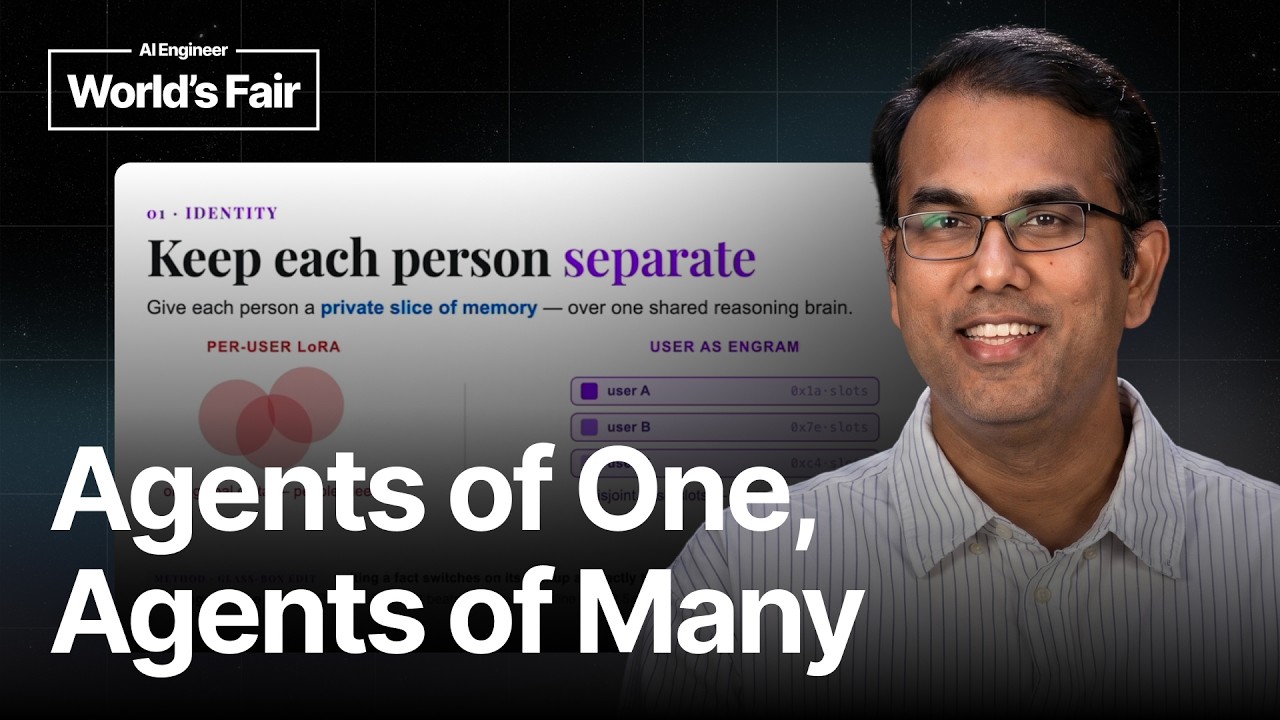
Wearing the Agent: From Group Chats to Glasses — Sai Krishna Rallabandi

The talk addresses the architectural shift required for agentic systems moving from single-user deployments to complex group chats and wearable devices. The speaker argues that these multi-user environments fundamentally break single-user assumptions, necessitating a complete redesign of memory management and security layers. Key challenges include preventing information leaks when multiple skills collide (security) and efficiently curating evolving conversations over long periods without context bloat (memory).

Key takeaways

  1. Group Settings Break Single-User Assumptions

    Agents designed for one user fail in group settings because the complexity of tracking multiple participants, maintaining privacy, and managing shared information requires unique architectural solutions.

  2. Security Must Be Designed at the Action Surface 12:24

    Instead of trying to guard all input (which is impossible due to vast surface areas like web pages, emails, and GitHub issues), security must focus on designing a deterministic guard layer that monitors actions—specifically when the agent reads or exports variables (e.g., bash variables) before taking action.

  3. Memory Requires Atomic Information Extraction

    Traditional memory methods are insufficient for groups. The system must move beyond storing raw conversation logs and instead extract high-value, atomic facts from the discussion. This requires designing sophisticated auto-raters to determine relevance, hierarchy, and temporal importance.

Watch on YouTube Full article

· 21:11

Everything Is a Rollout — Alex Shaw + Ryan Marten, Terminal-Bench, Harbor, Laude Institute

Alex Shaw introduces Harbor, a framework designed for evaluating and optimizing AI agents. The talk argues that agent development should be viewed through the lens of machine learning rather than traditional software engineering. This requires treating agent performance as a 'blackbox artifact' and managing it via empirical evaluation—a process formalized by 'rollouts.' Harbor provides the necessary infrastructure (sandboxes, standardized environments) to execute these complex evaluations in parallel.

Key takeaways

  1. Agent Development vs. Software Engineering 5:15

    Unlike traditional software engineering where behavior is predictable before execution, agentic coding and AI agents are best treated as blackbox artifacts whose performance requires empirical evaluation (e.g., 'Generated code is best treated as a blackbox artifact').

  2. The Role of Rollouts in Agent Evaluation 10:30

    Agent evaluation relies on 'rollouts' within sandboxed environments. This process involves passing the sandbox to the agent, collecting a trajectory, and then passing it to a verifier which produces rewards. Harbor standardizes this universal process.

  3. Harbor as an Interoperable Standard 12:20

    Harbor is presented as a common language and open-source framework for specifying agentic environments, allowing interoperability across different agents, models (e.g., GPT 5.5), and sandboxes to maximize data velocity.

  4. Diverse Evaluation Use Cases 17:30

    Evaluation can be highly specialized, including assessing how well agents build products (e.g., RampBench), how they use a product's headless mode, or automating internal processes.

Watch on YouTube Full article