
Topic

AI Architecture

All digests tagged AI Architecture

· 19:09

Wearing the Agent: From Group Chats to Glasses — Sai Krishna Rallabandi

The talk addresses the architectural shift required for agentic systems moving from single-user deployments to complex group chats and wearable devices. The speaker argues that these multi-user environments fundamentally break single-user assumptions, necessitating a complete redesign of memory management and security layers. Key challenges include preventing information leaks when multiple skills collide (security) and efficiently curating evolving conversations over long periods without context bloat (memory).

Key takeaways

  1. Group Settings Break Single-User Assumptions

    Agents designed for one user fail in group settings because the complexity of tracking multiple participants, maintaining privacy, and managing shared information requires unique architectural solutions.

  2. Security Must Be Designed at the Action Surface 12:24

    Instead of trying to guard all input (which is impossible due to vast surface areas like web pages, emails, and GitHub issues), security must focus on designing a deterministic guard layer that monitors actions—specifically when the agent reads or exports variables (e.g., bash variables) before taking action.

  3. Memory Requires Atomic Information Extraction

    Traditional memory methods are insufficient for groups. The system must move beyond storing raw conversation logs and instead extract high-value, atomic facts from the discussion. This requires designing sophisticated auto-raters to determine relevance, hierarchy, and temporal importance.

Watch on YouTube Full article

· 23:55

Notion's Token Town — Sarah Sachs, Notion

The presentation argues that building sustainable AI-native products requires shifting focus from optimizing token economics to mastering product architecture and optionality. The speaker warns against vendor lock-in due to volatile model pricing (the 'token town' trap) and advocates for strategies like implementing an 'auto model,' leveraging open weight models, prioritizing CPUs over GPUs for deterministic tasks, and building robust multi-agent orchestration systems.

Key takeaways

  1. Vendor Lock-In is the Primary Risk 12:08

    Relying solely on a single AI provider creates significant risk because pricing structures are volatile. The speaker asserts that 'your supplier is your competitor' (7:28), making model agnosticism crucial for business viability.

  2. Win on Product, Not Tokens 14:04

    Instead of competing on the lowest cost per token, companies must build data flywheels and orchestration layers that solve unique customer problems. The value should come from the product's workflow, not just its underlying model capability (8:44).

  3. Implement Model Agnosticism 22:05

    To maintain optionality, systems must be designed to route traffic across multiple models and providers (e.g., Notion’s 'auto model' handling 75% of traffic) to mitigate pricing shocks or provider deprecations (13:25).

  4. Prioritize CPUs for Deterministic Tasks

    For tasks that do not require complex reasoning—such as turning a CSV into a PDF, running deterministic SQL queries, or simple tool calls—CPUs are often more cost-effective and efficient than relying on GPUs/LLMs (17:00).

Watch on YouTube Full article

· 15:00

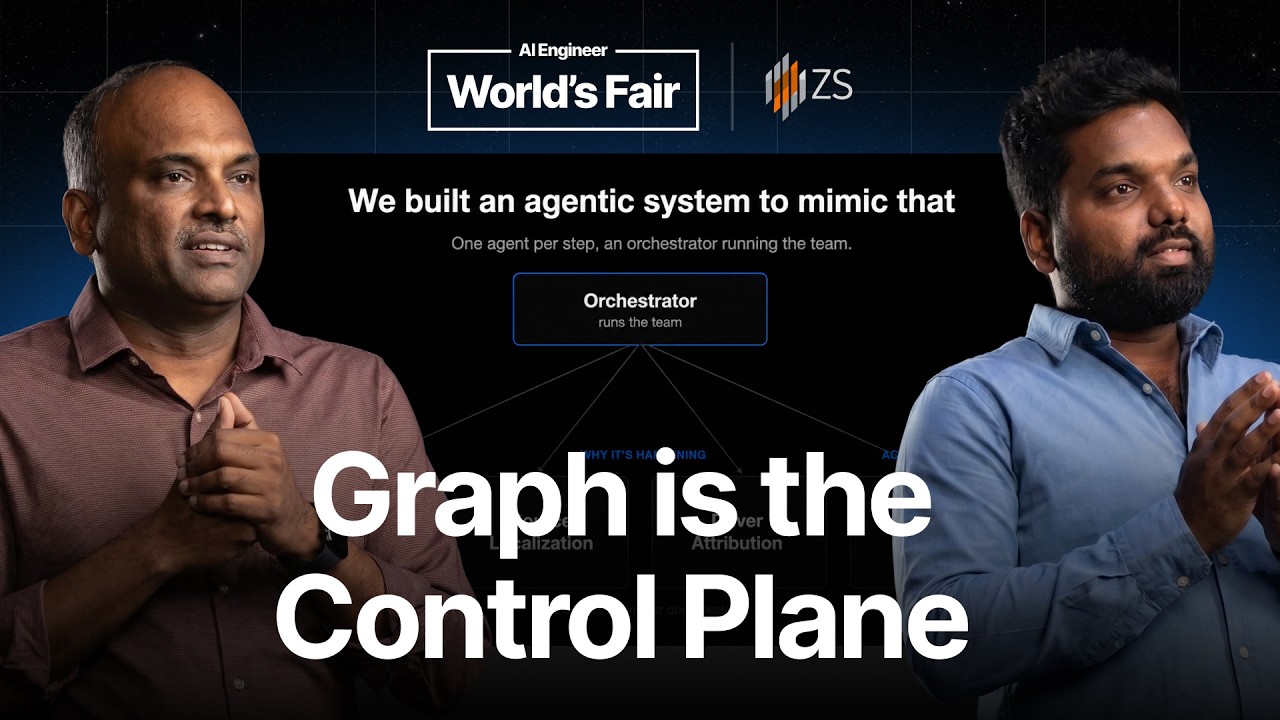
Why We Killed Our Multi-Agent Pipeline — Subbiah Sethuraman and Abhilash Asokan, ZS Associates

The video details the architectural overhaul of a multi-agent pipeline designed for complex pharma commercial analytics. The initial system failed because it attempted to mimic human analyst behavior by assigning separate agents to every step (signal detection, localization, attribution, synthesis), leading to context loss and incoherent reasoning. The rebuild focused on three key principles: 1) Separating deterministic signal detection into a pre-agent automated pipeline; 2) Consolidating core reasoning into a single agent that owns the end-to-end picture; and 3) Utilizing a Knowledge Graph (KG) not as a data lookup table, but as a 'control plane' to bound hypotheses and guide the investigation process. This resulted in a system capable of producing complex analyses in minutes, matching months of human effort.

Key takeaways

  1. Deterministic vs. Agentic Workflow 11:41

    Complex workflows must separate deterministic parts (like signal detection) into automated pipelines that run before the agent is activated. Agents should be reserved for investigation and reasoning, not initial data fetching or filtering.

  2. Single Point of Reasoning Ownership 13:25

    Instead of distributing judgment across multiple agents, consolidate the entire end-to-end reasoning process into a single main agent. This agent can use tools to spawn sub-agents only for focused lookups, ensuring coherence and maintaining ownership of the overall conclusion.

  3. Knowledge Graph as Control Plane

    A Knowledge Graph must be treated as a control plane—a mechanism that dictates what hypotheses an agent can test and what path it can take—rather than merely being a lookup table for data. This bounds the search space and ensures domain relevance.

Watch on YouTube Full article

· 15:58

From Systems of Record to Systems of Context — Omri Bruchim, monday.com

The talk outlines a fundamental shift in enterprise software from 'Systems of Record'—which merely log what happened—to 'Systems of Context,' which actively understand the meaning and connections between data points. monday.com addresses this challenge by building a 'Monday world model' using two distinct, precomputed engines: a slow engine for durable, long-term user profiling (who you are) and a fast engine for real-time signals (what is urgent today). This architecture mirrors both the brain's hippocampus/neocortex function and the Lambda data architecture, ensuring that AI agents can reason on deep context rather than just retrieving disconnected data.

Key takeaways

  1. The Problem: Data vs. Understanding

    Current AI assistants have access to vast amounts of data (boards, emails, Slack messages) but often fail because the core problem is not retrieval (data availability), but 'understanding'—the ability to connect disparate pieces of information and determine true user priority.

  2. The Solution: System of Context

    Instead of just logging events, the system must build a context layer ahead of time. This 'Monday world model' allows AI agents (like Sidekick/Psyche) to understand not only *what* happened but *why* it matters and *who* is affected.

  3. Architectural Design: Two Engines 13:35

    The context layer is built using two engines running on different time windows. The slow engine mines weeks of activity to build a durable profile of user patterns and goals, while the fast engine processes recent data for live signals and immediate urgency.

  4. Resilience and Intelligence

    This dual-engine approach provides resilience; if one source fails, the system degrades gracefully. Furthermore, it allows the AI to understand when to be proactive (notify) and when to remain silent.

Watch on YouTube Full article

· 18:02

The Desktop Frontier — Ahmad Osman, Osmantic

The presentation outlines the 'Desktop Frontier' of AI, arguing that frontier-class intelligence is rapidly moving from massive data centers onto consumer and personal hardware. The core thesis emphasizes that efficiency (impact per parameter) is surpassing raw model size. Key predictions include running GLM 5.2 class intelligence on a single RTX 5090 within approximately 18 months, driven by architectural advancements like the Densing Law.

Key takeaways

  1. Local Frontier AI Timeline 0:01

    It is predicted that within roughly 18 months (late 2027), the equivalent of GLM 5.2 class intelligence will run on a single RTX 5090 with 32 GB VRAM, making high-end cloud capabilities accessible locally.

  2. Efficiency Over Size 0:04

    The key metric is 'impact per parameter,' meaning newer, more efficient models are outperforming older, less efficient ones, regardless of total parameter count.

  3. Sovereign AI Imperative 0:08

    Individuals and businesses should own their compute stack to maintain control over their AI operations, mitigating risks associated with cloud provider limitations or service discontinuation.

Watch on YouTube Full article

· 26:22

Engineers... STOP Picking GPT-5.6 Sol OR Claude Fable 5… FUSE THEM

The video argues that in agentic engineering, the optimal approach is not to choose a single 'winner' model (e.g., GPT 5.6 Sol vs. Claude Fable 5), but rather to implement Model Fusion. This involves building custom agent harnesses that coordinate multiple state-of-the-art models working together. The process utilizes specialized commands—`/opinion` for diverse perspectives, `/fusion` for consolidating results, and `/auto validate` for intelligent on-the-fly review—to significantly outperform single-agent workflows.

Key takeaways

  1. Model Fusion: AND, Not OR

    The most powerful approach is combining the compute and intelligence of multiple models rather than selecting a single winner. This pattern combines concepts previously known as architect editor, prompt chaining, and agent chaining.

  2. Three Core Commands for Orchestration 2:00

    A custom fusion harness uses three commands: `/opinion` (to gather multiple perspectives), `/fusion` (to combine and consolidate results), and `/auto validate` (for intelligent on-the-fly validation, addressing the review constraint of agentic engineering).

  3. Value of Fusion vs. Single Agent 5:45

    Fusion allows agents to identify consensus, divergence, and discarded information, providing a comprehensive view that is critical for high-stakes strategic decisions.

Watch on YouTube Full article