Topic

System Design

All digests tagged System Design

· 23:55

Notion's Token Town — Sarah Sachs, Notion

The presentation argues that building sustainable AI-native products requires shifting focus from optimizing token economics to mastering product architecture and optionality. The speaker warns against vendor lock-in due to volatile model pricing (the 'token town' trap) and advocates for strategies like implementing an 'auto model,' leveraging open weight models, prioritizing CPUs over GPUs for deterministic tasks, and building robust multi-agent orchestration systems.

Key takeaways

  1. Vendor Lock-In is the Primary Risk 12:08

    Relying solely on a single AI provider creates significant risk because pricing structures are volatile. The speaker asserts that 'your supplier is your competitor' (7:28), making model agnosticism crucial for business viability.

  2. Win on Product, Not Tokens 14:04

    Instead of competing on the lowest cost per token, companies must build data flywheels and orchestration layers that solve unique customer problems. The value should come from the product's workflow, not just its underlying model capability (8:44).

  3. Implement Model Agnosticism 22:05

    To maintain optionality, systems must be designed to route traffic across multiple models and providers (e.g., Notion’s 'auto model' handling 75% of traffic) to mitigate pricing shocks or provider deprecations (13:25).

  4. Prioritize CPUs for Deterministic Tasks

    For tasks that do not require complex reasoning—such as turning a CSV into a PDF, running deterministic SQL queries, or simple tool calls—CPUs are often more cost-effective and efficient than relying on GPUs/LLMs (17:00).
Watch on YouTube Full article

· 10:35

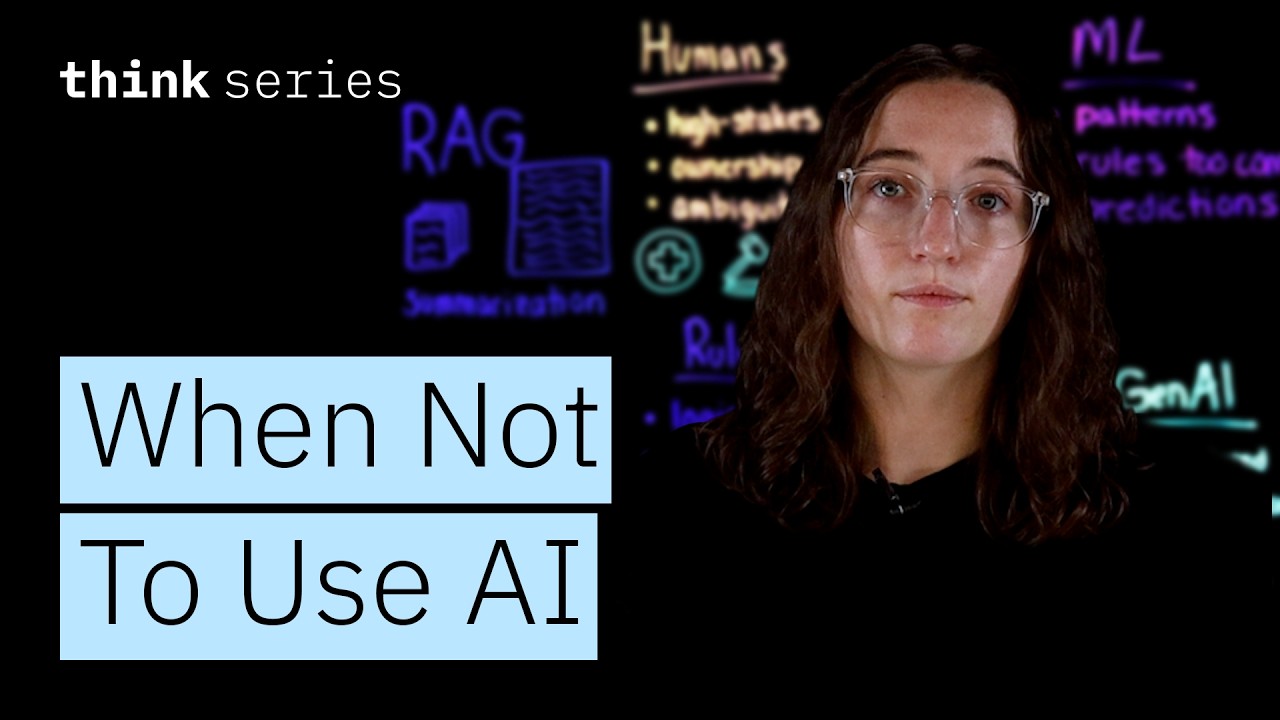
Knowing When Not to Use AI: AI Agents vs Rules vs ML

System design requires disciplined choices regarding intelligence types—Human judgment, Rules/Code, Machine Learning, or Generative AI—rather than defaulting to AI agents for every problem. The choice must balance trade-offs across accuracy, cost, complexity, and risk. Successful modern systems are typically hybrid, combining the determinism of code with the pattern recognition of ML and the flexibility of LLMs.

Key takeaways

  1. Human Judgment 2:00

    Best for high-stakes decisions, ambiguity, ethical considerations, or situations requiring accountability (e.g., medical diagnosis, legal interpretation). Trade-offs include being expensive, slow, and difficult to scale.

  2. Rules/Code-Based Solutions 3:00

    Ideal for tasks requiring clear, stable logic, consistent exact outputs, and zero error tolerance (e.g., payment processing, input validation, security access control). Code is fast, cheap, reliable, and highly interpretable.

  3. Machine Learning (ML) 4:10

    Excels at finding patterns in structured data and making probabilistic predictions when rules are too complex to define manually (e.g., fraud detection, customer churn prediction). Requires monitoring for model drift.

  4. Generative AI (LLMs/Agents) 5:40

    Best used when inputs are unstructured (text, documents) and tasks require reasoning or transformation. Flexibility is prioritized over precision, and some error is tolerated (e.g., summarization, intent understanding). Trade-offs include non-determinism and higher cost at scale.

Watch on YouTube Full article