Knowing When Not to Use AI: AI Agents vs Rules vs ML
Summary
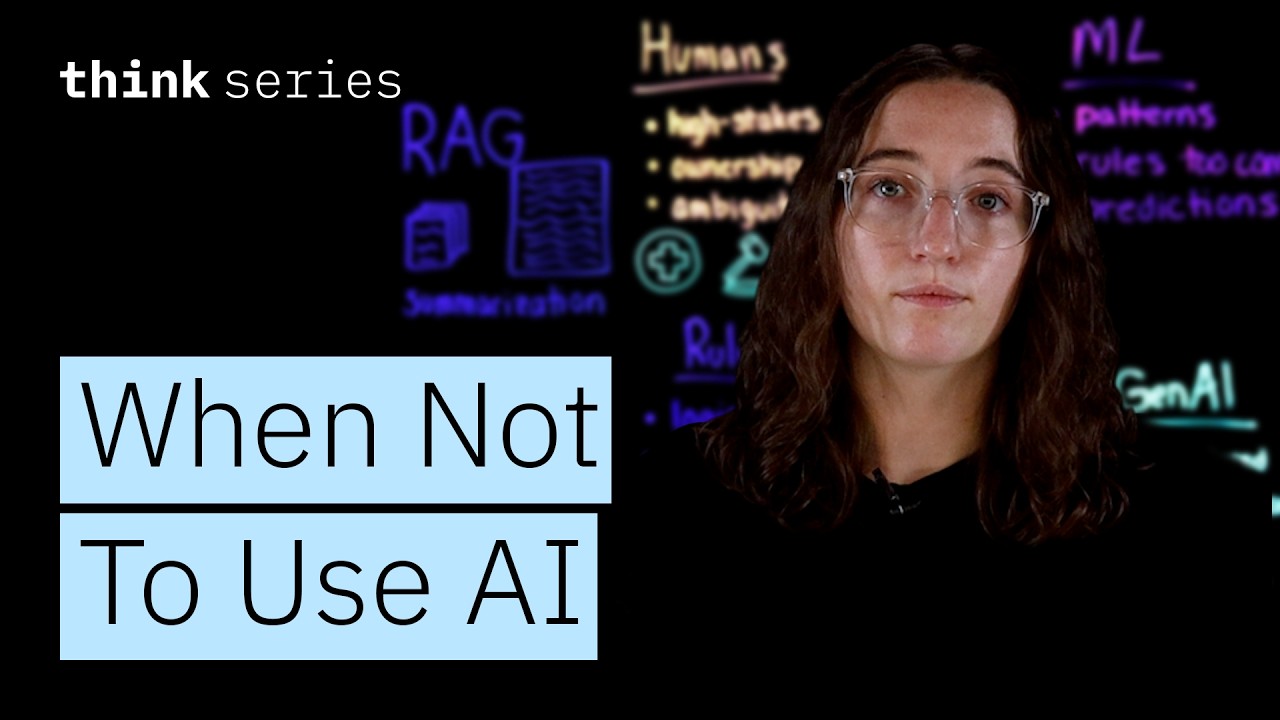
System design requires disciplined choices regarding intelligence types—Human judgment, Rules/Code, Machine Learning, or Generative AI—rather than defaulting to AI agents for every problem. The choice must balance trade-offs across accuracy, cost, complexity, and risk. Successful modern systems are typically hybrid, combining the determinism of code with the pattern recognition of ML and the flexibility of LLMs.
Key takeaways
-
Human Judgment
2:00
Best for high-stakes decisions, ambiguity, ethical considerations, or situations requiring accountability (e.g., medical diagnosis, legal interpretation). Trade-offs include being expensive, slow, and difficult to scale.
-
Rules/Code-Based Solutions
3:00
Ideal for tasks requiring clear, stable logic, consistent exact outputs, and zero error tolerance (e.g., payment processing, input validation, security access control). Code is fast, cheap, reliable, and highly interpretable.
-
Machine Learning (ML)
4:10
Excels at finding patterns in structured data and making probabilistic predictions when rules are too complex to define manually (e.g., fraud detection, customer churn prediction). Requires monitoring for model drift.
-
Generative AI (LLMs/Agents)
5:40
Best used when inputs are unstructured (text, documents) and tasks require reasoning or transformation. Flexibility is prioritized over precision, and some error is tolerated (e.g., summarization, intent understanding). Trade-offs include non-determinism and higher cost at scale.
Technical details
-
Determinism vs. Non-Determinism
400s
Code-based systems provide deterministic, reliable outputs (e.g., checking if a balance is sufficient for payment). Generative AI systems are non-deterministic, meaning correctness cannot be guaranteed across runs and testing difficulty increases.
-
Hybrid System Architecture
480s
The most successful solutions combine these types of intelligence. Example: Using code for transaction calculation (determinism), ML for trend identification, and LLMs to generate a final natural language report.
-
ML Limitations
280s
While good at predicting trends over massive structured data, ML models struggle with tasks requiring deep societal analysis or explaining the 'why' behind the trend (explainability).
Mentioned resources
Channel & topics
Watch on YouTube · Back to latest
This independent, AI-assisted summary is provided for commentary and informational purposes. It may contain errors or omit important context. Please watch the original video for the creator's complete presentation. Video, thumbnail, and related copyrights belong to their respective owners.