60% Faster Time-to-Interview: Transforming Hiring with AI Agents with LangChain
Summary
LinkedIn details the architecture of a hiring agent built with LangChain and LangGraph that successfully cut time-to-interview by 60% for small businesses. The system evolved from static workflows to an advanced agentic control model utilizing a central planner within a plan-execute-replan loop. Key architectural components include specialized memory types (conversational and experiential), middleware hooks for PII detection, and rigorous 'harness engineering' techniques—such as state flag chaining and one-shot tool guards—to ensure the probabilistic nature of LLMs results in a dependable product.
Key takeaways
-
Hiring is an Agent Problem
The hiring process is inherently iterative (plan, act, observe, adapt), requiring continuous adaptation rather than being a one-shot task. This necessitates an agentic approach.
-
Architectural Evolution to LangGraph
0:03
The system progressed from hard-coded static workflows (if/then) to sequential LangChain chains, culminating in LangGraph for its true agentic control model featuring a central planner and plan-execute-replan loop.
-
Choosing LangGraph
0:05
LinkedIn selected LangGraph over 89 evaluated frameworks because it complements existing infrastructure, builds upon core LangChain primitives (runnables, tools), and allowed for zero rewrite adoption.
-
Achieving Determinism via Harness Engineering
0:10
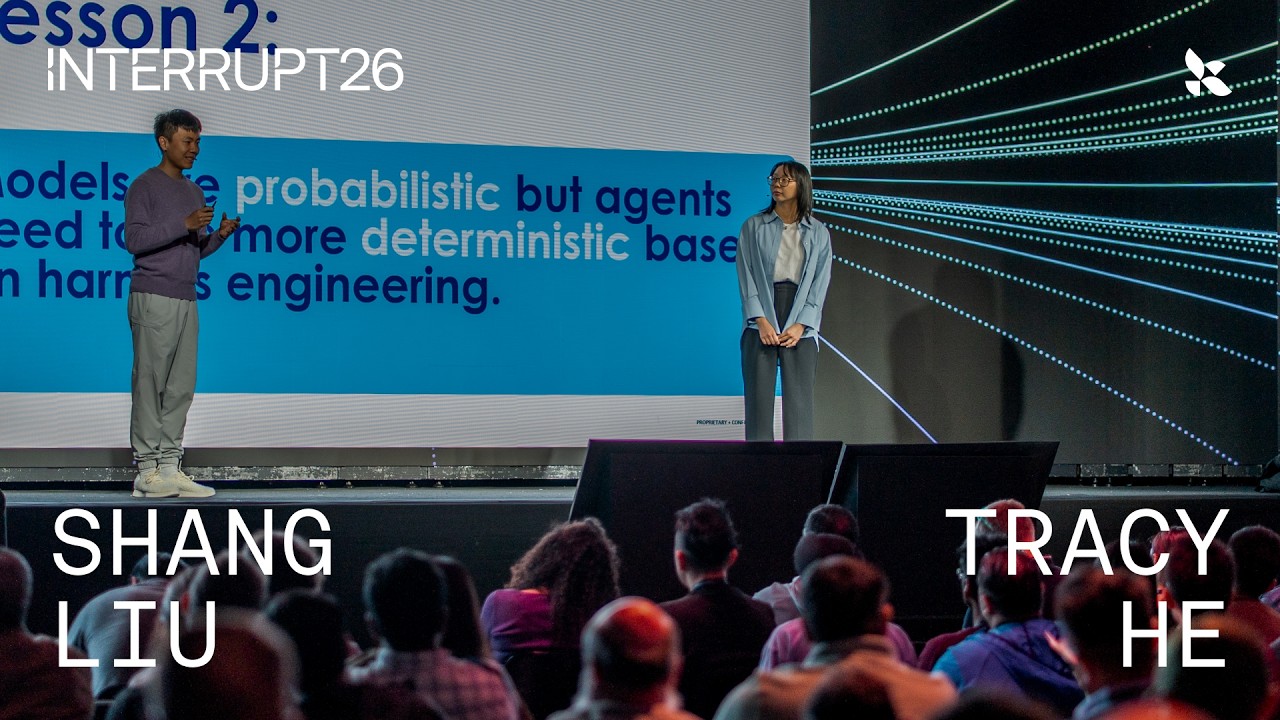
To make the agent dependable, LinkedIn implemented advanced 'harness engineering' techniques, including context management (checkpoint trimming), output format determinism (template confirmation/fallbacks), and node-change determinism (state flag chaining and one-shot tool guards).
Technical details
-
Agent Architecture & Control Flow
4s
The core design uses a single LLM-powered planner responsible for high-level decision-making, operating on a continuous plan-execute-replan pattern. This centralized reasoning ensures coherence across complex, multi-step problem-solving.
-
Memory Persistence
7s
The LinkedIn agent platform utilizes two primary memory types: Conversational Memory (stores chat histories) and Experiential Memory (stores state checkpoints). These are supplemented by specialized applications like episodic and semantic memory.
-
Observability and Debugging
10s
LangSmith is deeply integrated for troubleshooting, providing a powerful trace ID and root cause output. Agent evaluation involves capturing the full trace (context retrieval, tool calls, decision steps) and using an LLM-as-judge process.
-
Human-in-the-Loop Design
11s
Instead of relying on LangGraph's interrupt primitive (which was unsuitable for their use case), they built a context-driven human-in-the-loop system that runs the graph end-to-end, persisting only minimum cross-turn context to maintain stateless scalability.
-
Determinism Mechanisms
10s
To ensure predictable agent behavior, they implemented: Context Management (checkpoint trimming, conflict handling), Output Format Determinism (template confirmation/fallbacks), and Node-Change Determinism (state flag chaining and one-shot tool guards).
Mentioned resources
- LangChain
- LangGraph
- LangSmith
Channel & topics
Watch on YouTube · Back to latest
This independent, AI-assisted summary is provided for commentary and informational purposes. It may contain errors or omit important context. Please watch the original video for the creator's complete presentation. Video, thumbnail, and related copyrights belong to their respective owners.