Topic

LLM Observability

All digests tagged LLM Observability

Voice Agent observability with LangSmith 🌟 thumbnail

· 0:55

Voice Agent observability with LangSmith 🌟

This session demonstrates how to achieve deep observability for voice agents using LangSmith when integrating Google's Gemini Live model and the Google ADK. Since Gemini Live is a native speech-to-speech model that bypasses text transcription to maintain low latency, robust tracing is critical. The process involves setting up tools (like a weather assistant), recording both user and agent audio, and utilizing LangSmith to view comprehensive traces that include transcripts, tool calls, interruption events, full cost breakdowns, and even audio playback for debugging.

Key takeaways

  1. Gemini Live's Low-Latency Advantage

    Gemini Live is Google's native speech-to-speech model; it takes audio directly as input and produces audio output without transcribing to text, which keeps latency low and ensures a natural voice experience.

  2. Comprehensive Voice Agent Tracing

    LangSmith provides visibility into the agent's internal workings, capturing not only standard transcripts and tool calls but also specific events like interruptions and detailed token-level cost breakdowns.

  3. Production Readiness Tools

    The observability provided by LangSmith allows engineers to perform standard LLM operations—such as running evals, adding traces to data sets, building dashboards, and debugging—on complex voice agent interactions.
Watch on YouTube Full article

60% Faster Time-to-Interview: Transforming Hiring with AI Agents with LangChain thumbnail

· 18:05

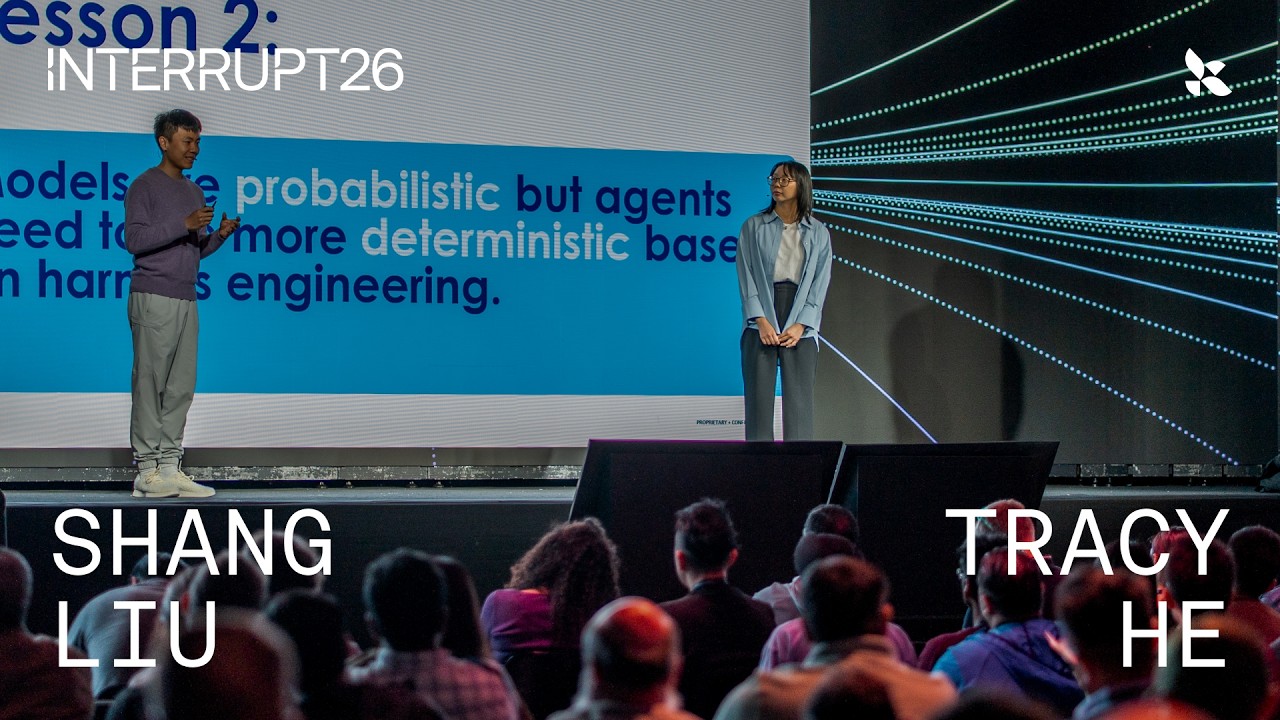
60% Faster Time-to-Interview: Transforming Hiring with AI Agents with LangChain

LinkedIn details the architecture of a hiring agent built with LangChain and LangGraph that successfully cut time-to-interview by 60% for small businesses. The system evolved from static workflows to an advanced agentic control model utilizing a central planner within a plan-execute-replan loop. Key architectural components include specialized memory types (conversational and experiential), middleware hooks for PII detection, and rigorous 'harness engineering' techniques—such as state flag chaining and one-shot tool guards—to ensure the probabilistic nature of LLMs results in a dependable product.

Key takeaways

  1. Hiring is an Agent Problem

    The hiring process is inherently iterative (plan, act, observe, adapt), requiring continuous adaptation rather than being a one-shot task. This necessitates an agentic approach.

  2. Architectural Evolution to LangGraph 0:03

    The system progressed from hard-coded static workflows (if/then) to sequential LangChain chains, culminating in LangGraph for its true agentic control model featuring a central planner and plan-execute-replan loop.

  3. Choosing LangGraph 0:05

    LinkedIn selected LangGraph over 89 evaluated frameworks because it complements existing infrastructure, builds upon core LangChain primitives (runnables, tools), and allowed for zero rewrite adoption.

  4. Achieving Determinism via Harness Engineering 0:10

    To make the agent dependable, LinkedIn implemented advanced 'harness engineering' techniques, including context management (checkpoint trimming), output format determinism (template confirmation/fallbacks), and node-change determinism (state flag chaining and one-shot tool guards).

Watch on YouTube Full article