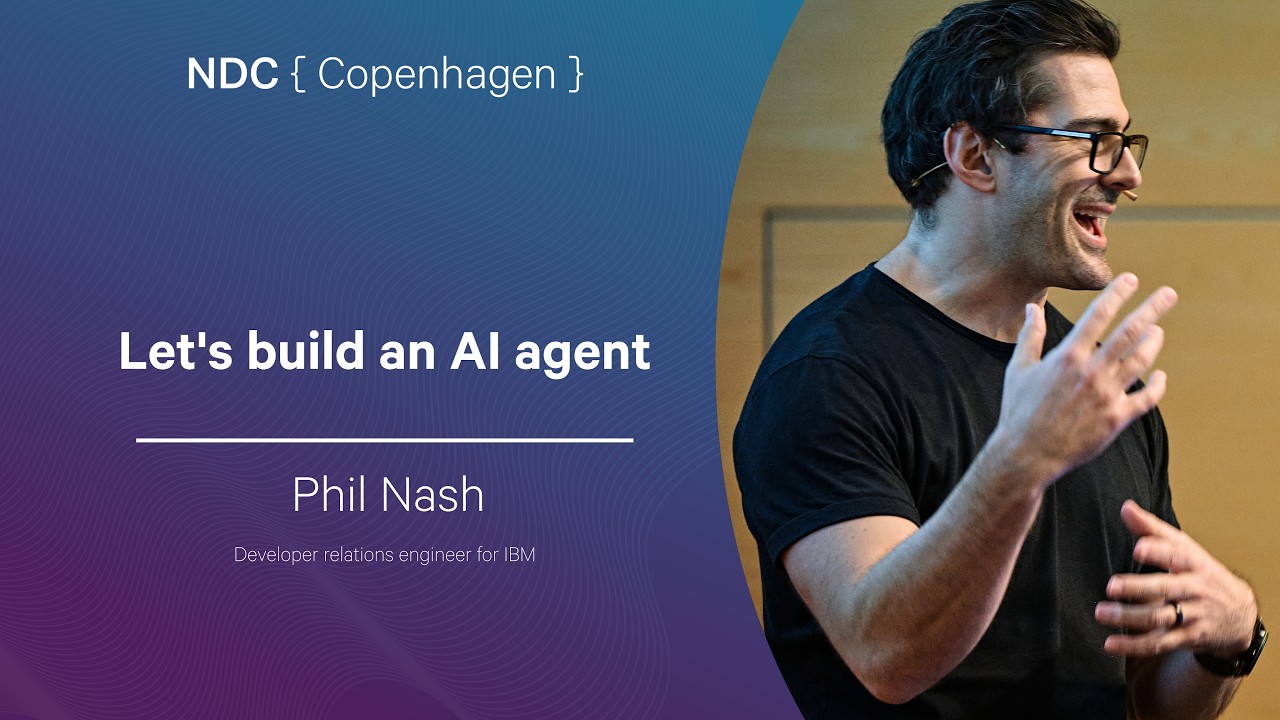
Let's build an AI agent - Phil Nash - NDC Copenhagen 2026
This talk demystifies AI agents by building one from scratch, demonstrating how Large Language Models (LLMs), tools, and memory work together in a continuous loop to achieve goals. The core mechanism involves an agent runtime that orchestrates function calls—allowing the LLM to interact with external systems like file systems or calculators. Advanced concepts covered include the Model Context Protocol (MCP) for standardized tool interaction and 'Skills' for progressive disclosure of capabilities, enabling agents to perform complex tasks like self-refactoring.
Key takeaways
-
Agent Architecture
17:03
An agent fundamentally runs tools in a loop to achieve a goal. This process requires an LLM, external tools (functions), and an orchestration layer (the 'harness') that manages the interaction.
-
The Agent Loop
28:10
The core agent functionality is implemented in a loop: The model generates function calls $\rightarrow$ The harness executes those functions (awaiting results) $ ightarrow$ The results are fed back to the model for the next step, continuing until the goal is met.
-
Standardization via MCP
36:00
The Model Context Protocol (MCP) provides a standardized way for agents to interact with services. It separates concerns into Server components (tools, resources, prompts) and Client components.
-
Progressive Disclosure with Skills
40:05
Skills allow for progressive disclosure of capabilities. Instead of loading all tool declarations at once, the agent only loads a skill's header initially and can request more details (resources, scripts) as needed.