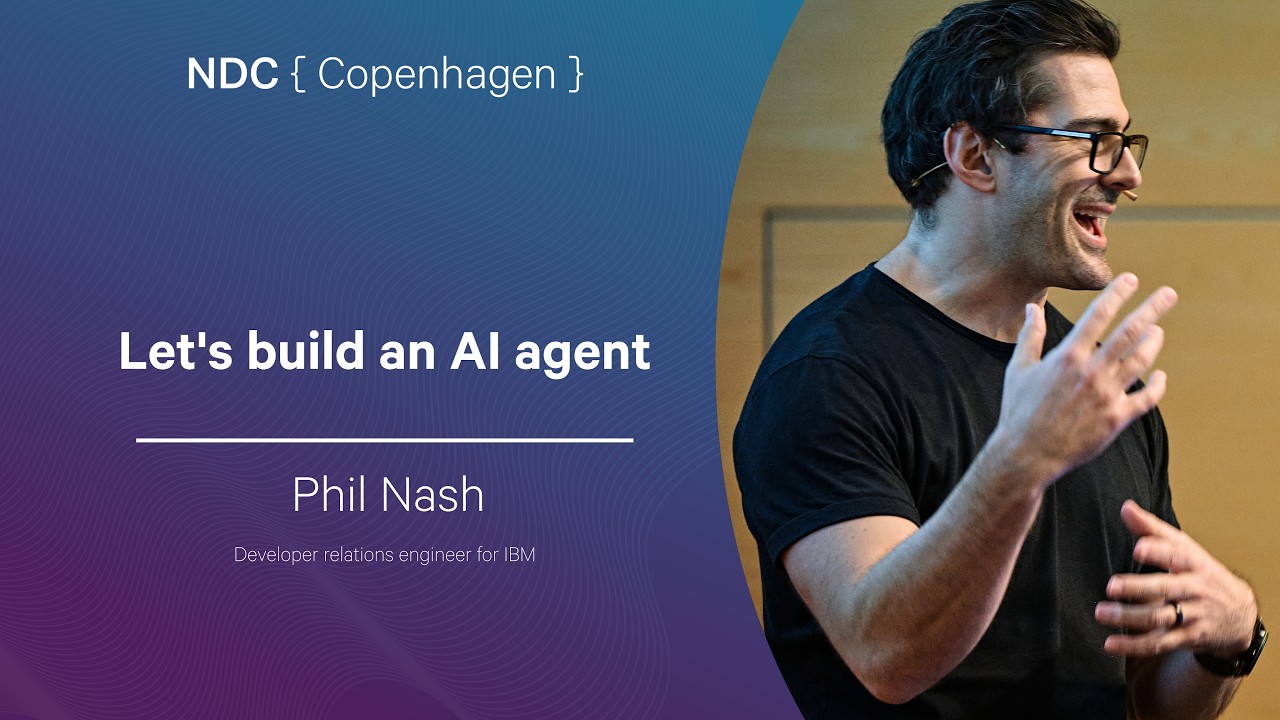
Let's build an AI agent - Phil Nash - NDC Copenhagen 2026
Summary
This talk demystifies AI agents by building one from scratch, demonstrating how Large Language Models (LLMs), tools, and memory work together in a continuous loop to achieve goals. The core mechanism involves an agent runtime that orchestrates function calls—allowing the LLM to interact with external systems like file systems or calculators. Advanced concepts covered include the Model Context Protocol (MCP) for standardized tool interaction and 'Skills' for progressive disclosure of capabilities, enabling agents to perform complex tasks like self-refactoring.
Key takeaways
-
Agent Architecture
17:03
An agent fundamentally runs tools in a loop to achieve a goal. This process requires an LLM, external tools (functions), and an orchestration layer (the 'harness') that manages the interaction.
-
The Agent Loop
28:10
The core agent functionality is implemented in a loop: The model generates function calls $\rightarrow$ The harness executes those functions (awaiting results) $ ightarrow$ The results are fed back to the model for the next step, continuing until the goal is met.
-
Standardization via MCP
36:00
The Model Context Protocol (MCP) provides a standardized way for agents to interact with services. It separates concerns into Server components (tools, resources, prompts) and Client components.
-
Progressive Disclosure with Skills
40:05
Skills allow for progressive disclosure of capabilities. Instead of loading all tool declarations at once, the agent only loads a skill's header initially and can request more details (resources, scripts) as needed.
Technical details
-
Agent Components
1023s
An agent requires an LLM, tools/functions to impact the external world, and a harness (orchestration code) that manages memory and runs the tool loop. The process is fundamentally about running functions based on model output.
-
Basic Agent Implementation
1250s
The initial basic agent uses a service like Gemini 3 Flash preview and relies on system instructions to guide behavior. Memory is added by passing the entire history of messages (chat context) back into the model prompt.
-
Tool Use/Function Calling
1750s
Tools are defined by providing a name, description, and JSON schema for parameters. When an agent uses a tool (e.g., `add(a, b)`), the model returns function calls, which must be intercepted and executed by the harness before results are fed back to the model.
-
MCP Implementation
2160s
The MCP client connects to an MCP server (e.g., a file system or calculator) via transports like Standard IO or streamable HTTP. The client translates the tool declarations from the server into the format required by the LLM.
Mentioned resources
- OpenRAG
- Dockling
- Gemini 3 Flash preview
- Langflow
Channel & topics
Watch on YouTube · Back to latest
This independent, AI-assisted summary is provided for commentary and informational purposes. It may contain errors or omit important context. Please watch the original video for the creator's complete presentation. Video, thumbnail, and related copyrights belong to their respective owners.