Topic

DevOps Automation

All digests tagged DevOps Automation

· 13:42

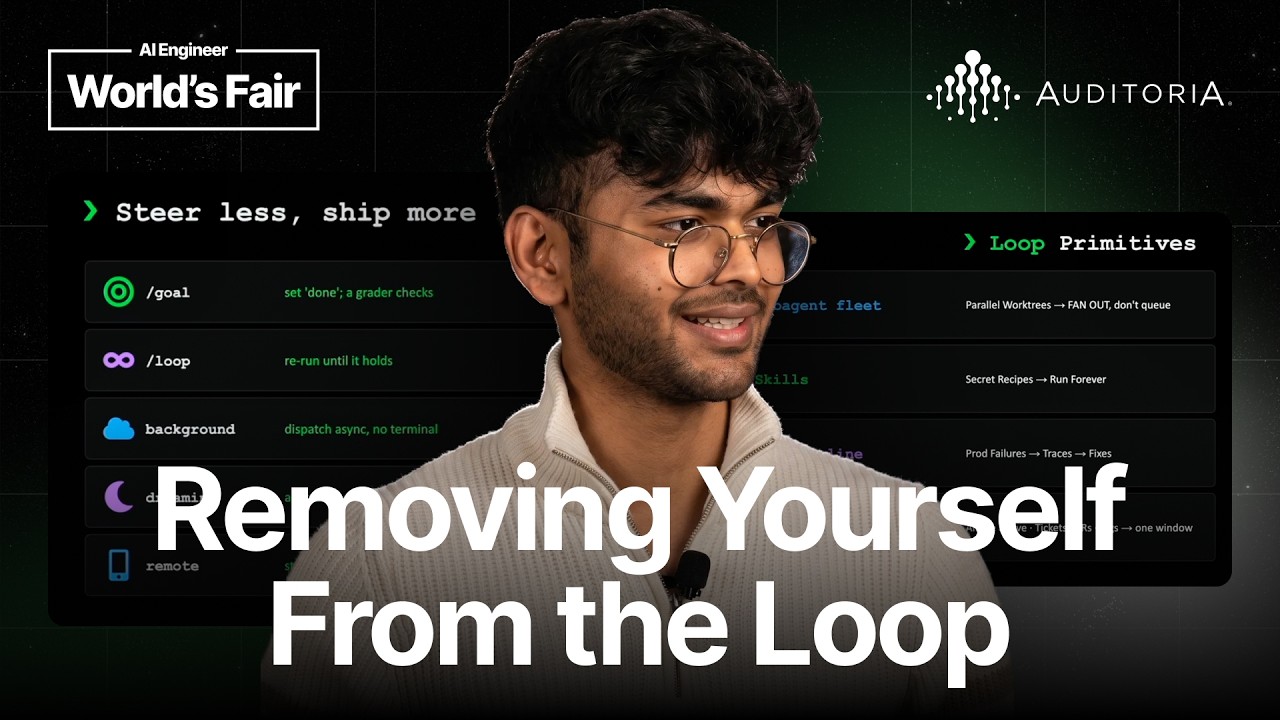
Your Finance Agent's Bottleneck Is You — Ramana Siddanth Emani, Auditoria AI

The primary bottleneck in developing production AI agents, especially for regulated fields like finance, is not model capability or hardware, but the developer's manual workflow. The talk outlines how advanced agent harnesses can automate and multiply human output by implementing primitives such as sub-agents, skills, goals, and loops. By orchestrating these agents across parallel worktrees (e.g., handling multiple Jira tickets simultaneously), developers can drastically reduce time spent on repetitive tasks like testing, building, and deployment, shifting the human role from executor to final verifier.

Key takeaways

  1. The Developer Loop is the Bottleneck

    Shipping production agents fails due to developer velocity limitations. The solution lies in automating the internal developer loop rather than waiting for model or hardware upgrades (0:00, 2:37).

  2. Parallel Task Execution via Sub-Agents 7:02

    Sub-agents allow for parallel processing using isolated 'worktrees'—virtual folders where agents write and execute code independently. This enables handling multiple tasks (e.g., QA bug tickets) simultaneously, far exceeding human capacity (4:22).

  3. Minimal UX for Orchestration 8:38

    Effective agent use requires minimal User Experience (UX), consolidating all project dashboards, logs, Jira tickets, and GitHub PRs into a single pane of glass widget to reduce context switching and manual orchestration effort (5:18).

  4. Achieving Autonomy with Goals and Dreaming

    Future agent development involves combining 'goals' (setting a desired outcome) with automated loops. Furthermore, allowing agents to 'dream' by collecting customer usage patterns can drive self-improvement and feature upgrades autonomously (11:35).
Watch on YouTube Full article

· 21:21

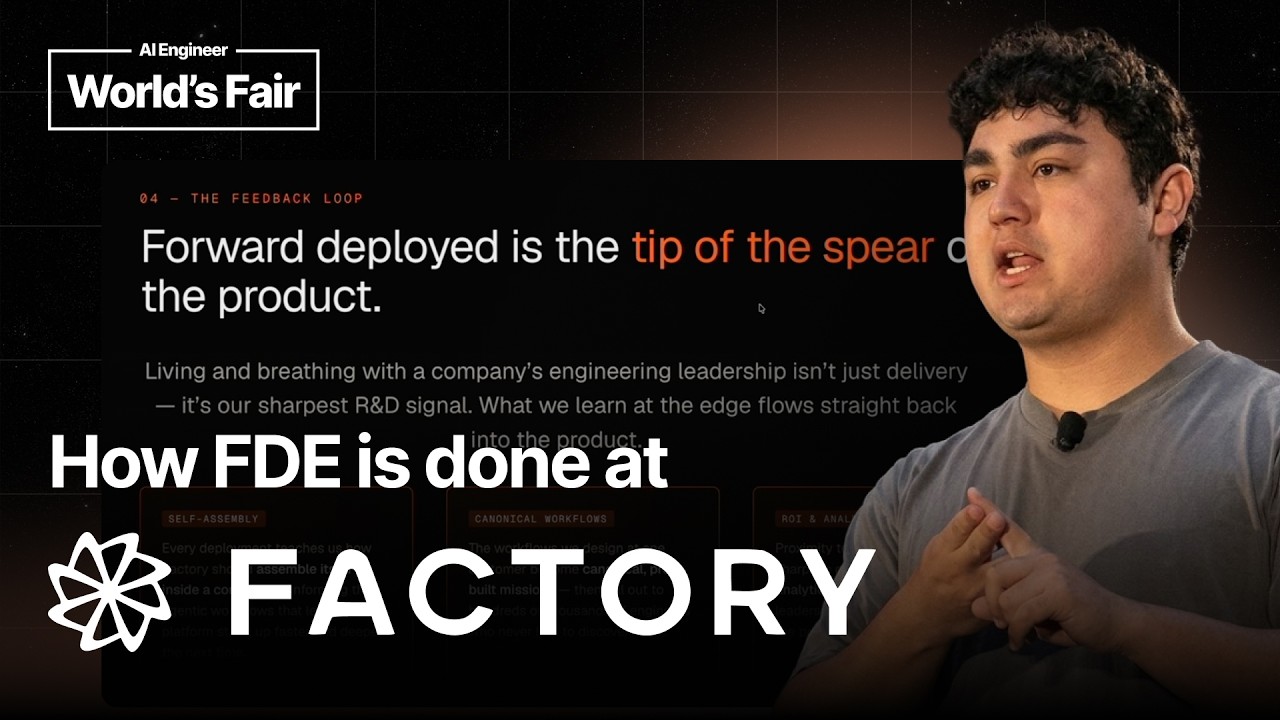
How Forward Deployed Engineering is done at Factory — Eno Reyes

Forward Deployed Engineering (FDE) is evolving from traditional professional services consulting into a strategic function where engineers act as 'the tip of the spear' for product development. The core goal is to build an autonomous 'Software Factory' within a customer's environment. This factory automates the entire signal-to-deploy pipeline—from capturing external signals (e.g., bug reports, Slack conversations) through planning, coding, and rigorous validation (SAST, linters, type checkers)—with minimal human intervention. Success hinges on achieving 'agent readiness,' which measures the density of deterministic validation loops in a codebase, enabling massive migrations (e.g., 30-50 million lines of code) autonomously.

Key takeaways

  1. The Shift from Consulting to Product Strategy

    Factory argues that FDE should not be professional services work on behalf of a customer, but rather the stream of information gathered from critical customers. This data is fed back into the product to rapidly improve it, making the deployed engineer an integral part of the product's evolution.

  2. The Software Factory Pipeline 8:23

    This factory concept describes a continuous process where external signals flow in, are prioritized into plans, converted into code changes (the source of truth), pass through automated validation stages (linters, type checkers, SAST tools), and finally deploy. The goal is an uninterrupted signal-to-deploy flow without human intervention.

  3. Data Ownership and Autonomy 10:57

    To ensure scalability and security, the deployed engineer must utilize a model independent agent harness (like Droid) that guarantees the customer owns all traces and data. This allows for highly secure deployments, including air-gapping in sensitive environments like finance or healthcare.

  4. Agent Readiness as a Metric 20:05

    Autonomy is measured by 'agent readiness,' which quantifies the number of deterministic validation loops (e.g., passing linters, type checkers) present in a codebase. A high volume of these loops allows advanced agents to operate on complex tasks for extended periods without human intervention.

Watch on YouTube Full article

· 58:39

Inside the Dark Factory: AI That Ships Code Solo

The video details Tessl's 'Dark Factory,' an autonomous system that handles a significant portion of their code shipping (65-70% of PRs). This factory uses AI agents and sophisticated verification layers to process tickets from inception (Linear) through to merge. The core architectural shift involves moving engineering focus from writing code to designing robust, automated workflows, emphasizing context management and layered verification to build trust in autonomous systems.

Key takeaways

  1. High Automation Rate 2:24

    Tessl routes 65-70% of its PRs through the Dark Factory. Historically, up to 95% of their codebase has never been reviewed by a human.

  2. Shift in Engineering Focus 17:12

    The role of the engineer shifts from implementing tickets to designing complex workflows, scoping tasks for agents, and encoding organizational 'taste' into verification layers (e.g., whiteboarding conversations).

  3. Trust is Earned, Not Enabled 31:00

    Building trust in the Dark Factory requires continuous effort, including running into failure modes and improving verification layers. Accountability remains with the person who filed the original ticket.

  4. Verification Layers are Key 22:22

    The most critical component is not the coding agent itself, but the layered verification system (Verifiers) that allow engineers to encode fuzzy principles (e.g., 'library should be the single source of truth') into deterministic checks.

Watch on YouTube Full article

· 31:25

Robert Overweg - One Brain, No Filtering - AI Native DevCon June 2026

The presentation details a 'One Brain' concept—a centralized, AI-native knowledge management layer designed to eliminate information silos and improve decision-making by weaving together research, client context, and operational data. The system uses an orchestrator (OpenClaw) and structured vaults to allow agents to access and synthesize organizational knowledge in real time, shifting focus from manual file retrieval to idea generation and proactive insights.

Key takeaways

  1. Shift from File Search to Idea Synthesis 5:40

    The core value lies in moving beyond searching for specific files; the system allows users to search for 'ideas' or 'contacts.' Agents can interpret natural language queries (e.g., asking about CI/CD steps) and provide contextually accurate answers based on stored knowledge.

  2. Structured Knowledge Flow 7:10

    Knowledge is categorized into 'company knowledge' (new developments, research wikis) and the 'creation pipeline.' Information must be promoted to a central vault from various sources (e.g., Obsidian notes, meeting transcripts) to gain grounding in reality before being shared widely.

  3. Scaling and Security Challenges 17:32

    While the system is powerful, scaling remains a challenge, particularly regarding data segregation (permissions) across different client or team buckets. The local setup on one person's laptop was initially used for testing, but enterprise rollout requires careful consideration of security boundaries.

Watch on YouTube Full article

· 31:16

May Walter - From Blind Spots to Merged PRs: Runtime Intelligence for Continuous Agentic Performance

The talk details implementing a runtime intelligence layer for coding agents to enable continuous performance optimization in mature codebases. The approach moves beyond reactive bug fixing by running sensors in production to capture deep forensic context (e.g., function execution frequency, failure modes). This allows agents to proactively surface high-ROI fixes—such as N+1 queries or missing database indexes—scored by complexity and impact, enabling tech leads to prioritize improvements before sprint planning.

Key takeaways

  1. Automating the Investigation Phase 17:52

    Instead of waiting for performance degradation to become a crisis (a 'leaky bucket' problem), the goal is to automate the investigation phase. This allows teams to identify potential optimizations and their estimated impact/cost without dedicating unpredictable engineering time.

  2. Prioritizing Impact over Task Completion 25:30

    The focus shifts from merely generating pull requests (PRs) to identifying the highest impact, lowest risk changes. The system must provide human-readable context that justifies attention, preventing 'PR fatigue' from agents.

  3. Defining Business Context 22:00

    Effective agentic workflows require more than just code analysis; they need business context. The system must map production activity (endpoints, event consumers) to function-level context to understand the true impact of a potential fix.

Watch on YouTube Full article