Topic

Finance Technology

All digests tagged Finance Technology

· 13:42

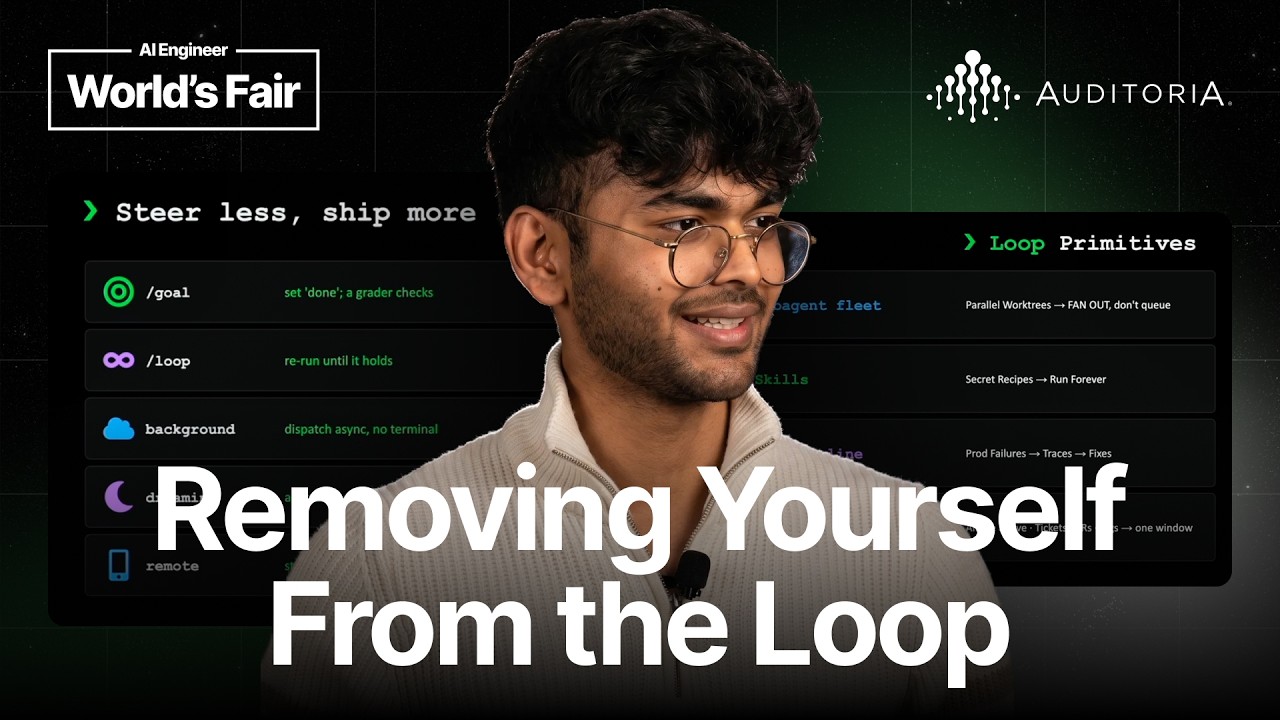
Your Finance Agent's Bottleneck Is You — Ramana Siddanth Emani, Auditoria AI

The primary bottleneck in developing production AI agents, especially for regulated fields like finance, is not model capability or hardware, but the developer's manual workflow. The talk outlines how advanced agent harnesses can automate and multiply human output by implementing primitives such as sub-agents, skills, goals, and loops. By orchestrating these agents across parallel worktrees (e.g., handling multiple Jira tickets simultaneously), developers can drastically reduce time spent on repetitive tasks like testing, building, and deployment, shifting the human role from executor to final verifier.

Key takeaways

  1. The Developer Loop is the Bottleneck

    Shipping production agents fails due to developer velocity limitations. The solution lies in automating the internal developer loop rather than waiting for model or hardware upgrades (0:00, 2:37).

  2. Parallel Task Execution via Sub-Agents 7:02

    Sub-agents allow for parallel processing using isolated 'worktrees'—virtual folders where agents write and execute code independently. This enables handling multiple tasks (e.g., QA bug tickets) simultaneously, far exceeding human capacity (4:22).

  3. Minimal UX for Orchestration 8:38

    Effective agent use requires minimal User Experience (UX), consolidating all project dashboards, logs, Jira tickets, and GitHub PRs into a single pane of glass widget to reduce context switching and manual orchestration effort (5:18).

  4. Achieving Autonomy with Goals and Dreaming

    Future agent development involves combining 'goals' (setting a desired outcome) with automated loops. Furthermore, allowing agents to 'dream' by collecting customer usage patterns can drive self-improvement and feature upgrades autonomously (11:35).

Watch on YouTube Full article

· 19:50

Why Off-the-Shelf AI Doesn't Understand Money — Udi Menkes, Intuit

Off-the-shelf Large Language Models (LLMs) often provide fluent but inaccurate financial advice—a phenomenon termed the 'fluent bluff'—because they lack real-world experience. The core argument is that mere context is not sufficient; true intelligence requires grounding in verifiable business outcomes. To solve this, Intuit builds systems that transform raw business data (e.g., General Ledger, P&L) into millions of State-Action-Outcome records. These structured datasets are used to train models that predict the actual impact of actions, leading to 'outcome-driven finance' and outperforming frontier LLMs in real-world decision-making.

Key takeaways

  1. The Fluent Bluff: Why Off-the-Shelf Models Fail at Money 4:08

    LLMs trained on general internet data (blogs, books) can give confident advice that is fundamentally wrong for specific business constraints. Examples include recommending a negative cash flow business acquire another property or raising prices when it risks losing all revenue.

  2. The Solution: Grounding in State-Action-Outcome Data

    Instead of relying on general knowledge, the system must be grounded by creating structured records detailing what a company *did* (Action) given its current financial status (State), and what the verifiable result was (Outcome). This moves advice from theoretical possibility to proven reality.

  3. Measuring Impact: Beyond Simple Difference 15:45

    Determining the true impact of an action requires advanced statistical methods like Conditional Average Treatment Error (CATE) to account for confounding variables, such as a company's natural propensity for success. Failing to do this leads to inaccurate conclusions about causality.

Watch on YouTube Full article