Topic

AI

All digests tagged AI

· 19:50

Why Off-the-Shelf AI Doesn't Understand Money — Udi Menkes, Intuit

Off-the-shelf Large Language Models (LLMs) often provide fluent but inaccurate financial advice—a phenomenon termed the 'fluent bluff'—because they lack real-world experience. The core argument is that mere context is not sufficient; true intelligence requires grounding in verifiable business outcomes. To solve this, Intuit builds systems that transform raw business data (e.g., General Ledger, P&L) into millions of State-Action-Outcome records. These structured datasets are used to train models that predict the actual impact of actions, leading to 'outcome-driven finance' and outperforming frontier LLMs in real-world decision-making.

Key takeaways

  1. The Fluent Bluff: Why Off-the-Shelf Models Fail at Money 4:08

    LLMs trained on general internet data (blogs, books) can give confident advice that is fundamentally wrong for specific business constraints. Examples include recommending a negative cash flow business acquire another property or raising prices when it risks losing all revenue.

  2. The Solution: Grounding in State-Action-Outcome Data

    Instead of relying on general knowledge, the system must be grounded by creating structured records detailing what a company *did* (Action) given its current financial status (State), and what the verifiable result was (Outcome). This moves advice from theoretical possibility to proven reality.

  3. Measuring Impact: Beyond Simple Difference 15:45

    Determining the true impact of an action requires advanced statistical methods like Conditional Average Treatment Error (CATE) to account for confounding variables, such as a company's natural propensity for success. Failing to do this leads to inaccurate conclusions about causality.
Watch on YouTube Full article

· 20:07

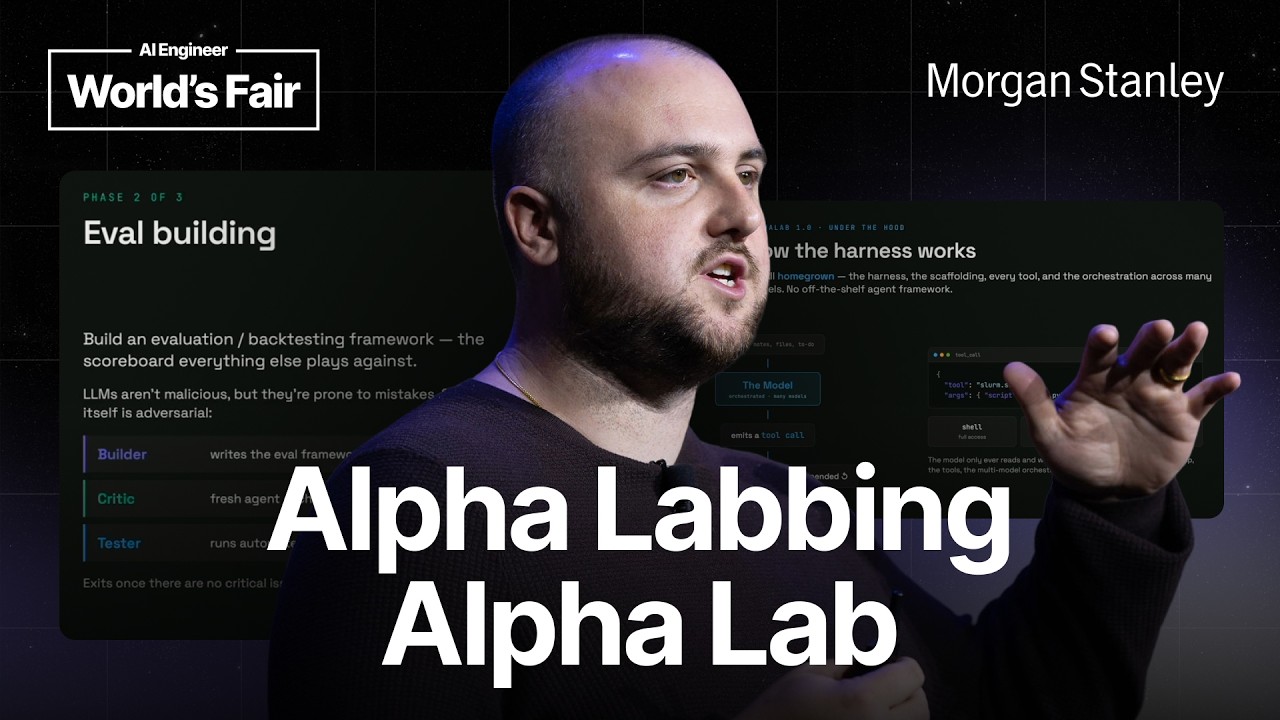
Morgan Stanley's ALPHALAB: Multi-Agent Research Across Optimization Domains — Brendan Rappazzo

Morgan Stanley's AlphaLab is a multi-agent research system designed to automate quantitative finance research by managing the entire experimental lifecycle. Unlike simple code generation, AlphaLab accepts a problem in plain language and autonomously handles hypothesis formation, backtesting setup, cluster job submission (using tools like Slurm), statistical testing, and iterative refinement. The core innovation lies in its focus on building proprietary, verifiable evaluation environments—treating them as critical data inputs—allowing the system to self-improve and encode deep enterprise knowledge.

Key takeaways

  1. Full Research Automation Cycle

    AlphaLab operates in three phases: 1) Research (building context/hypotheses), 2) Evaluation Building (creating robust backtests, involving multiple critic agents to prevent forward leakage), and 3) Mass Experimentation. This allows the system to move from a natural language goal to a suite of trained models.

  2. Architecture: Strategist and Workers 15:36

    The process is managed via a Kanban/Jira-like board. A 'Strategist' agent proposes experiments, which are then assigned to 'Worker' agents responsible for writing code, configuring Slurm jobs (e.g., requiring 4 H100s), submitting the job, and performing postmortem analysis.

  3. The Value of Verifiable Environments

    The system's robustness hinges on building custom evaluation environments (evals) that mimic a private Kaggle competition. This strict format, which includes held-out validation sets, is crucial for measuring performance and encoding proprietary enterprise knowledge.

  4. Self-Improving Meta-Harness

    The ultimate goal (AlphaLab 2.0) is a self-improving system where the LLM performs meta-optimization, analyzing results and improving the harness itself, rather than just executing tasks within it.

Watch on YouTube Full article

· 1:56:13

Poolside’s Model Factory, Laguna S, Open Models, and the Race to AGI — Eiso Kant, Poolside AI

The discussion centers on the engineering systems required for achieving AGI, arguing that model building is fundamentally a process of infrastructure and data management rather than pure intelligence. Poolside details its 'Model Factory,' an end-to-end system enabling rapid iteration (from six months to eight weeks) by treating model development as an industrialized process. Key technical advancements include streaming data directly into training, ensuring perfect reproducibility via immutable data layers, and leveraging agentic systems that write code and manage jobs. The consensus emphasizes that future progress relies on improving compute efficiency through low-precision methods (e.g., FP8) and focusing on behavioral traits like persistence and reasoning over sheer model size.

Key takeaways

  1. Model Building is 90% Engineering 20:30

    The core challenge in foundation model development lies in building robust, scalable infrastructure. The Model Factory manages the entire lifecycle—from raw data ingestion and filtering to large-scale distributed training and post-training refinement.

  2. The Importance of Reproducibility 26:40

    Achieving scientific rigor requires treating data as an immutable layer, versioning code, and ensuring perfect reproducibility. This allows researchers to track and trace every experiment down to the single token.

  3. Shift from Tool Calls to Code Writing 29:10

    The industry is moving beyond simple tool calls (e.g., stuffing 50 tools in a system prompt) toward models writing complex, conditional code scripts that interact with an internal virtual machine environment.

  4. Focus on Behavior and Efficiency 1:00:00

    The gains seen in smaller models (like Laguna S) come less from raw intelligence and more from improved behaviors, such as persistence, verification, and backtracking. This suggests that the peak performance for knowledge work may be at much lower parameter counts than previously assumed.

Watch on YouTube Full article

· 15:13

HTML Is All Agents Need — James Russo, HeyGen

The presentation argues that HTML, CSS, and JavaScript are the native languages of Large Language Models (LLMs), making them the ideal foundation for agent-generated video content. The speaker introduces Hyperframes, an open-source framework designed to turn agents' generated HTML into deterministic MP4 videos. Key technical challenges addressed include overcoming browser asynchronous rendering issues by freezing time and seeking frame-by-frame, ensuring that complex elements like WebGL and SVGs are consistently rendered in the final video output.

Key takeaways

  1. HTML as LLM Native Language 3:33

    LLMs' training data is predominantly HTML, CSS, and JavaScript. Forcing them to use custom DSLs or JSON structures hinders performance compared to letting them operate in their native language.

  2. Hyperframes Framework 9:30

    This open-source framework converts an agent's generated HTML into a video format, allowing anything renderable in a browser (e.g., 3.js, SVGs) to be included in the final MP4 output.

  3. Deterministic Video Rendering 10:20

    Since browsers are designed to load asynchronously (great for web performance but bad for video consistency), Hyperframes solves this by freezing the clock and deterministically seeking frame-by-frame to ensure all assets are loaded before capturing each frame.

  4. Focus on Taste, Not Language 13:05

    Instead of teaching agents a new framework language, the focus is placed on 'skills' that teach good video principles (taste), allowing for higher quality output from single-shot prompts.

Watch on YouTube Full article

· 58:54

Building an AI-Powered Personal Companion Mobile App - Gerald Versluis - NDC Copenhagen 2026

The talk demonstrates how to integrate advanced AI functionalities into cross-platform mobile applications using .NET MAUI. The session emphasizes building robust, context-aware companion apps by leveraging abstraction layers and standardized APIs (like the Essentials API). Key architectural patterns include supporting multimodal input (voice, image), utilizing cloud services like Azure AI Foundry for LLMs, and implementing local model support via Onyx for sensitive data scenarios.

Key takeaways

  1. AI Integration is Cross-Platform 17:22

    The implementation of AI features can be abstracted across platforms (iOS, Android, Windows) using .NET MAUI's abstraction layer, ensuring a consistent user experience while allowing platform-specific native behavior.

  2. Context Awareness and Memory 23:50

    AI applications can be significantly enhanced by incorporating context from various sources—including location (geolocation), calendar data, biometrics, and conversation history (memory)—to provide highly personalized user experiences.

  3. Multimodal Input Handling 30:05

    The system supports multiple input types beyond text, including voice recording and image analysis. This requires transforming raw data (audio/image) into a format consumable by Large Language Models (LLMs), such as using speech-to-text transcription.

  4. Model Agnosticism via Interfaces 40:05

    By relying on interfaces (e.g., `I ChatClient`), developers can easily swap out concrete AI implementations—such as those from Microsoft Foundry, OpenAI, or local models like Apple Intelligence/Onyx—without changing core application logic.

Watch on YouTube Full article

· 1:48:40

🔬 "The Most Innovative Diffusion Research Is Happening in Drug Discovery, Not Image Generation"

The video discusses the shift of advanced AI research from image generation into complex biological domains, specifically drug discovery and protein-ligand interaction modeling. Genesis Molecular AI introduces PEARL, a foundation model that uses diffusion techniques to predict how proteins flex to accommodate ligands (induced fit). The discussion highlights that modern drug design requires multi-parameter prediction (ADMET) and sophisticated agentic systems (SAPPHIRE) capable of reasoning like a chemist, moving far beyond simple structural predictions. Achieving high accuracy (sub-Angstrom resolution) is crucial for these models to be useful in physical chemistry workflows.

Key takeaways

  1. Diffusion Models in 3D Structure Prediction 1:42

    Diffusion techniques are proving to be a highly effective primitive for 3D structure prediction, particularly in modeling protein-ligand complexes. This represents a major advancement over previous methods like GANs and is central to Genesis's PEARL model.

  2. PEARL Model Capabilities 9:30

    The PEARL model predicts not only where a ligand binds but also models the conformational flexibility of the protein itself (induced fit). It demonstrated strong zero-shot performance on the OpenBind benchmark against notoriously difficult targets.

  3. Agentic Drug Discovery Systems 10:10

    Genesis's SAPPHIRE system represents an agentic approach to drug discovery. This AI agent is designed to mimic a chemist by reasoning about poses, forming hypotheses, reading literature, and proposing the next round of candidates.

  4. The Need for High Resolution 10:40

    Traditional benchmarks like 2Å RMSD are considered insufficient because they lack the resolution needed to discern critical details (e.g., aromatic ring flips) required for accurate physical chemistry predictions, necessitating a focus on sub-Angstrom accuracy.

Watch on YouTube Full article