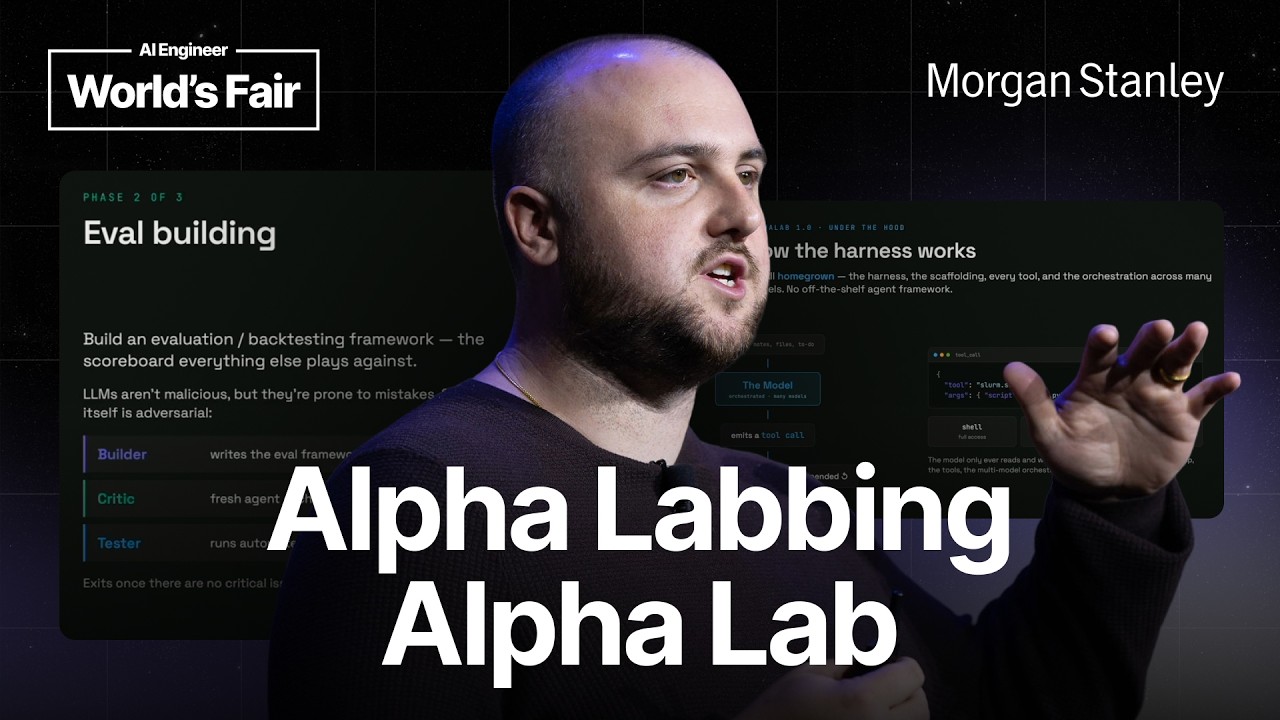
Morgan Stanley's ALPHALAB: Multi-Agent Research Across Optimization Domains — Brendan Rappazzo
Morgan Stanley's AlphaLab is a multi-agent research system designed to automate quantitative finance research by managing the entire experimental lifecycle. Unlike simple code generation, AlphaLab accepts a problem in plain language and autonomously handles hypothesis formation, backtesting setup, cluster job submission (using tools like Slurm), statistical testing, and iterative refinement. The core innovation lies in its focus on building proprietary, verifiable evaluation environments—treating them as critical data inputs—allowing the system to self-improve and encode deep enterprise knowledge.
Key takeaways
-
Full Research Automation Cycle
AlphaLab operates in three phases: 1) Research (building context/hypotheses), 2) Evaluation Building (creating robust backtests, involving multiple critic agents to prevent forward leakage), and 3) Mass Experimentation. This allows the system to move from a natural language goal to a suite of trained models.
-
Architecture: Strategist and Workers
15:36
The process is managed via a Kanban/Jira-like board. A 'Strategist' agent proposes experiments, which are then assigned to 'Worker' agents responsible for writing code, configuring Slurm jobs (e.g., requiring 4 H100s), submitting the job, and performing postmortem analysis.
-
The Value of Verifiable Environments
The system's robustness hinges on building custom evaluation environments (evals) that mimic a private Kaggle competition. This strict format, which includes held-out validation sets, is crucial for measuring performance and encoding proprietary enterprise knowledge.
-
Self-Improving Meta-Harness
The ultimate goal (AlphaLab 2.0) is a self-improving system where the LLM performs meta-optimization, analyzing results and improving the harness itself, rather than just executing tasks within it.