Topic

LLM Integration

All digests tagged LLM Integration

· 15:13

HTML Is All Agents Need — James Russo, HeyGen

The presentation argues that HTML, CSS, and JavaScript are the native languages of Large Language Models (LLMs), making them the ideal foundation for agent-generated video content. The speaker introduces Hyperframes, an open-source framework designed to turn agents' generated HTML into deterministic MP4 videos. Key technical challenges addressed include overcoming browser asynchronous rendering issues by freezing time and seeking frame-by-frame, ensuring that complex elements like WebGL and SVGs are consistently rendered in the final video output.

Key takeaways

  1. HTML as LLM Native Language 3:33

    LLMs' training data is predominantly HTML, CSS, and JavaScript. Forcing them to use custom DSLs or JSON structures hinders performance compared to letting them operate in their native language.

  2. Hyperframes Framework 9:30

    This open-source framework converts an agent's generated HTML into a video format, allowing anything renderable in a browser (e.g., 3.js, SVGs) to be included in the final MP4 output.

  3. Deterministic Video Rendering 10:20

    Since browsers are designed to load asynchronously (great for web performance but bad for video consistency), Hyperframes solves this by freezing the clock and deterministically seeking frame-by-frame to ensure all assets are loaded before capturing each frame.

  4. Focus on Taste, Not Language 13:05

    Instead of teaching agents a new framework language, the focus is placed on 'skills' that teach good video principles (taste), allowing for higher quality output from single-shot prompts.
Watch on YouTube Full article

· 57:28

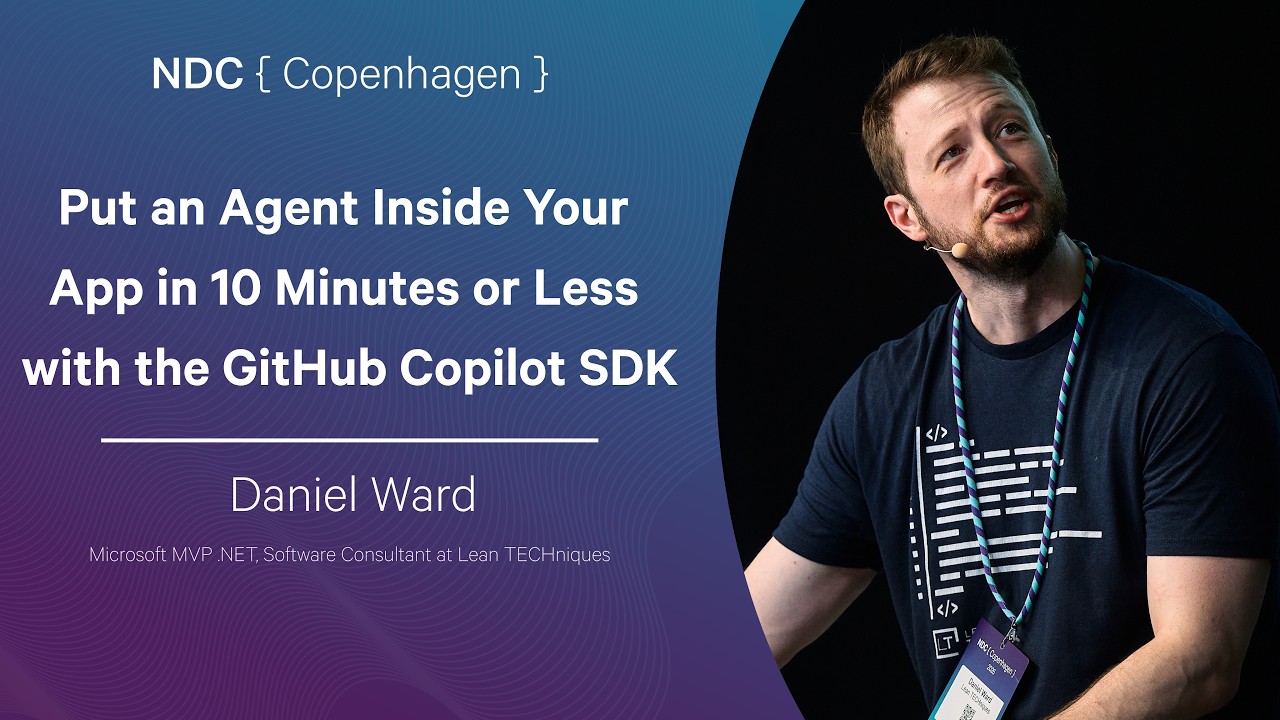
Put an Agent Inside Your App in 10 Minutes or Less with the GitHub Copilot SDK - Daniel Ward

This talk demonstrates how to rapidly embed custom AI agents into existing applications using the GitHub Copilot SDK. The session covers agent architecture—defining an agent as an LLM augmented with tools and a looping mechanism—and provides two coding demos (in C#) showing basic functionality like weather queries, streaming responses, and creating custom tools. For build engineers, the focus is on advanced use cases such as automated incident response (generating suggested fixes and opening Pull Requests from production logs) and building comprehensive daily briefing systems that integrate multiple enterprise services (Jira, Teams, GitHub).

Key takeaways

  1. Agent Architecture 17:53

    An AI agent is fundamentally an LLM combined with external tools and a looping mechanism. The LLM handles the creative analysis, while the tools allow it to perform deterministic actions (e.g., fetching web data or querying APIs).

  2. Copilot SDK Functionality 3:35

    The Copilot SDK is an open-source library that allows calling GitHub Copilot (or other LLMs like Anthropic/OpenAI) from code. It supports multiple languages (TypeScript, Python, Go, C#, etc.) and provides granular control over sessions, including event handling (`onEvent`) for streaming responses.

  3. Automated Incident Response 51:01

    A powerful use case is connecting production errors to automated fixes. The process involves the SDK collecting logs, using Copilot to suggest a fix based on stack traces, and then programmatically opening a draft Pull Request (PR).

  4. Reliability vs. Prompting 53:21

    For repeatable, mission-critical workflows (like daily reports), using deterministic code with the SDK is significantly more reliable than relying solely on prompt chaining, as failures in a chain compound exponentially.

Watch on YouTube Full article

· 10:07

Universal 3.5 Pro Demo: Smarter Speech-to-Text with Contextual Awareness

This demo introduces Universal 3.5 Pro, an advanced Speech-to-Text (STT) model designed to significantly boost transcription accuracy through enhanced contextual awareness. Key features include passing domain-specific prompts (e.g., 'cardiology consultation'), applying context to key terms to prevent misapplication, and supporting dynamic mid-call prompt updates via API calls. Furthermore, the model retains conversation history (agent context), allowing it to accurately transcribe user input even in poor audio conditions by understanding the situational flow of a voice agent interaction.

Key takeaways

  1. Contextual Prompting for Domain Accuracy

    Passing detailed information about the audio content (e.g., 'cardiology consultation between Dr. Smith and elderly patient regarding chest pain...') dramatically improves model accuracy within specific domains. The more specific the prompt, the better the results.

  2. Contextual Key Terms 2:00

    Unlike previous methods where key terms were applied blindly, Universal 3.5 Pro allows users to define what a key term represents (e.g., 'The user's name is Zachary Klebanoff'). This prevents the model from incorrectly applying terminology based solely on acoustic similarity.

  3. Dynamic Mid-Call Prompt Updates 2:55

    The prompt can be updated in real time via the API (not available in the playground demo). This is crucial for voice agents, allowing tool calls or external data to adjust the model's context mid-conversation.

  4. Conversation/Agent Context 3:30

    The model retains previous transcriptions and accepts LLM-generated responses from a voice agent as context. This provides situational awareness, improving accuracy even in poor audio conditions and reducing the Word Error Rate (WER) on voice agent datasets.

Watch on YouTube Full article