Topic

Software Factory

All digests tagged Software Factory

· 58:39

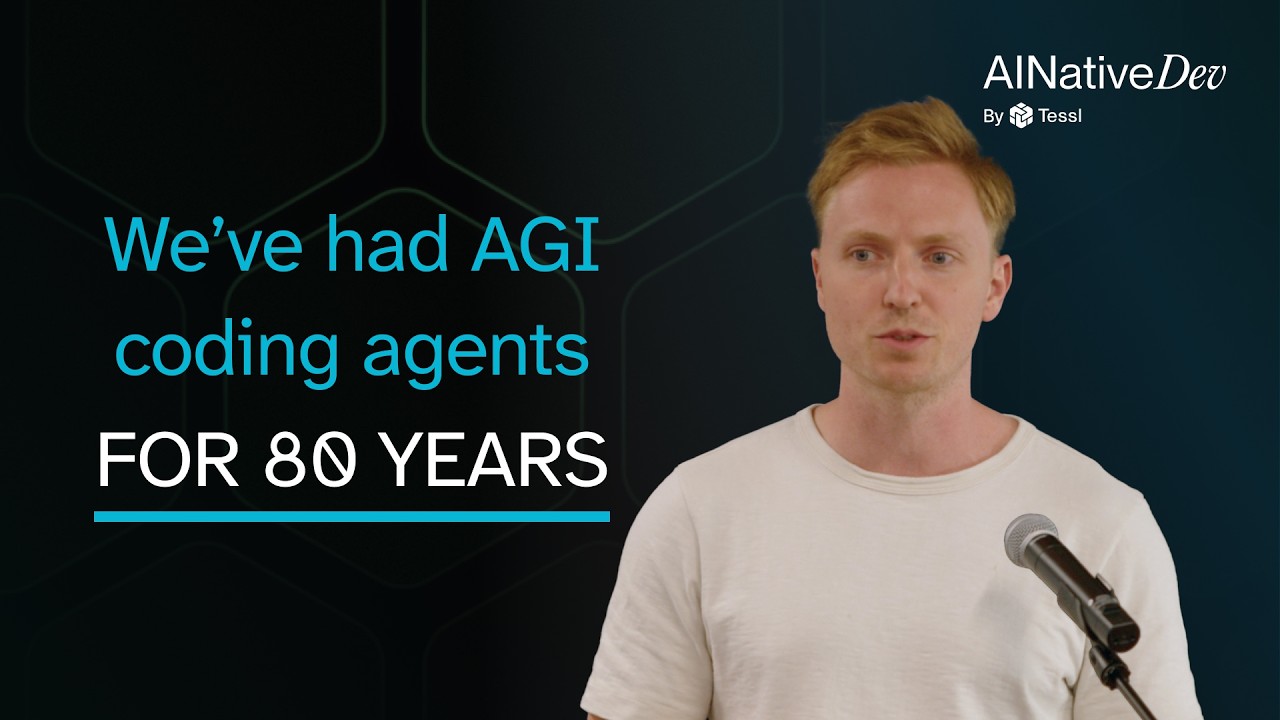
Inside the Dark Factory: AI That Ships Code Solo

The video details Tessl's 'Dark Factory,' an autonomous system that handles a significant portion of their code shipping (65-70% of PRs). This factory uses AI agents and sophisticated verification layers to process tickets from inception (Linear) through to merge. The core architectural shift involves moving engineering focus from writing code to designing robust, automated workflows, emphasizing context management and layered verification to build trust in autonomous systems.

Key takeaways

  1. High Automation Rate 2:24

    Tessl routes 65-70% of its PRs through the Dark Factory. Historically, up to 95% of their codebase has never been reviewed by a human.

  2. Shift in Engineering Focus 17:12

    The role of the engineer shifts from implementing tickets to designing complex workflows, scoping tasks for agents, and encoding organizational 'taste' into verification layers (e.g., whiteboarding conversations).

  3. Trust is Earned, Not Enabled 31:00

    Building trust in the Dark Factory requires continuous effort, including running into failure modes and improving verification layers. Accountability remains with the person who filed the original ticket.

  4. Verification Layers are Key 22:22

    The most critical component is not the coding agent itself, but the layered verification system (Verifiers) that allow engineers to encode fuzzy principles (e.g., 'library should be the single source of truth') into deterministic checks.
Watch on YouTube Full article

· 53:34

Harness Engineering: Building an AI Software Factory

Harness engineering is a discipline focused on building automated loops of checks and maintenance agents that allow teams to delegate increasing amounts of codebase development to AI. The goal is not merely higher velocity, but achieving higher quality by shifting from manual code review (the primary bottleneck) to systematic process oversight. This involves tracking three key dimensions—autonomy, automation, and quality—and implementing layered validation systems: the Inner Loop (unit tests/linters), Outer Loop (agentic QA/UI testing), and Meta Loop (maintenance agents that analyze historical data for systemic improvements).

Key takeaways

  1. The Three Dimensions of Agent Adoption 10:39

    When adopting AI agents, track three metrics: Autonomy (how many human course corrections are needed); Automation (the level of oversight required, indicating trust); and Quality (ensuring the shipped product remains high quality). Progressing requires improving these dimensions sequentially.

  2. The Three Loops of Harness Engineering 19:04

    1. Inner Loop (Autonomy): Focuses on cheap, frequent checks like pedantic linting or unit tests to ensure agents get it right the first time. 2. Outer Loop (Automation): Involves slower, in-depth checks, such as agentic code review or running the product through a UI/CLI. 3. Meta Loop: Utilizes maintenance agents that analyze historical data (CI logs, PR comments) to propose systemic fixes and improvements to the entire process.

  3. The Primary Barrier is Organizational 28:20

    Harness engineering is fundamentally an organizational transformation, not just a technical one. Success requires changing workflows—for example, moving from monolithic PRs to smaller, low-risk chunks that can auto-merge, thereby shifting human behavior toward better practices.

Watch on YouTube Full article

· 34:18

FORGET Loop Engineering. Agentic Engineering is about THIS

The video argues that 'Loop Engineering' is an insufficient and inaccurate mental model for modern software development with AI agents. The superior approach is **Agentic Engineering**, which focuses on building complex AI developer workflows (ADWs) within a 'software factory.' These ADWs orchestrate three core actors of value creation—Engineers, Agents, and Code—to automate the entire development lifecycle, from planning to deployment, thereby scaling impact and accelerating development far beyond what simple loops can achieve.

Key takeaways

  1. Shift Focus from Loops to Workflows

    Loop engineering is a poor rebrand of the Software Development Life Cycle (SDLC). The focus must be on building comprehensive AI developer workflows that combine code execution with agents, rather than focusing solely on iterative loops.

  2. The Three Actors of Value Creation 2:00

    Successful agentic engineering requires understanding and strategically placing three actors: the human engineer, specialized AI agents, and deterministic code. Code is highlighted as the most reliable actor because it costs zero tokens and runs consistently.

  3. Scaling Developer Workflows 4:00

    Advanced workflows move beyond simple loops by integrating multiple validation steps (e.g., linting, type checking, formatting) and scaling compute through specialized sandboxes for parallel execution. This process is the core of building a 'software factory.'

  4. Meta-Engineering: Building the System 8:00

    The most valuable engineering effort is not working on the application layer, but performing meta-work on the agentic layer—building the system that orchestrates and manages all other components (the 'system that builds the system').

Watch on YouTube Full article