Topic

Process Automation

All digests tagged Process Automation

· 20:23

AI tools for Forward Deployed Engineering — Vasuman Moza, Varick Agents

The core bottleneck in enterprise AI adoption is not model intelligence or execution capability, but rather the ability to deeply understand and re-engineer complex, undocumented human business processes. Forward Deployed Engineers (FDEs) are critical for this process, mapping existing workflows—including edge cases and handoffs—and building autonomous agents on top of legacy systems (e.g., SAP, NetSuite). The technical solution involves using a Veric OS platform that builds agents on existing systems without requiring costly migrations, leveraging dependency graphs, and employing custom post-trained models to extract accurate context from messy enterprise data.

Key takeaways

  1. The AI Bottleneck is Context, Not Execution

    While modern LLMs can solve the execution of work (intelligence constraint), the primary bottleneck remains understanding the unique business processes within a specific company. Every department (e.g., healthcare sales vs. SaaS sales) operates differently, requiring deep context extraction.

  2. Forward Deployed Engineering (FDE) Role 7:24

    FDEs are responsible for mapping how humans currently perform work and then re-engineering the process around AI. This ensures that AI solutions are adoptable and deliver measurable, department-wide ROI rather than failing as isolated 'point solutions.'

  3. Non-Disruptive Deployment Strategy 17:02

    To overcome enterprise resistance to migration (e.g., spending $5 million over five years on NetSuite), agents must be built *on top* of existing systems of record (Salesforce, SAP, Dynamics) rather than requiring a full system overhaul.

  4. Agent Tooling for FDEs

    The Veric platform provides specialized tools: an Engagement Agent (assistant to synthesize notes/docs), and a Workflow Agent that ensures the constructed workflow correctly shadows real-world process edge cases. A future autonomous assistant will handle minor changes without human intervention.
Watch on YouTube Full article

· 14:05

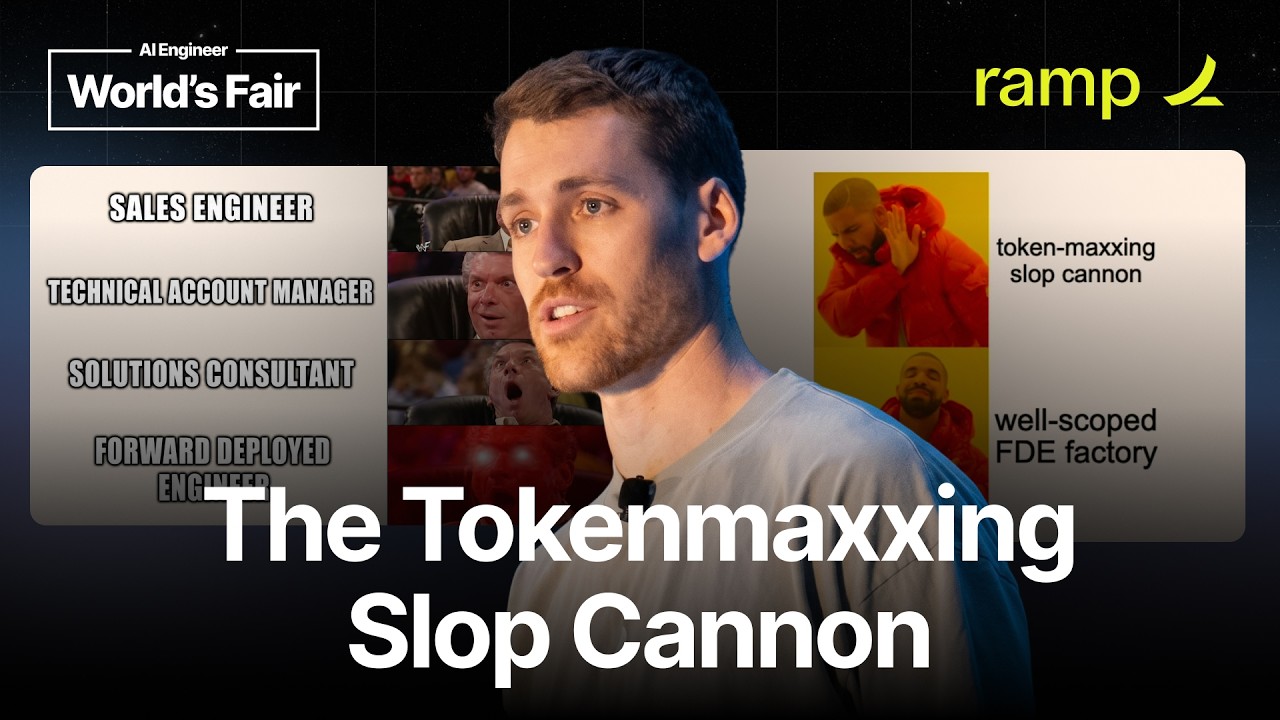
How Forward Deployed Engineering is done at Ramp — Leo Mehr

The talk outlines two core principles for Forward Deployed Engineering (FDE): always scoping and scaling with tokens. FDE teams must resist the urge to simply say 'yes' to every request; instead, they must rigorously scope requirements by asking context-gathering questions to ensure the right product is built. To scale this function, the entire FDE pipeline—from initial intake to spec writing—must be automated using AI agents (scaling with tokens). This requires building robust agent harnesses and implementing validation loops using evals, rubrics, and human feedback.

Key takeaways

  1. Always Scope First 5:16

    FDEs must pause before accepting urgent requests (e.g., SAP S/4HANA integrations) to gather context and determine what is truly necessary for the customer's success, rather than simply fulfilling the immediate ask.

  2. Scale with Tokens 8:24

    The future of FDE requires automating every stage of the request lifecycle—from gathering context to writing a spec—by replacing manual work with AI agents and model capabilities.

  3. Hybrid Approach is Key

    Effective modern FDE needs both human judgment (for taste and final validation) and agent volume/automation to handle the sheer scale of incoming requests.

Watch on YouTube Full article

· 53:34

Harness Engineering: Building an AI Software Factory

Harness engineering is a discipline focused on building automated loops of checks and maintenance agents that allow teams to delegate increasing amounts of codebase development to AI. The goal is not merely higher velocity, but achieving higher quality by shifting from manual code review (the primary bottleneck) to systematic process oversight. This involves tracking three key dimensions—autonomy, automation, and quality—and implementing layered validation systems: the Inner Loop (unit tests/linters), Outer Loop (agentic QA/UI testing), and Meta Loop (maintenance agents that analyze historical data for systemic improvements).

Key takeaways

  1. The Three Dimensions of Agent Adoption 10:39

    When adopting AI agents, track three metrics: Autonomy (how many human course corrections are needed); Automation (the level of oversight required, indicating trust); and Quality (ensuring the shipped product remains high quality). Progressing requires improving these dimensions sequentially.

  2. The Three Loops of Harness Engineering 19:04

    1. Inner Loop (Autonomy): Focuses on cheap, frequent checks like pedantic linting or unit tests to ensure agents get it right the first time. 2. Outer Loop (Automation): Involves slower, in-depth checks, such as agentic code review or running the product through a UI/CLI. 3. Meta Loop: Utilizes maintenance agents that analyze historical data (CI logs, PR comments) to propose systemic fixes and improvements to the entire process.

  3. The Primary Barrier is Organizational 28:20

    Harness engineering is fundamentally an organizational transformation, not just a technical one. Success requires changing workflows—for example, moving from monolithic PRs to smaller, low-risk chunks that can auto-merge, thereby shifting human behavior toward better practices.

Watch on YouTube Full article