Topic

Neo4j

All digests tagged Neo4j

· 31:25

Robert Overweg - One Brain, No Filtering - AI Native DevCon June 2026

The presentation details a 'One Brain' concept—a centralized, AI-native knowledge management layer designed to eliminate information silos and improve decision-making by weaving together research, client context, and operational data. The system uses an orchestrator (OpenClaw) and structured vaults to allow agents to access and synthesize organizational knowledge in real time, shifting focus from manual file retrieval to idea generation and proactive insights.

Key takeaways

  1. Shift from File Search to Idea Synthesis 5:40

    The core value lies in moving beyond searching for specific files; the system allows users to search for 'ideas' or 'contacts.' Agents can interpret natural language queries (e.g., asking about CI/CD steps) and provide contextually accurate answers based on stored knowledge.

  2. Structured Knowledge Flow 7:10

    Knowledge is categorized into 'company knowledge' (new developments, research wikis) and the 'creation pipeline.' Information must be promoted to a central vault from various sources (e.g., Obsidian notes, meeting transcripts) to gain grounding in reality before being shared widely.

  3. Scaling and Security Challenges 17:32

    While the system is powerful, scaling remains a challenge, particularly regarding data segregation (permissions) across different client or team buckets. The local setup on one person's laptop was initially used for testing, but enterprise rollout requires careful consideration of security boundaries.
Watch on YouTube Full article

· 19:38

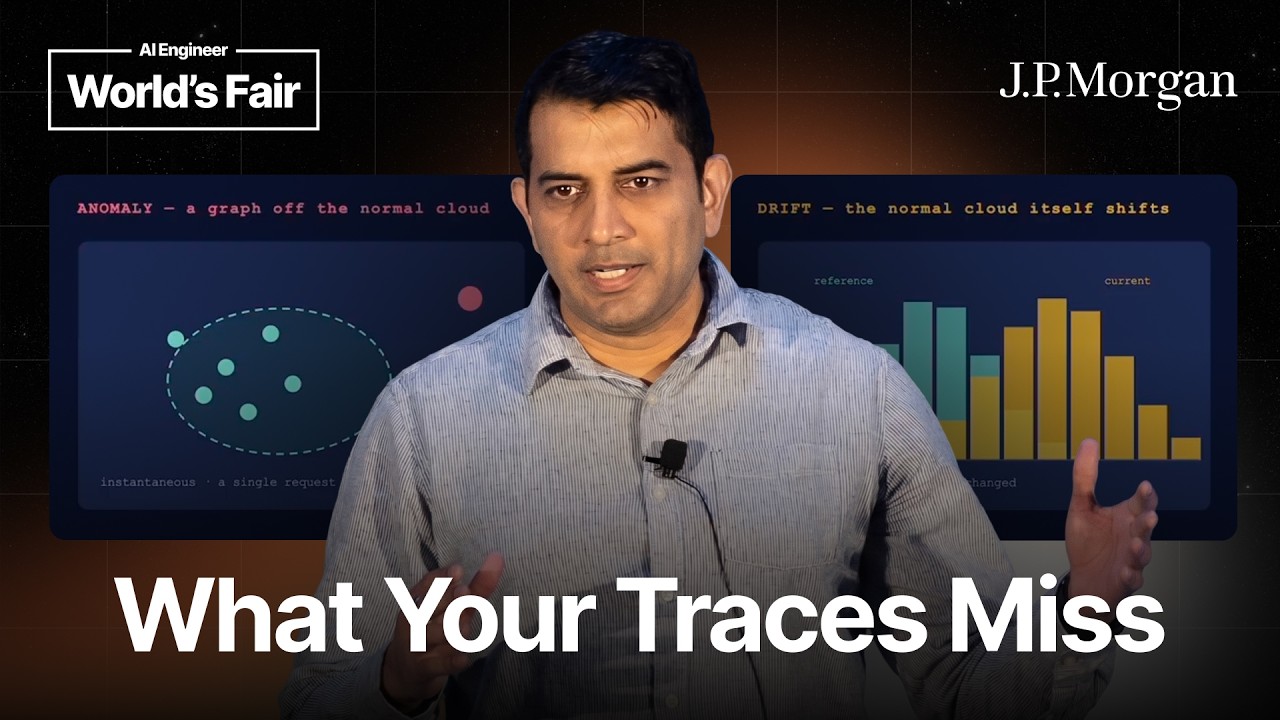
Learned Execution Graphs for Anomaly Detection & Drift in APIs — Ritvik Pandya, JP Morgan Chase

This talk details using short-lived execution graphs (DAGs) to monitor API request processing for advanced anomaly and drift detection. Instead of relying on traditional service level monitoring (SLM) that reports 'healthy' averages, this method models the entire request flow as a Directed Acyclic Graph (DAG). By comparing the actual execution graph against a learned baseline, it can pinpoint performance issues or skipped steps to specific nodes, drastically reducing root cause analysis time. The system differentiates between transient anomalies and persistent drift—categorizing drift into structural, volume, and covariate types—to ensure accurate alerting and proactive system re-baselining.

Key takeaways

  1. Execution Graphs for Monitoring

    Representing API request processing as a DAG allows holistic tracking of middleware steps, context passing, and execution order. This provides granular visibility beyond simple endpoint latency checks.

  2. Anomaly vs. Drift Detection 12:13

    The system distinguishes between sudden anomalies (e.g., traffic spikes) and slow drift—a gradual change in performance or pattern over time—which requires updating the baseline itself.

  3. Three Types of Drift 14:15

    Drift is categorized into structural (new/removed nodes), volume (expected request load changes), and covariate (changes in input data distribution, e.g., different currency types).

Watch on YouTube Full article