Topic

System Reliability

All digests tagged System Reliability

· 21:18

Why Agentic Systems Need Ontologies — Frank Coyle, UC Berkeley

The talk argues that while Large Language Models (LLMs) and agentic systems represent a powerful shift toward AI, their inherent probabilistic nature makes them unreliable for mission-critical tasks. To mitigate failures—such as incorrect order statuses or double refunds—the solution is 'Neurosymbolic AI': coupling the LLM's generative power with external, formal ontologies. An ontology acts as a logical guardrail, enforcing constraints (e.g., payment status must be one of three values) that are impossible to reliably enforce using prompt engineering alone.

Key takeaways

  1. The Problem with Probabilistic Agents

    LLMs reason probabilistically over domains they only half understand, leading to failures in brittle tools and fragile handoffs. These errors cannot be reliably stopped by mere instructions or prompt engineering.

  2. Neurosymbolic AI: Guardrails for LLMs 7:04

    This approach ties together neural networks (LLMs) with symbolic AI (rule-based systems and ontologies). The ontology provides the necessary guardrails to keep the probabilistic model constrained and honest.

  3. The Role of Ontologies 8:43

    An ontology is a formal specification of a shared conceptualization, defining typed entities, their relationships, and constraints. It allows systems to validate proposed actions (e.g., ensuring an order can only be refunded once).
Watch on YouTube Full article

· 19:38

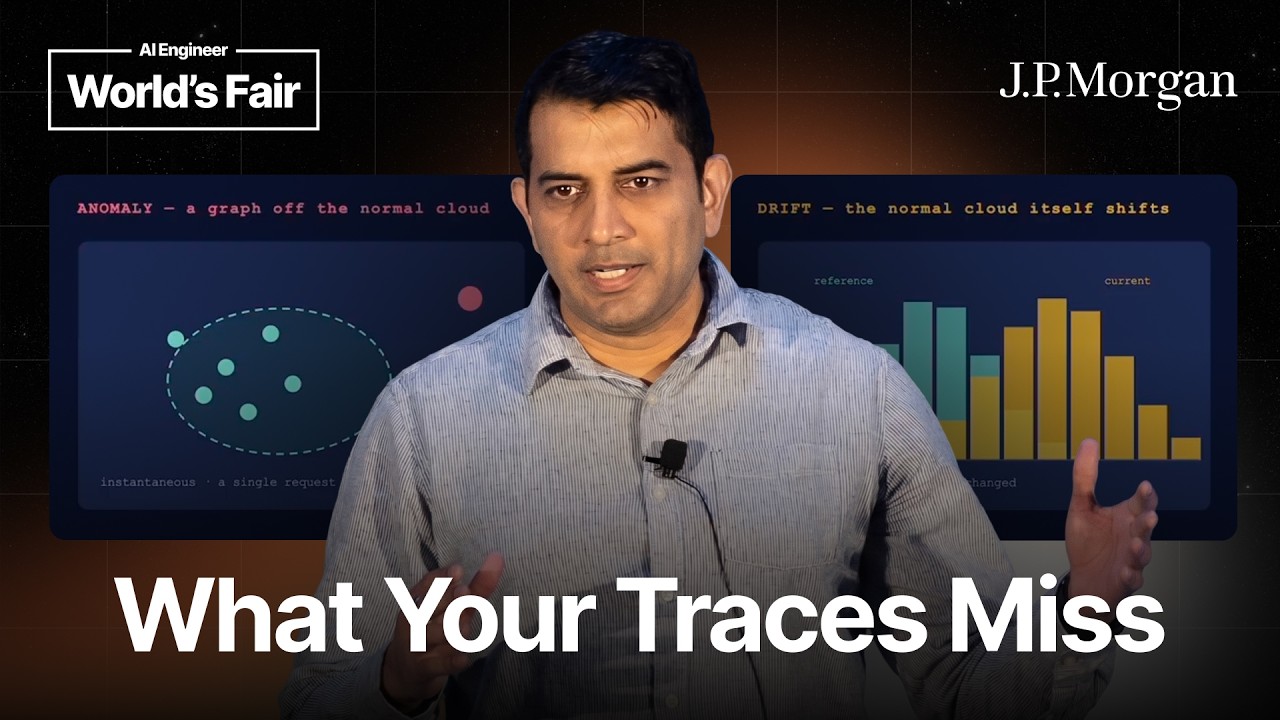
Learned Execution Graphs for Anomaly Detection & Drift in APIs — Ritvik Pandya, JP Morgan Chase

This talk details using short-lived execution graphs (DAGs) to monitor API request processing for advanced anomaly and drift detection. Instead of relying on traditional service level monitoring (SLM) that reports 'healthy' averages, this method models the entire request flow as a Directed Acyclic Graph (DAG). By comparing the actual execution graph against a learned baseline, it can pinpoint performance issues or skipped steps to specific nodes, drastically reducing root cause analysis time. The system differentiates between transient anomalies and persistent drift—categorizing drift into structural, volume, and covariate types—to ensure accurate alerting and proactive system re-baselining.

Key takeaways

  1. Execution Graphs for Monitoring

    Representing API request processing as a DAG allows holistic tracking of middleware steps, context passing, and execution order. This provides granular visibility beyond simple endpoint latency checks.

  2. Anomaly vs. Drift Detection 12:13

    The system distinguishes between sudden anomalies (e.g., traffic spikes) and slow drift—a gradual change in performance or pattern over time—which requires updating the baseline itself.

  3. Three Types of Drift 14:15

    Drift is categorized into structural (new/removed nodes), volume (expected request load changes), and covariate (changes in input data distribution, e.g., different currency types).

Watch on YouTube Full article