Topic

Software Development Lifecycle (SDLC)

All digests tagged Software Development Lifecycle (SDLC)

· 17:38

How Forward Deployed Engineering is done at Cognition — Jia Wu

Forward Deployed Engineering (FDE) at Cognition focuses on maximizing the overlap between product capabilities and complex customer problem spaces, moving beyond simple code generation. The core value proposition is measured by tangible business outcomes—such as reducing delivery timelines or increasing PR acceptance rates—rather than merely token usage. FDE embeds within client ecosystems to identify high-leverage areas for AI agents like Devin, addressing the full software development lifecycle (SDLC) challenges including testing, review, and maintenance.

Key takeaways

  1. Shifting Focus from Tokens to Outcomes

    The industry trend is shifting away from optimizing for token usage toward measuring true business outcomes. Cognition measures value by demonstrating a real delta—for example, an 82% reduction in delivery timelines after agent activation.

  2. FDE's Role: Maximizing Problem-Product Overlap 8:36

    FDE aims to maximize the intersection between existing product domains and critical customer problems. This requires deep understanding of the client’s problem space, identifying the highest leverage points for automation.

  3. The Value is Non-Linear 3:25

    Adoption of AI agents follows a non-linear curve: initial use may be a step function, but enterprise-wide adoption and integration lead to parabolic growth as product capabilities align with the customer's full backlog.

  4. Core Mandates of FDE

    FDE operates under two mantras: relentlessly tying into the customer (who are the 'lifeblood') and prioritizing correctness and customer success at all costs. The goal is to make the customer successful, not just ship code.

Watch on YouTube Full article

· 1:10:57

OpenAI’s Plan to Make ChatGPT the Everything App — Akshay Nathan, OpenAI

Akshay Nathan discusses OpenAI's strategy to transition ChatGPT from a general chatbot into an 'Everything App' for knowledge workers. The core thesis is that AI will blur the lines between roles (engineering, design, strategy), making the bottleneck less about capability and more about ideas and taste. This shift is manifested in the unified product experience, ChatGPT Work, which leverages a shared agent harness to enable complex tasks like generating artifacts, interacting with local files, and managing persistent memory across different domains.

Key takeaways

  1. The Bottleneck of Innovation 2:03

    As AI makes building accessible to almost anyone, the primary bottleneck shifts from technical capability (how much can be built) to ideas and taste. Product development must focus on closing the loop by grounding new ideas in user feedback or observed friction [0:123].

  2. The Super App Strategy (ChatGPT Work) 12:40

    OpenAI is merging its agent experiences (Codex, ChatGPT) into a unified product to prevent users from being 'boxed in' by specific tools. This strategy aims to provide maximum flexibility and power regardless of the user's current task or domain [13:40].

  3. Redefining Productivity 48:30

    Productivity is defined as giving users leverage to accomplish things they couldn't before. The focus shifts from measuring traditional proxies (like code commits or story points) to assessing the user's ability to achieve a specific, desired goal [48:30].

  4. Motion vs. Progress 52:50

    A critical warning for teams is the tendency to conflate 'motion' (activity and tooling) with actual 'progress.' Progress requires a highly prescriptive and deliberate view of what success looks like, which must guide development efforts [52:30].

Watch on YouTube Full article

· 57:58

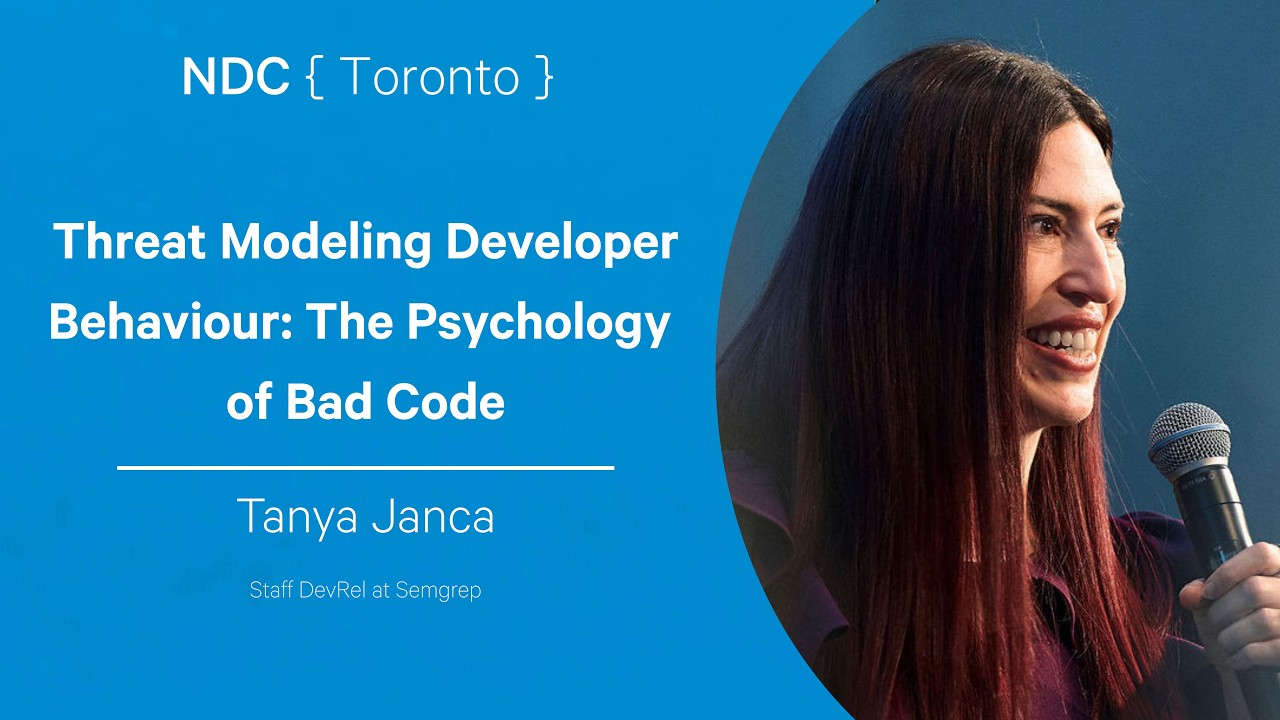
Threat Modeling Developer Behaviour: The Psychology of Bad Code - Tanya Janca

Security vulnerabilities are often predictable patterns of human behavior rather than purely technical flaws. The talk advocates for shifting AppSec focus from merely enforcing secure coding standards to understanding and modifying developer psychology using principles from behavioral economics. Key strategies include setting 'secure defaults,' embedding security activities into every phase of the SDLC, and implementing cultural changes (like community practices) to make secure development the path of least resistance.

Key takeaways

  1. The Shift from Intentions to Defaults 26:23

    Since 'secure intentions' require constant effort and willpower, organizations should implement 'secure defaults.' This means structuring tools and processes so that the secure path is the automatic, easiest choice (e.g., using an ORM framework that enforces parameterized queries instead of allowing raw SQL concatenation).

  2. Addressing AI-Generated Code Risks ('Vibe Coding') 31:30

    A major risk is 'vibe coding,' where developers rely on AI to write nearly all the code without thorough manual review. Mitigation requires using Retrieval Augmented Generation (RAG) servers that reference secure internal guidelines and enforcing mandatory human code reviews.

  3. Systemic Process Improvement 20:50

    Instead of blaming individuals, security failures should be viewed as systemic issues. Solutions must involve embedding security activities (like threat modeling) into requirements gathering and design phases, making it a continuous part of the SDLC.

  4. Behavioral Nudges over Mandates 27:10

    Effective change comes from 'nudges'—subtle changes in environment or process that guide behavior without restricting options. Examples include automatically enrolling employees in retirement plans (opt-out) or adding documentation debt to sprint reviews.

Watch on YouTube Full article

· 1:15:02

Full Workshop: Setting Yourself Up for Success —Jason Liu, OpenAI Codex

Jason Liu provides a comprehensive workshop on leveraging Codex and the Agents SDK for advanced knowledge work automation. The focus shifts from simple text generation to using AI agents (threads) as collaborative teammates capable of managing complex projects, interacting with external applications via 'Computer Use,' and maintaining long-running processes through automated 'heartbeats.' Key strategies include building custom skills/plugins, utilizing a personal memory vault, and treating the computer itself as an integrated component of the workflow.

Key takeaways

  1. Systematic Context Management via Appshots 20:05

    The 'Appshot' feature is highlighted as critical for providing deep context to AI models. Unlike simple screenshots, Appshots capture the entire accessibility tree of an application (e.g., Slack), allowing agents to perform complex actions with single function calls and greatly improving accuracy.

  2. Advanced Project Management with Threads 5:50

    The concept of 'compaction' allows threads (pinned conversations) to maintain long-term context, acting like dedicated project managers. These threads can delegate tasks to sub-agents and communicate with each other, forming a collaborative team structure.

  3. Automating Long-Running Workflows (Heartbeats) 11:30

    Instead of manual checks, 'heartbeat' automations can wake up threads over time to perform continuous maintenance tasks (e.g., checking PR status, monitoring support issues), allowing for sustained project oversight.

  4. Extending AI Capabilities with Skills and Plugins 23:25

    Skills are simple constructs (files/scripts) that solve specific problems (e.g., 'Review my code like Charlie'). Plugins connect the system to external services (Slack, Gmail), allowing agents to perform actions across different platforms.

Watch on YouTube Full article

· 36:51

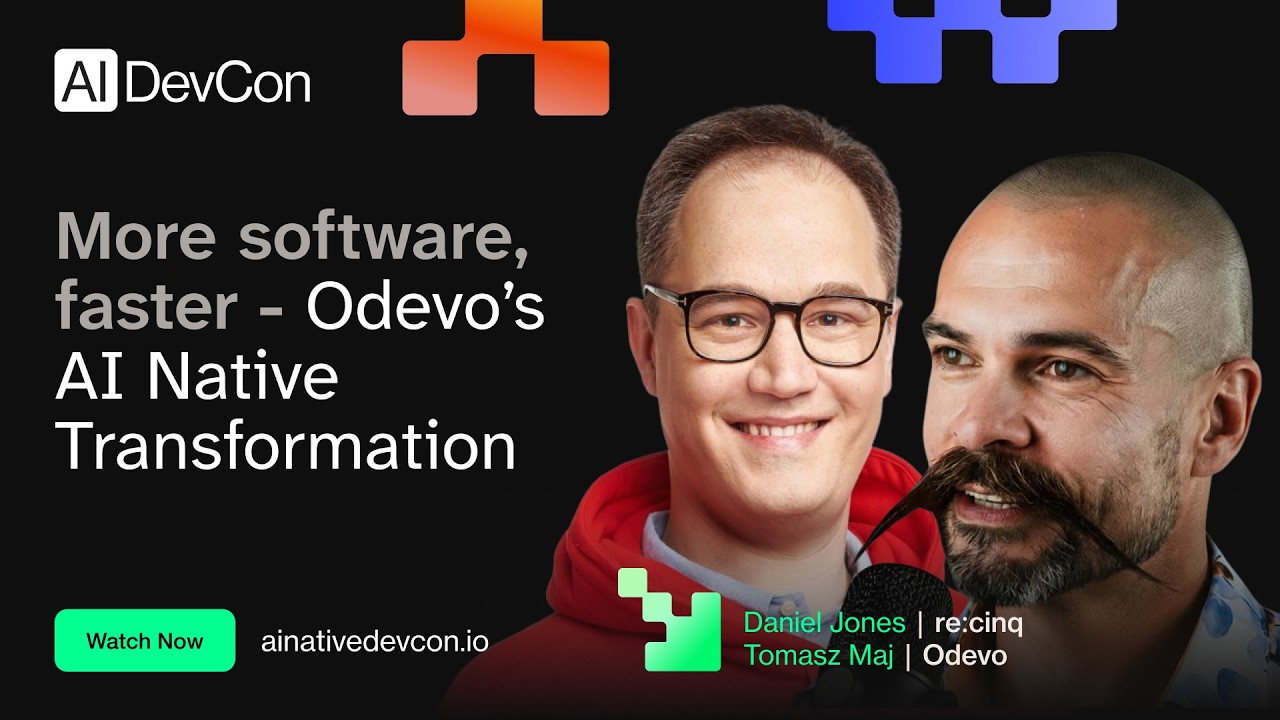
Daniel Jones & Tomasz Maj - More software, faster - Odevo's AI Native transformation - AI DevCon '26

Odevo details its AI-native transformation journey, moving from a highly heterogeneous tech landscape across multiple acquisitions and time zones. The core message is that adopting generative/agentic coding practices requires more than just providing licenses; it demands fundamental improvements in organizational processes, including robust CI/CD pipelines, standardized coding guidelines, and cultural shifts toward 'boldness' and experimentation. By systematizing training and focusing on failure modes, Odevo achieved significant metrics increases, such as 94% AI adoption among developers.

Key takeaways

  1. AI Adoption Requires Process Maturity 20:03

    Adopting agentic coding is not simple. Success hinges on foundational elements like having a reliable CI/CD platform, standardized coding practices, and comprehensive testing protocols. Without these fundamentals, generating code quickly will only expose bottlenecks elsewhere.

  2. The Importance of Discovery and Workshops 23:50

    Successful AI transformation requires a 'discovery' phase to understand the current state (the 'lay of the land') and using workshops (e.g., employing techniques like TRIZ) to address employee fears, reduce hesitancy, and build consensus on necessary improvements.

  3. Focus on Failure Modes 27:10

    Training should not focus only on the 'happy path.' It is crucial to teach developers about failure modes (e.g., context management, hallucination) and how agents operate in complex environments.

  4. The Biggest Impact is Boldness 32:10

    The most significant outcome of the AI transformation was not just increased efficiency but a cultural shift toward 'boldness'—the willingness to try ambitious, end-to-end agentic workflows and rewrite large systems quickly.

Watch on YouTube Full article