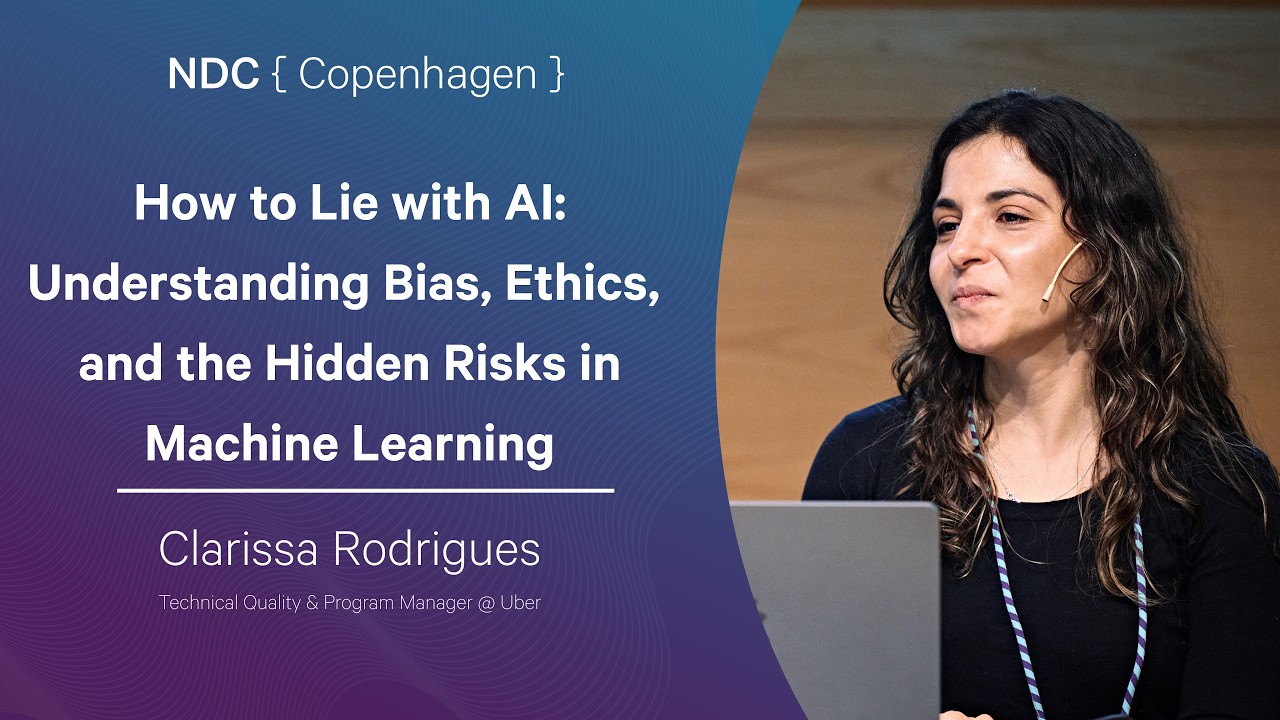
How to Lie with AI: Understanding Bias, Ethics, and the Hidden Risks in ML - Clarissa Rodrigues
Summary
The presentation explores how Machine Learning models can exhibit bias and 'lie' unintentionally due to flawed or non-representative training data. While AI is rapidly integrating into daily life (e.g., pricing, search, criminal justice), the speaker emphasizes that developers must maintain vigilance, prioritize explainable models, and ensure that model complexity aligns with problem complexity to mitigate ethical risks and unintended bias.
Key takeaways
-
ML Models are not inherently predictable like humans.
2:00
Unlike traditional algorithms where input/output is predictable, ML models can produce varied outputs based on internal weights and parameters. This lack of inherent transparency requires developers to be critically aware of model decisions.
-
Bias originates from data, not the algorithm itself (Garbage In, Garbage Out).
8:30
To build a robust model, it is crucial that the training data is representative and free from historical or aggregation biases. Simply having more data does not guarantee accuracy; representativeness is key.
-
The importance of Explainable AI (XAI).
3:25
Developers must strive for transparency by using explainable models to understand what the system is doing behind the scenes, rather than relying solely on complex black-box architectures.
Technical details
-
ML Model Architectures
240s
Various models exist for different objectives: Regression, Clustering, and Classification. Advanced deep learning structures include Support Vector Machines (SVM), Convolutional Neural Networks (CNN), Long Short-Term Memory networks (LSTM), and general Deep Neural Networks.
-
Bias Mitigation
600s
Bias can manifest in various ways, including gender bias (e.g., translation defaulting to male pronouns) or historical bias (e.g., COMPAS system). Techniques exist to reduce these biases during model optimization.
-
Generative AI and Hallucination
1400s
Modern Generative AI models are trained by humans, which allows them to sound highly natural. However, they can 'hallucinate' or provide incorrect data (as demonstrated with cloud services), requiring careful validation of training sources.
Mentioned resources
- COMPAS
- Uber AI Solutions
Channel & topics
Watch on YouTube · Back to latest
This independent, AI-assisted summary is provided for commentary and informational purposes. It may contain errors or omit important context. Please watch the original video for the creator's complete presentation. Video, thumbnail, and related copyrights belong to their respective owners.