Topic

Artificial Intelligence

All digests tagged Artificial Intelligence

· 20:24

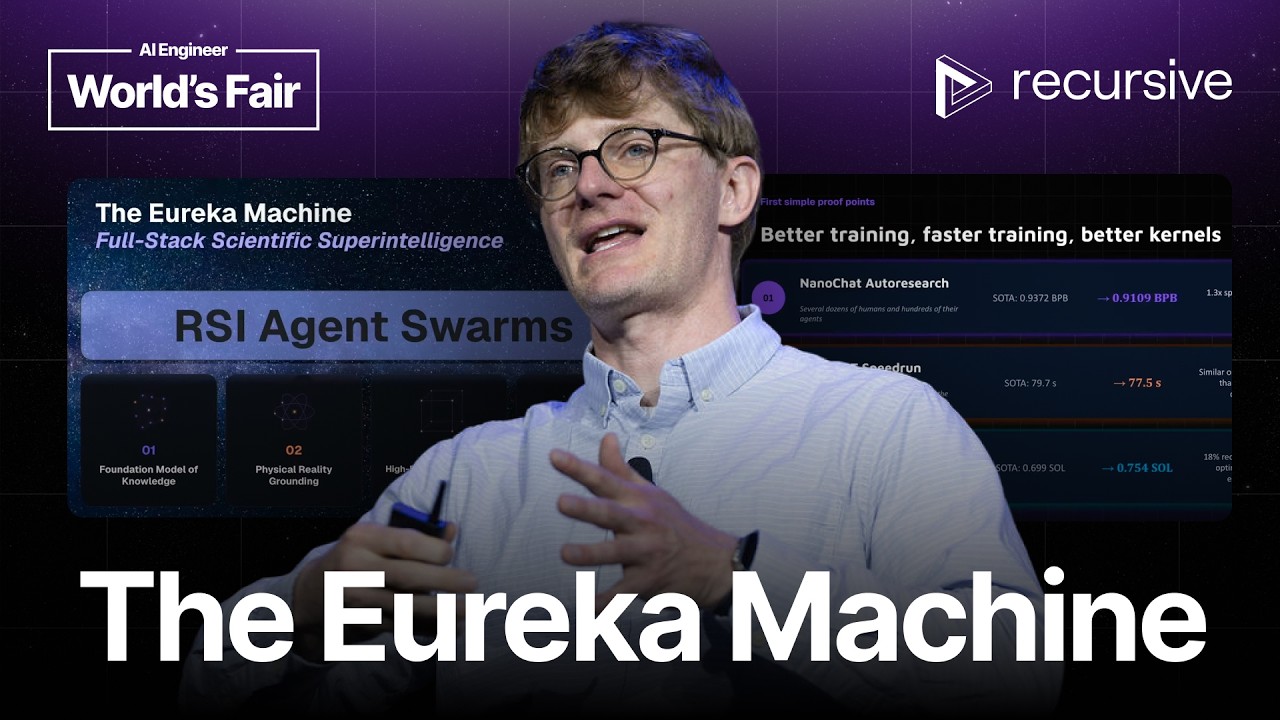
First Steps Toward Automated AI Research — Richard Socher, CEO Recursive AI

Richard Socher proposes the concept of the 'Eureka machine,' a system designed to automate scientific discovery across all fields—from physics and biology to economics. Drawing parallels with evolution and Popper's philosophy of science, he argues that humanity is at an inflection point where Artificial Intelligence (AI) can achieve Recursive Self-Improvement (RSI). This process involves building systems that improve their own code and architecture over long time horizons, accelerating scientific progress far beyond current human capacity.

Key takeaways

  1. The Eureka Machine Goal 15:07

    The ultimate goal is to build a machine that automates the entire process of scientific discovery. This requires integrating knowledge (scientific data), simulation, physical experimentation, and an agent swarm to manage all inputs.

  2. Evolutionary Analogy for Progress

    Scientific progress is viewed as an open-ended evolutionary process. Just as biology evolved over billions of years, technology and AI are expected to undergo rapid, exponential shifts (S-curves) leading to massive human flourishing.

  3. The Necessity of RSI

    AI progress is accelerating because modern AI can code. The next major step involves building a system with Recursive Self-Improvement (RSI)—an AI that has self-awareness of its shortcomings and autonomously updates its entire architecture, moving beyond manual processes.
Watch on YouTube Full article

· 14:32

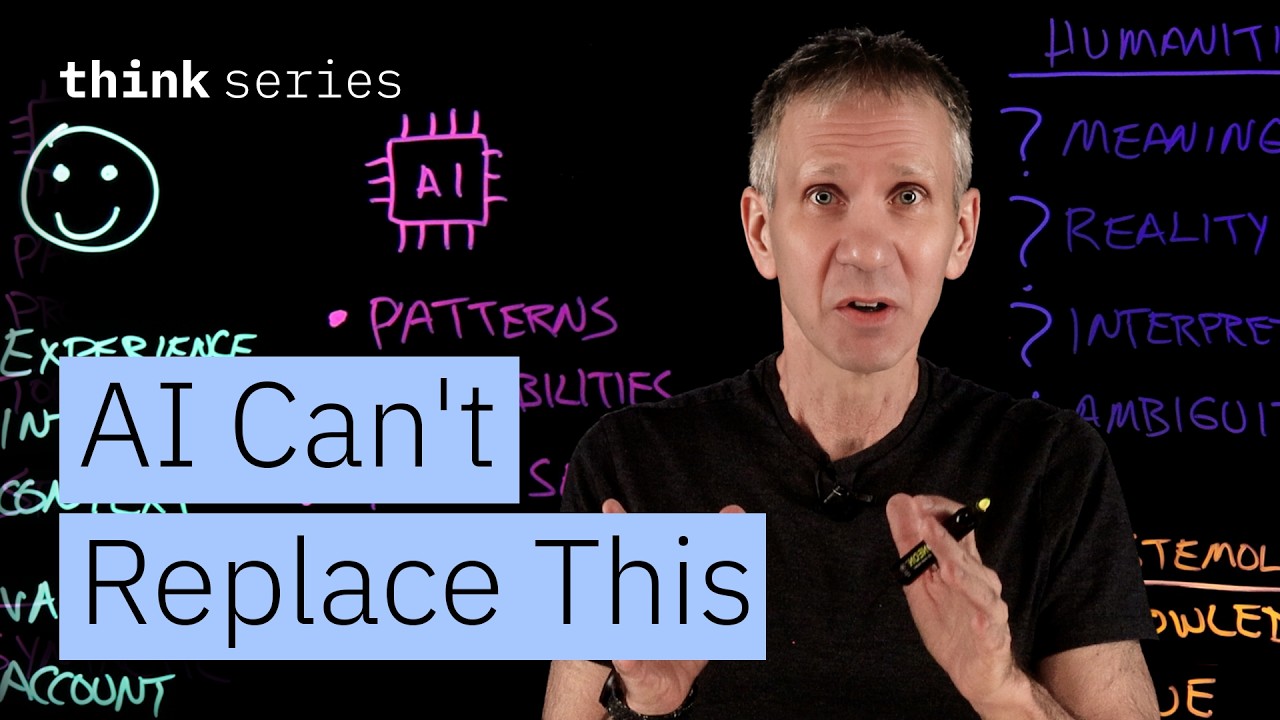
Why AI Makes the Humanities More Important Than Ever

While advanced AI systems excel at generating fluent language by predicting statistical patterns (syntactic), they lack inherent understanding of human intent, ethics, or context (semantic). The video argues that fundamental humanistic disciplines—such as philosophy, history, and rhetoric—are crucial for providing the necessary judgment, ethical grounding, and critical interpretation required to use AI responsibly. In an AI-driven world, technical fluency is insufficient; the most valuable skill becomes critical thinking and interpretive judgment.

Key takeaways

  1. AI operates on patterns, not understanding 7:40

    Large Language Models (LLMs) function by predicting token sequences based on statistical correlations, meaning they are fundamentally syntactic. They do not inherently possess lived experience or semantic understanding of truth or value.

  2. The user is the critical interpreter 11:55

    AI systems shift the need for interpretation rather than eliminating it. The human must act as the active participant who interprets the AI's output, making decisions and taking action based on that interpretation.

  3. Prompting is a form of system control 13:40

    The quality of an AI output is highly dependent on the prompt (input). Structuring prompts, defining constraints, and clearly expressing intent are practical applications of rhetoric and discourse analysis, making this skill an operational competence in AI systems.

Watch on YouTube Full article

· 18:04

Local Agentic Theory For Mobile Games — Shafik Quoraishee & Joanne Song, The New York Times

The presentation outlines 'Local Agentic Theory' for mobile games, arguing that the future of AI gaming lies in decentralized, on-device agents rather than centralized cloud models. These local agents use advanced techniques (like LLM reasoning over game state) to provide highly personalized experiences. Furthermore, this approach allows accessibility features to move beyond static toggles, enabling real-time, dynamic tuning of gameplay difficulty and interaction controls based on the user's live context (e.g., tracking eye gaze or shaky taps).

Key takeaways

  1. Local Computation is Essential for Mobile AI 4:09

    Running AI locally minimizes latency, avoids expensive cloud inference calls, and ensures privacy by keeping computation within the device's security zone. This allows advanced AI features to function reliably even without constant internet connectivity (e.g., in a subway tunnel).

  2. Agentic Systems vs. Reinforcement Learning (RL) 7:36

    While RL models train by changing weights through cycles, an agentic system uses language models and in-context learning to reason over the game's state space. This allows for a more dynamic loop that adapts to new situations using local device functionality.

  3. The Device Budget Constraint 13:39

    Local agents must operate within strict resource budgets: time (fitting planning into a single 16ms frame for 60Hz refresh rates), space (managing model weights and state history compression), and energy (optimizing processing to prevent rapid battery drain).

  4. Accessibility as a Graded Dial, Not Toggles

    Traditional fixed-state games are limited by static menus. The proposed model uses international standards like WCAG 2.2 to build dynamic player states. Agents can actively monitor user input (e.g., tracking eye gaze or analyzing shaky taps) and dynamically adjust controls—such as resizing targets or injecting exit routes from focus traps—to meet the player's real-time needs.

Watch on YouTube Full article

· 14:04

I Cut the Internet and Let AI Read the File I Could Never Upload. It Caught the Leak.

This video details methods for running AI models locally on sensitive documents while completely disconnected from the internet ('air-gapping'). The core problem addressed is data leakage risk when uploading proprietary or PII-containing files to cloud AI providers. Solutions range from using open-source tools like LM Studio with downloaded, local models (e.g., GPT-OSS Safeguard 20B) to sophisticated enterprise methods utilizing Azure and LoRA for fine-tuning within a controlled boundary.

Key takeaways

  1. Local AI Processing Capability

    It is possible to run downloaded, open-weight models on a laptop with Wi-Fi disabled. These local models can scan documents for private material (PII, financial data, legal notes) and mask it without sending any data over the network.

  2. Enterprise Adoption of Local AI

    Large companies like Discovery Bank and Bayer are implementing specialized, fine-tuned models (on-premise/Azure) to handle confidential information. This approach allows for faster processing while keeping proprietary data within a controlled boundary.

  3. The Risk of Cloud Dependence 5:13

    Even if an AI model claims it did not look at a file, the logs may show that the entire repository was uploaded to the provider (e.g., Grok build leak), emphasizing the need for hard guardrails like air-gapping.

  4. LoRA and Enterprise Tuning

    Microsoft uses Low-Rank Adaptation (LoRA) to fine-tune models by adjusting only a subset of parameters, allowing large clients to create highly specialized models that outperform general cloud providers for specific tasks.

Watch on YouTube Full article

· 25:58

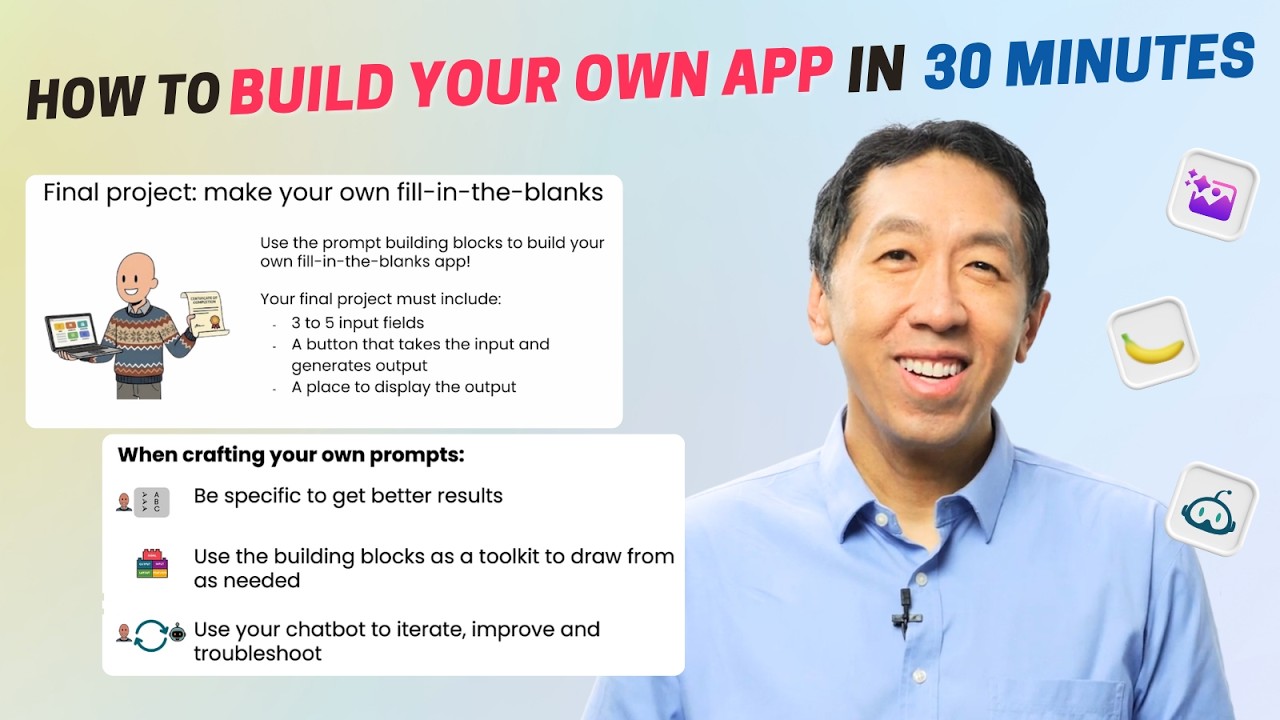
Build Your Own App In Just 30 Minutes! Full Course with Andrew Ng

This course teaches build-engineering principles for modern software development by leveraging AI tools (like ChatGPT or Gemini). Instead of writing code manually, users learn 'prompting'—the art of giving precise instructions to an AI system to generate functional web applications (HTML files). The process emphasizes iterative refinement and mastering five key building blocks: Goal, Input, Layout, Special Features, and Output. By following this framework, users can build complex tools, such as a birthday card generator or a ping pong game, with minimal coding experience.

Key takeaways

  1. The Power of Prompting 4:30

    Creating software in the AI era involves telling the AI what to do (prompting) rather than typing out code. The more specific and precise the prompt, the more predictable the resulting application will be.

  2. The Five Building Blocks of Prompts 6:10

    To build effective prompts, consider these five components: 1) The Goal (what to create), 2) User Input (data the user provides), 3) Layout (arrangement of parts), 4) Special Features (additional functionality), and 5) Output (the desired result format).

  3. Iterative Development and Troubleshooting 11:20

    Software development is an iterative process. If the initial AI-generated app has bugs or needs improvement, users must continue the conversation with specific instructions (e.g., 'Nothing happens when I click on the generate card button. Can you fix it for me?').

Watch on YouTube Full article