Topic

Large Language Models (LLMs)

All digests tagged Large Language Models (LLMs)

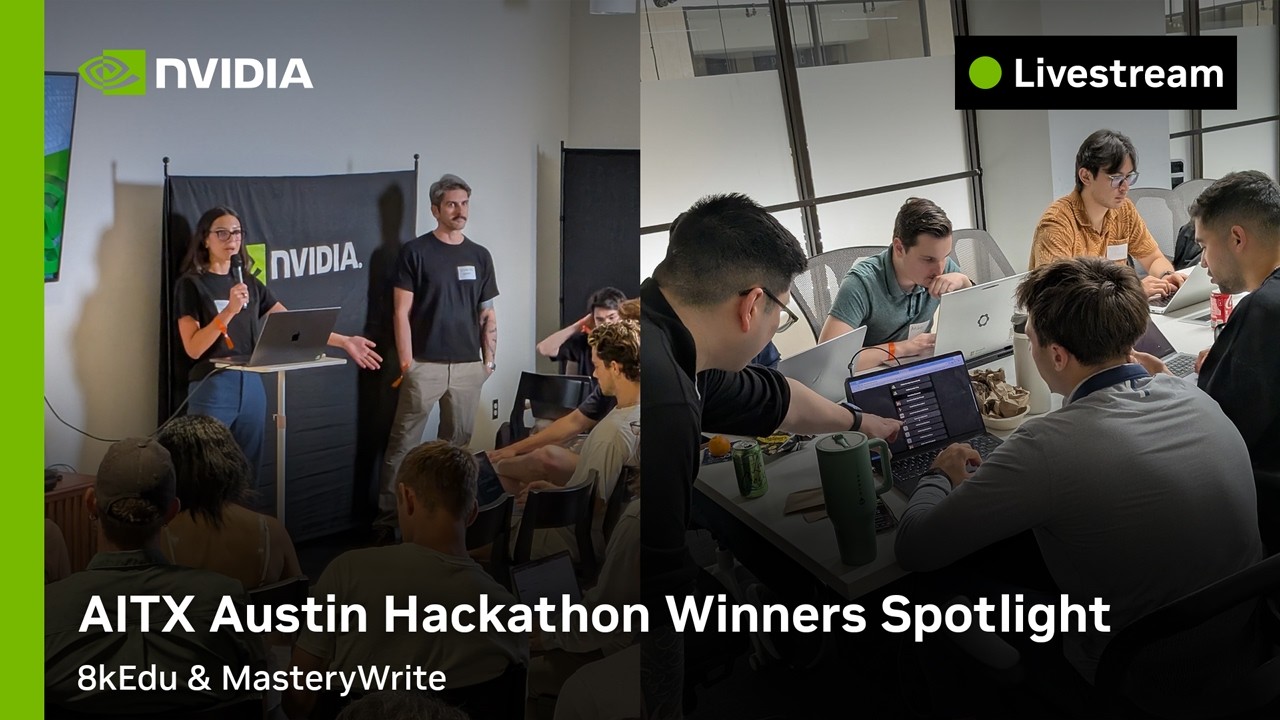
AITX Austin Hackathon Winners Spotlight thumbnail

· 36:43

AITX Austin Hackathon Winners Spotlight

This technical spotlight details two winning autonomous agent applications from the AITX Hackathon: MasteryWrite and 8kEdu. Both projects demonstrate advanced capabilities beyond simple chat, focusing on taking real-world action in educational technology (EdTech). Key architectural takeaways include using specialized frameworks like NemoClaw/OpenShell to enforce policies around student PII data, implementing continuous self-improvement loops for assessment grading, and leveraging Visual Language Models (VLMs) to transform video lectures into interactive learning widgets.

Key takeaways

  1. MasteryWrite: Autonomous Assessment Engine 2:00

    This agent scores student essays against a rubric, explains its reasoning, and uses an autonomous evaluation loop to improve its own grading criteria over time. The system is designed to handle complex educational assessment while maintaining strict policies around student PII data.

  2. 8kEdu: Interactive Video Learning 5:05

    The agent transforms YouTube lectures into interactive learning experiences. Instead of relying on the entire transcript, it focuses on specific video frames (e.g., a matrix calculation) to generate editable widgets (charts, notebooks), allowing users to learn concepts from multiple sources and build recursive learning graphs.

  3. Local Model Deployment for Edge Cases 7:50

    The teams highlighted the utility of running models locally (e.g., using DGX Spark) to manage costs, ensure privacy, and run complex video-based inferences without constant reliance on external APIs.


Watch on YouTube Full article

Can LLMs Write Fast Multi-GPU Kernels? — Simran Arora, Together AI thumbnail

· 30:00

Can LLMs Write Fast Multi-GPU Kernels? — Simran Arora, Together AI

Multi-GPU AI workloads are increasingly bottlenecked by inter-node and intra-node communication links rather than individual GPU compute power. The speaker introduces ParallelKittens, a set of minimal primitives designed to simplify writing high-performance multi-GPU kernels. A benchmark called ParallelKernelBench tests whether frontier LLMs can generate optimized CUDA kernels for complex real-world patterns (e.g., data parallelism across tensor/expert dimensions). While models show promise in generating correct kernels, their ability to reason about critical architectural trade-offs—such as collective ordering, data partitioning, or choosing between transfer mechanisms (Copy Engine vs. TMA)—remains limited.

Key takeaways

  1. The Bottleneck Shift 17:04

    Improvements in compute (e.g., A100 to B200) have outpaced improvements in communication links (Intra-node: 3x; Inter-node: 2x). This forces the bottleneck off the individual GPU and onto the interconnects, causing standard PyTorch/NCCL baselines to fall below 50% of their communication-aware roofline.

  2. Kernel Development Simplification 2:20

    The speaker's team developed ParallelKittens, a small set of primitives that adds minimal lines to a single GPU kernel but enables state-of-the-art multi-GPU performance in production environments (e.g., Together AI).

  3. LLM Performance on Kernel Generation 20:40

    On the ParallelKernelBench, the best frontier models solved 28 out of 87 problems zero-shot. While scaling up attempts increased correctness to 36/87, the performance gain (speedup) plateaued near 31%. Failures are not syntax but stem from inability to reason about complex trade-offs.

Watch on YouTube Full article

How to build with Gemini 3.5 Transcribe thumbnail

· 4:50

How to build with Gemini 3.5 Transcribe

Google DeepMind launched Gemini 3.5 Transcribe, an LLM-based transcription model available via both the Interactions API and the Live API. This model significantly enhances accuracy by correctly transcribing complex data types—such as email addresses, phone numbers, and mixed units of measurement—and maintaining high performance across over 85 supported languages, even when language codes are set to English.

Key takeaways

  1. LLM-Based Transcription Model

    The model's LLM foundation allows it to handle complex data structures and context better than traditional transcription models. For example, it can correctly identify and edit email addresses even if spoken phonetically (e.g., 'tosten at google.com').

  2. Handling Complex Data Types 2:00

    Gemini 3.5 Transcribe accurately recognizes specific formats, including US phone numbers and international variations (e.g., Singapore's 8-digit format). It can also correctly interpret units of measure (e.g., meters vs. centimeters).

  3. Multilingual and Customization Support 0:40

    The model supports over 85 languages, automatically recognizing spoken language even if language hints are set to English. Accuracy can be further improved by providing custom vocabulary (e.g., names of people in a meeting) or setting specific language codes.

Watch on YouTube Full article

How We Got LLMs to Recommend Our Open Source Library — Christopher Burns, Inth thumbnail

· 16:27

How We Got LLMs to Recommend Our Open Source Library — Christopher Burns, Inth

The talk details how modern developer experience primitives must adapt for consumption by Large Language Models (LLMs) and autonomous agents. The core argument is that optimizing documentation requires moving beyond traditional SEO methods to focus on agent-facing artifacts. Key strategies include manually curating `LLMs.txt`, serving bundled markdown files, and ensuring the repository structure (`node_modules`) contains necessary context for coding agents.

Key takeaways

  1. Agent Inbound is the New Standard

    Inbound traffic sources are shifting from human discovery to LLMs (e.g., Claude, ChatGPT) recommending libraries like C15T. This requires optimizing for 'agent primitives' rather than just developer experience.

  2. Manual Optimization Beats Automation 9:52

    For critical files like `LLMs.txt`, manually writing the content is significantly more effective than generating it automatically; 'forty good lines beat a thousand lines of noise.'

  3. Bundling Context in Node Modules

    Coding agents rarely visit live documentation sites. To improve discoverability, developers should ship bundled markdown documents and an `AGENTS.md` file directly within the package's `node_modules` directory.

Watch on YouTube Full article

Inside DeepWiki: How Cognition Builds Wikis for Devin at Scale thumbnail

· 17:12

Inside DeepWiki: How Cognition Builds Wikis for Devin at Scale

Jacob Teo details DeepWiki, an auto-generated codebase documentation product used as a context layer for agents like Devin. The presentation covers how DeepWiki scaled from internal tools to indexing 1.4 million repositories. Key technical advancements include evolving the wiki algorithm from a heavily orchestrated v1 to a more agentic v2, which improves robustness at massive scale. Furthermore, he outlines four principles of context engineering—Primary Sources, Context-Poisoning avoidance, Path Compression, and Unknown Unknowns—to guide future codebase intelligence systems.

Key takeaways

  1. DeepWiki's Evolution (v1 to v2) 12:28

    The wiki algorithm shifted from being highly orchestration-led (relying on tight control over model calls) to an agentic core (V2). This shift allows the system to adapt to code base abnormalities by enabling the agent to call tools for extra scaffolding, making it more robust as models improve. (7:48)

  2. Context Engineering Principles

    When building context for agents, Cognition emphasizes four principles: ensuring primary sources are trusted ground truth; avoiding context-poisoning by only providing correct information; using Path Compression to skip obvious steps and save tokens/cost; and leveraging Unknown Unknowns—providing hints the agent wouldn't find on its own. (12:40)

  3. Codebase Graphing for Scale 10:07

    To handle large enterprises with massive codebases, DeepWiki uses heuristics incorporating directory structure, symbol graphs, Git history, and runtime data to quantify file connections. This process creates a codebase graph that informs the Table of Contents (TOC), which is critical because poor TOC generation leads to a bad wiki regardless of individual page quality. (6:07)

Watch on YouTube Full article

Hugging Face Journal Club: Training AI Scientists to Replicate Research thumbnail

· 34:41

Hugging Face Journal Club: Training AI Scientists to Replicate Research

The discussion summarizes research on Faraday-27B, a model trained by Inherent designed for scientific replication—the ability to reproduce results from redacted ML/AI papers. The system uses Reinforcement Learning (RL) and integrates CodeX as a tool, allowing the agent to execute code within a simulated environment. Key methodological advances include using sophisticated rubric-based judges (generated via Claude) instead of simple verifiers, employing multi-rollout averaging to mitigate variance, and implementing weighted credit assignment across the agent's steps.

Key takeaways

  1. Scientific Replication Task

    The model is tasked with replicating missing figures from redacted ML/AI papers. This process requires the agent to use tools (like CodeX) and execute code in a simulated environment, moving toward full automation of AI R&D.

  2. Advanced Judging Mechanism 0:01

    Instead of simple verification, the system uses a rubric-based judge (generated by Claude) that assigns fine-grained points for correct reasoning, figure accuracy, and code writing. This process involves averaging judgments across multiple rollouts to prevent reward hacking.

  3. Performance & Scaling 0:02

    The trained Faraday model demonstrated strong performance, sometimes outperforming much larger models like Claude and GPT-5. Furthermore, the system showed generalization even when given increased compute resources (e.g., scaling up to 8 hours/8 B300s).

Watch on YouTube Full article

Infra behind Krea 2: How to train and serve at scale — Gabriel Jorge Menezes, Krea.ai thumbnail

· 16:55

Infra behind Krea 2: How to train and serve at scale — Gabriel Jorge Menezes, Krea.ai

Gabriel Jorge Menezes details the complex infrastructure required to train and serve Krea 2, a diffusion transformer model trained from scratch on thousands of GPUs. The system addresses challenges like silent failures at scale, GPU thermal throttling, and cross-node communication issues by implementing advanced monitoring (tensor core utilization, InfiniBand metrics). For serving, they built a robust architecture using Gang scheduling and Kubernetes features (virtual kubelet, taints/tolerations) to ensure training workloads can utilize the entire cluster while maintaining production uptime through seamless traffic flipping.

Key takeaways

  1. Metrics are essential for large-scale pre-training 9:50

    Do not rely on GPU utilization (which is 'a lie'). Instead, monitor tensor core utilization and collect custom metrics like InfiniBand/NVLink errors, as most failures relate to cross-node communication. [5:58], [6:48]

  2. Embrace failure for stability 4:18

    When scaling training runs, instead of debugging every crash, it is often more efficient to 'let it crash.' The system should be designed to recover and run successfully on the same nodes over extended periods. [4:18]

  3. Checkpointing must be extremely fast 8:29

    To make long training runs survivable, checkpoint aggressively against a high-speed filesystem capable of writing terabytes quickly (e.g., achieving >1 TB/30 seconds). [8:29]

  4. Decouple training and production workloads 11:01

    Use a system that allows high-priority training jobs to utilize the entire cluster while seamlessly migrating inference traffic (production) to external providers or other clusters, ensuring zero downtime. [11:01]

Watch on YouTube Full article

Building a distributed training framework from first principles thumbnail

· 19:34:45

Building a distributed training framework from first principles

This video provides a comprehensive, first-principles derivation and implementation guide for building modern distributed training frameworks using PyTorch. The content covers advanced topics necessary for scaling large language models (LLMs), including various forms of parallelism (Data, Tensor, Pipeline, Expert), specialized attention mechanisms (MLA, RoPE), and context window extension techniques (YaRN). A significant portion is dedicated to the mathematical foundations, such as FLOPs calculation ($6NP$) and weight initialization theory, which are crucial for build-engineering teams designing high-performance AI infrastructure.

Key takeaways

  1. Distributed Parallelism Techniques 3:00:00

    The framework combines multiple parallelism types—Pipeline, Data, Tensor, Context, and Expert—into a single working system. This approach ensures that the movement of tensors, communication operations, and gradients are tracked holistically across devices.

  2. Mixture-of-Experts (MoE) 1:43:20

    To scale models without increasing inference latency linearly with parameter count, MoE uses a router to selectively activate only the top-$k$ experts for each token. This concept is vital for achieving compute optimality.

  3. Rotary Position Embeddings (RoPE) 4:10:00

    RoPE encodes positional information by rotating query and key vectors in a complex plane, ensuring that the resulting dot product depends only on the relative distance between tokens, solving the issue of absolute position bias inherent in traditional methods.

  4. YaRN for Context Extension 6:23:20

    To extend context windows (e.g., from 4k to 16k), YaRN addresses RoPE's weakness—the model learning absolute position bias. It interpolates the frequencies, scaling low-frequency dimensions while leaving high-frequency dimensions untouched.

  5. Computational Complexity (FLOPs) 2:50:00

    The FLOPs required for training a transformer model are approximated by $6NP$ (where N is tokens and P is parameters), derived from analyzing the forward and backward passes of matrix multiplication. This metric guides resource allocation and scaling law analysis.

Watch on YouTube Full article

IBM’s cloud collab, Meta’s Muse Glimmer & OpenAI’s upcoming Astra model thumbnail

· 36:33

IBM’s cloud collab, Meta’s Muse Glimmer & OpenAI’s upcoming Astra model

The discussion covers major shifts in AI infrastructure and model deployment. IBM is partnering with Together AI to build a massive inference cluster on IBM Cloud using NVIDIA's B300 generation chips for open-source models (expected early 2027). Meta released Muse Glimmer, an open, 30B-parameter dense model designed to run locally on consumer GPUs. Finally, OpenAI discussed its upcoming Astra model, which may achieve 'Critical' cybersecurity capabilities, raising significant concerns about zero-day exploit potential and the need for robust security guardrails.

Key takeaways

  1. IBM Cloud AI Cluster Partnership 1:15

    IBM is teaming up with Together AI to launch an inference cluster on IBM Cloud utilizing NVIDIA's B300 generation chips. This aims to provide cheaper, faster access to open-source AI models for enterprises (1:03).

  2. Meta Muse Glimmer Release 11:29

    Meta open-sourced Muse Glimmer, a 30B-parameter dense model optimized to run locally on consumer GPUs (e.g., Mac M3). It is designed for agentic tasks and tool calling without requiring cloud access (11:43).

  3. OpenAI Astra Model Capabilities 22:36

    OpenAI's upcoming Astra model may achieve 'Critical' cybersecurity capability levels, potentially allowing it to find and exploit zero-days. This raises concerns about the speed and scale of cyber warfare using AI (24:10).

Watch on YouTube Full article

What is Gemini 3.7 Flash? thumbnail

· 0:47

What is Gemini 3.7 Flash?

The video demonstrates the use of Gemini 3.7 Flash, described as an intelligent 'workhorse model,' for rapid game prototyping and development within Google Antigravity. The speaker showcases generating a detailed, playable animated sprite-based game (a 'pizza rush' concept) from a single prompt, highlighting the model's ability to generate complex initial codebases that can be extended for features like multiplayer functionality.

Key takeaways

  1. Gemini 3.7 Flash Capabilities

    The model is positioned as an intelligent 'workhorse' for coding and agents, capable of generating detailed, playable games from initial prompts (e.g., a pizza rush game).

  2. Code Quality Improvements 0:15

    Beyond gaming, the model shows improvements in shipping quality code across debugging, web development, and overall design adherence.

Watch on YouTube Full article

Scaling Compute on Context — Jack Morris, Engram thumbnail

· 19:42

Scaling Compute on Context — Jack Morris, Engram

This talk introduces the concept of 'Scaling Compute on Context,' addressing the fundamental limitation that current Large Language Models (LLMs) are trained exclusively on public data. While traditional deep learning progress relies on scaling three axes—more data, more compute, and bigger models—the inability to scale with private corporate or personal data limits model depth. The speaker reviews several advanced techniques (e.g., KV compaction, on-policy distillation, continued pretraining) aimed at transferring domain expertise from a fixed, unstructured corpus ($D$) into the model's weights, ultimately seeking a self-improving training mechanism analogous to AlphaGo.

Key takeaways

  1. The Knowledge Gap: Public vs. Private Data 5:59

    Current LLMs are superb on public data (Wikipedia, GitHub) but lack deep knowledge of private corporate or personal contexts (emails, internal meetings). This is the core problem that limits model depth and expertise acquisition.

  2. Scaling Compute on Context 8:40

    Since scaling with new public data is limited, the focus shifts to maximizing compute power given a fixed, private dataset ($D$). This approach aims to imbue the pre-trained model ($ heta$) with deep domain knowledge from $D$.

  3. The Goal: Self-Improvement and Depth Scaling 11:45

    Most current methods eventually saturate (hitting a 'data wall'). The desired property is self-improvement, where getting better makes the training questions harder, allowing compute to continuously buy depth rather than flattening out.

Watch on YouTube Full article

Hugging Face Journal Club: Direct On-Policy Distillation thumbnail

· 33:25

Hugging Face Journal Club: Direct On-Policy Distillation

The discussion details a novel technique called Direct On-Policy Distillation for achieving weak-to-strong generalization in large language models. This method proposes an efficient alternative to expensive full Reinforcement Learning (RL) training by leveraging the policy shift observed when training a small model with RL. Specifically, it uses this policy shift as a dense reward signal to train and update a much larger target model (student), significantly reducing computational costs compared to direct RL on the large model.

Key takeaways

  1. Weak-to-Strong Generalization via Policy Shift

    Instead of directly training a large model with expensive RL, this method measures how an RL run changes a small model's policy (the 'policy shift'). This shift is then used as a dense reward signal to distill knowledge into the larger target model.

  2. Efficiency Gains

    The technique offers substantial cost savings. For example, training a 7B model via RL might take 320 hours, while using distillation from a 1.5B model's policy shift can reduce the estimated time to around 164 hours.

  3. Methodological Blurring

    The process blurs the line between traditional RL and knowledge distillation by combining two types of losses: the policy shift signal (from RL) and a standard KL term, making the overall training setup highly efficient.

Watch on YouTube Full article

Taking Reinforcement Learning Cross Datacenter — Nan Jiang, Modal thumbnail

· 19:50

Taking Reinforcement Learning Cross Datacenter — Nan Jiang, Modal

This talk addresses scaling Reinforcement Learning (RL) post-training across geographically distributed compute resources by fundamentally changing the synchronization unit. Instead of shipping massive full checkpoints (up to 500 GB), the proposed method uses a small 'lossless patch' representing only the changes in visible weights, shrinking the transfer size from hundreds of gigabytes to potentially hundreds of megabytes. This enables the rollout fleet to operate elastically across different regions and providers, decoupling it from the central training cluster.

Key takeaways

  1. Decoupling RL Training from Compute Location 5:22

    The standard RL loop couples the trainer and rollout worker in a single fast-fabric cluster. The solution proposes that the 'rollout serving island'—a coherent endpoint or local group of endpoints—is the movable unit, allowing it to operate across scattered, autoscaled capacity (the 'bazaar') rather than being restricted to one perfect cluster (the 'cathedral').

  2. Sparse Weight Updates via Adam Absorption 8:05

    The core mechanism relies on the fact that while gradients are dense, the actual change in the served weight view is extremely small. This 'Adam absorption' phenomenon occurs because a typical Adam step (around 3 millionths) is far smaller than the BF16 rounding boundary (around 0.0039), meaning the visible value does not change significantly.

  3. Lossless Patch Synchronization 9:50

    The synchronization unit is redefined as a 'lossless patch' (a diff) rather than a full checkpoint. This patch, which includes the change index and replacement bits, allows the rollout engine to bitwise reconstruct the exact served version from a much smaller object.

Watch on YouTube Full article

Local Models: Trust, Control, Optimization — Carter Abdallah, NVIDIA thumbnail

· 43:21

Local Models: Trust, Control, Optimization — Carter Abdallah, NVIDIA

The panel emphasized that for AI systems to achieve true sovereignty and trust, the ecosystem must be open—encompassing not just models but the entire training stack. Open weights allow users to own their data traces and customize models (e.g., Neotron, Trinity) via post-training environments, enabling specialized performance far exceeding generalized frontier closed APIs. The future points toward local/on-device compute becoming viable for most daily tasks, shifting AI development from relying solely on massive cloud endpoints.

Key takeaways

  1. Open Models Ensure Trust and Sovereignty 17:32

    Trust in open models is derived from verifiability: users can inspect the files, matrices, and running code (e.g., implementations from Prime Intellect, VLM, SGLang) rather than relying on unverifiable closed APIs. The ability to run a model locally ensures predictable output regardless of geopolitical or corporate access changes.

  2. Specialization Outperforms Generalization 22:00

    Open models allow for deep customization and post-training on specific use cases (e.g., finance automation). This specialization can yield better performance than generalized frontier models while being significantly cheaper to operate, enabling a data flywheel by allowing users to own their output traces.

  3. Local Compute is the Next Inflection Point 40:01

    The industry is moving toward local AI capability. The panel predicts that within the next year, open models will achieve capabilities comparable to frontier closed models (e.g., better than Fable), making it possible for most daily tasks to run on personal devices.

Watch on YouTube Full article

Compression at the Edge — Chris Alexiuk, NVIDIA thumbnail

· 46:01

Compression at the Edge — Chris Alexiuk, NVIDIA

This panel discusses model compression techniques—primarily quantization—that enable running massive Large Language Models (LLMs) on resource-constrained edge devices. Key advancements include formats like NVFP4 and the ability to shrink models dramatically (e.g., GLM 5.2 from 1.5 TB to 250 GB). The discussion emphasizes that successful compression requires understanding model architecture, using advanced methods like Quantization Aware Distillation (QAD), and prioritizing evaluation metrics such as KL divergence over simple accuracy scores.

Key takeaways

  1. Model Compression is Critical for Edge AI

    Compression techniques are essential to democratize LLMs, making them viable for local deployment on consumer hardware (e.g., laptops/phones). The goal is enabling powerful models to run without constant reliance on cloud APIs.

  2. Advanced Quantization Formats and Techniques 0:04

    NVIDIA's NVFP4 is a specialized 4-bit float format where every group of 16 values shares one FP8 scale. For large models (>20B parameters), Post-Training Quantization (PTQ) works well, while smaller models (<20B) require Quantization Aware Distillation (QAD).

  3. Evaluation Focus Shifts to Logits and Architecture 0:08

    Verifying model integrity after compression is complex. The Super Weights paper suggests that quantizing even one number can degrade performance by 20%. Therefore, the preferred signal for evaluation is KL divergence between BF16 and quantized output logits, rather than traditional accuracy scores.

Watch on YouTube Full article

How AI agents reproduced ICML 2026  papers thumbnail

· 26:37

How AI agents reproduced ICML 2026 papers

The ICML 2026 Agents Reproduction Challenge was a large-scale community effort involving over 1,200 participants and AI agents attempting to reproduce claims from accepted machine learning papers. The initiative demonstrated the potential for automated reproducibility testing in academic research, finding that while a majority of papers were reproducible (some fully, some via smaller scale experiments), significant flaws were also identified. Key technical takeaways include the use of specialized tools like `tracko` and Hugging Face infrastructure to create fully auditable, machine-readable log books for every reproduction attempt.

Key takeaways

  1. Scale of Reproduction Effort 4:18

    The challenge involved 1,200+ participants attempting to reproduce claims from a subset of ICML 2026 papers. A total of 2,200 unique papers were attempted, resulting in approximately 35,000 different claims being judged (Timestamp: ~4:18).

  2. Reproducibility Success Rate 12:34

    A majority of the papers looked at were reproducible. Specifically, over 2,000 papers had at least one major claim independently verified (Timestamp: ~6:34).

  3. Identification of Flaws and Contested Claims 13:10

    The community found that about 23% of papers could not be fully reproduced as claimed, leading to at least 496 contested or falsified claims. Furthermore, 49 papers were almost fully falsified (Timestamp: ~8:15).

  4. Best Practices in Agent Use 15:42

    The 'Best Human in the Loop' award highlighted that effective reproduction requires human intervention to guide agents, especially when evaluating qualitative results (e.g., building a UI to compare quantized images) (Timestamp: ~10:35).

Watch on YouTube Full article

Hugging Face Journal Club: Scaling Laws for Pre-training & RL thumbnail

· 30:57

Hugging Face Journal Club: Scaling Laws for Pre-training & RL

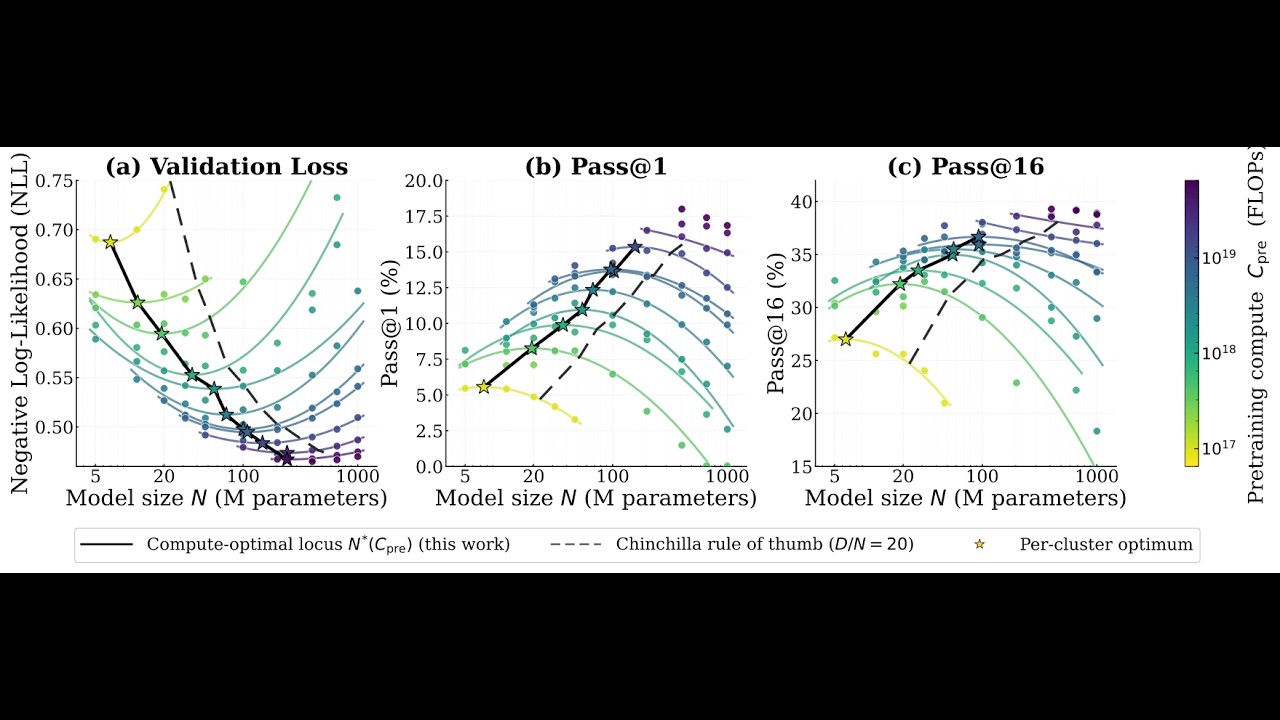
The discussion analyzes a paper proposing a joint scaling law for pre-training and Reinforcement Learning (RL), which models how compute allocation across these stages impacts downstream task performance. Key findings suggest that increasing compute allocated to pre-training significantly boosts the model's ability on specific tasks (Pass 1) but has diminishing returns on generalized capability (Pass K). The analysis highlights the importance of optimizing the trade-off between SFT and RL compute budgets.

Key takeaways

  1. Pre-training vs. RL Compute Allocation 15:20

    The primary takeaway is that increasing compute allocated to pre-training leads to higher performance on downstream tasks (Pass 1). Conversely, while RL improves Pass 1, the model's generalized capability (Pass K) remains relatively stable regardless of the pre-training scale.

  2. Scaling Laws and Model Size 24:45

    When fixing the total compute budget, training smaller models for longer is generally more effective than attempting to train larger models, contradicting simple Chinchilla scaling assumptions in certain contexts.

Watch on YouTube Full article

Between the Layers– Interpreting Large Language Models - Michelle Frost - NDC Toronto 2026 thumbnail

· 56:48

Between the Layers– Interpreting Large Language Models - Michelle Frost - NDC Toronto 2026

This talk provides a deep dive into AI Interpretability, arguing that for Large Language Models (LLMs) to achieve reliability and trust, we must move beyond external explanations (explainability) and understand the internal mechanisms (interpretability). The speaker outlines advanced research—particularly Anthropic's work on mechanistic interpretability—that focuses on decomposing model activations into sparse, single-meaning features. This shift allows engineers to treat LLMs not as black boxes, but as auditable systems that can be tested, monitored, and debugged at the circuit level.

Key takeaways

  1. Interpretability vs. Explainability 1:48

    Interpretability is the 'inside view' (understanding which internal parts wrote the answer), while explainability is the 'outside view' (a human-readable reason for the output). Mechanistic evidence comes from ablating suspected units and observing predictable behavior changes, whereas a salency map or local surrogate provides an account.

  2. The Need for Operational Trust 3:50

    To build trust in LLMs, we must make concepts like truthfulness and calibration operational. This requires understanding the model's internal mechanisms to ensure consistency (robustness) and prevent unsafe answers or agreement bias (syncopancy).

  3. The Interpretability Litmus Test 5:20

    A system should achieve 'understanding' if it can be able to: Name the units, Test their causal importance, Predict counterfactual failures (e.g., misinformation), Instrument them in production, and allow another engineer to Reproduce findings.

  4. Modern Mechanistic Approaches 9:20

    Advanced research uses tools like Sparse Autoencoders (SAEs) and overcomplete dictionaries to decompose model activations into 'features'—internal signals that track a single concept (monosemanticity). This allows for the mapping of complex behaviors to specific, nameable circuits.

  5. The Evolution of AI Safety 11:20

    Interpretability is presented as 'ethical infrastructure.' By understanding internal mechanisms (e.g., default circuits that trigger refusals), we can move from simply measuring outputs to actively debugging and governing the system's behavior.

Watch on YouTube Full article

Datadog Deleted All Its AI Context. It Worked. thumbnail

· 1:01:23

Datadog Deleted All Its AI Context. It Worked.

Datadog detailed its journey scaling AI coding agents across 4,000 engineers, highlighting that performance improvements were achieved by deleting years of accumulated context files (context rot). The discussion emphasizes the critical role of building dedicated evaluation (evals) platforms to make data-driven decisions about model selection and agent capabilities. Key findings include using evals to replay historical PRs for code review guardrails and adapting hiring practices away from traditional LeetCode interviews toward real-world, large codebase tasks.

Key takeaways

  1. Context Rot: Deleting Context Improved Performance 2:49

    The team found that deleting old, accumulated AI context files (written prior to models like Sonnet 3.5) led to better evaluation scores, demonstrating 'context rot'—where historical information becomes irrelevant or harmful to the agent's performance.

  2. Evals for Code Review and Regression Testing 5:49

    The first concrete application of evals was building a platform that replays historical PRs known to have caused incidents, allowing agents to act as a last guardrail before production deployment.

  3. Shift from Productivity to Ambition 59:02

    The core lesson learned is that the goal of AI adoption should not solely be increasing productivity, but rather 'increasing ambition'—enabling teams to attempt and validate more complex ideas.

  4. AI-Driven Interviewing 53:25

    The process of hiring is evolving away from low-signal LeetCode interviews toward real-world scenarios that require AI to navigate and understand large, complex codebases.

Watch on YouTube Full article

Stanford CS329A Self-Improving AI Agents | Part 1 | Course Overview thumbnail

· 1:09:42

Stanford CS329A Self-Improving AI Agents | Part 1 | Course Overview

This course overview details the evolution of Large Language Models (LLMs) from simple predictive models to complex, self-improving agents. Key advancements include understanding scaling laws based on parameters, compute, and data size; developing advanced reasoning capabilities through Chain-of-Thought (CoT); and moving beyond single-turn chat interactions into sophisticated agentic workflows. The focus shifts to building systems that can plan, interact with external tools, self-correct using verifiers, and achieve end-to-end goals in domains like software engineering and data analysis.

Key takeaways

  1. LLM Scaling Laws 2:20

    Model performance improves significantly by scaling up parameters, compute (compute on the x-axis), or dataset size. This exponential growth has been foundational for models like GPT-3 and PaLM.

  2. Agentic Workflows vs. Chatbots 17:05

    Modern LLM applications are moving from single-turn chat formats to complex agentic workflows (e.g., Deep Research, Cloud Code). These systems can take a goal, plan steps, interact with environments/tools, and correct their actions until the goal is achieved.

  3. The Role of Verifiers 22:00

    In agentic systems, verifiers (like unit tests for code) are crucial feedback mechanisms. They allow models to verify generated outputs and guide self-correction, which is essential in verifiable domains like math and coding.

  4. Self-Improvement Loop 27:30

    The most advanced frontier involves combining test time scaling (e.g., repeated sampling) with fine-tuning to generate synthetic, high-quality data. This creates a self-improving loop where the model trains on its own generated solutions.

Watch on YouTube Full article