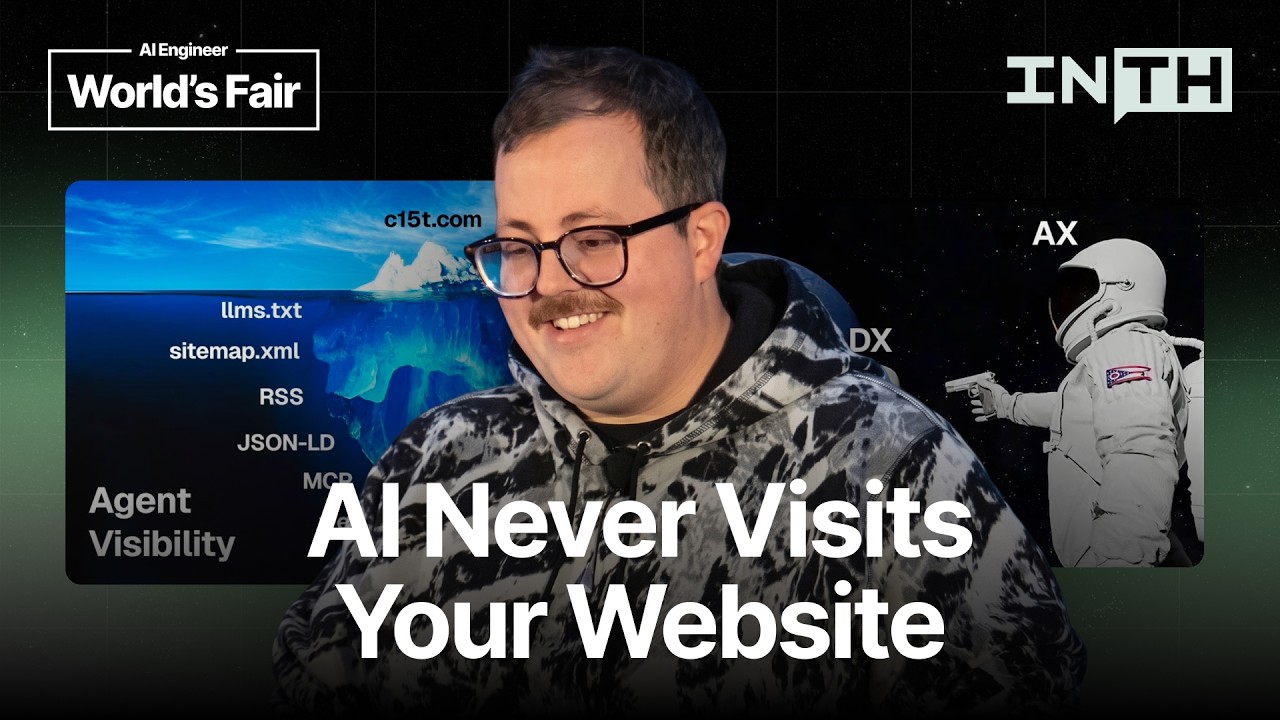
How We Got LLMs to Recommend Our Open Source Library — Christopher Burns, Inth
The talk details how modern developer experience primitives must adapt for consumption by Large Language Models (LLMs) and autonomous agents. The core argument is that optimizing documentation requires moving beyond traditional SEO methods to focus on agent-facing artifacts. Key strategies include manually curating `LLMs.txt`, serving bundled markdown files, and ensuring the repository structure (`node_modules`) contains necessary context for coding agents.
Key takeaways
-
Agent Inbound is the New Standard
Inbound traffic sources are shifting from human discovery to LLMs (e.g., Claude, ChatGPT) recommending libraries like C15T. This requires optimizing for 'agent primitives' rather than just developer experience.
-
Manual Optimization Beats Automation
9:52
For critical files like `LLMs.txt`, manually writing the content is significantly more effective than generating it automatically; 'forty good lines beat a thousand lines of noise.'
-
Bundling Context in Node Modules
Coding agents rarely visit live documentation sites. To improve discoverability, developers should ship bundled markdown documents and an `AGENTS.md` file directly within the package's `node_modules` directory.