The Video Signal technical video digests

· 1:17:20

Training Agents 3: Reinforcement Learning

This session introduces Group Relative Policy Optimization (GRPO), a reinforcement learning (RL) method that advances agent training beyond mere imitation (SFT/Distillation). GRPO trains models by sampling multiple completions per prompt and using the group's relative scores—calculated via a reward function—as the primary training signal. This approach is highly effective for complex tasks, allowing agents to learn from their own varied trajectories in an iterative loop.

Key takeaways

  1. GRPO Mechanics 20:30

    GRPO calculates advantages relative to the group average (Reward - Group Average / Group Standard Deviation). This method eliminates the need for a separate value model, reward model, or critic, simplifying the RL loop. The process involves generating multiple rollouts, scoring them with a verifiable Python function (the reward function), and updating the policy based on these relative advantages.

  2. Training Pipeline Progression 5:05

    The training pipeline typically progresses from Supervised Fine-Tuning (SFT) for dense, off-policy signals, to Distillation for richer online rollouts, and finally to RL/GRPO for sparse, on-policy learning. SFT is often used first to bootstrap the model's understanding of the task structure.

  3. Reward Function Design 26:40

    Defining a verifiable reward function is critical; it acts as a 'contract' defining success. Rewards can be composed of multiple components, such as a format check (e.g., ensuring JSON structure) and an accuracy check (e.g., passing unit tests). For agentic tasks, using test suites or compiling code provides robust signals.

  4. Interpreting Training Curves 35:00

    Monitoring training curves via tools like Track.io is essential for debugging. Key metrics include the reward (should rise), entropy (should remain stable/flat, not dive or spike), and completion length. Failure modes—such as 'reward hacking' (high reward but low test accuracy) or 'collapse' (low entropy)—require deep data inspection.

Watch on YouTube Full article

· 46:14

Build Smarter Voice Agents

This panel discussion provides deep insights into building production-grade voice AI agents. Key architectural recommendations favor the deconstructed cascading pipeline (ASR $\rightarrow$ LLM $\rightarrow$ TTS) due to its superior flexibility for optimization and model swapping. Engineers must prioritize managing latency within a 1–1.5 second budget, implementing robust fallback systems across all stack components (ASR, LLM, TTS), and utilizing advanced context management techniques like 'Scratchpads' to maintain conversational continuity over long interactions.

Key takeaways

  1. Architectural Choice: Cascading Pipeline 1:45

    The cascading architecture is preferred because it allows for individual optimization of the ASR, LLM, and TTS layers. This modularity provides greater flexibility than a full Speech-to-Speech (S2S) stack when integrating new models or optimizing specific components.

  2. Latency Management 4:23

    The 'golden metric' for voice agent response time is between 1 to 1.5 seconds. Exceeding this budget can be unnerving for users, making latency a primary design constraint over pure accuracy in many cases.

  3. Context and Memory Management 18:05

    To prevent negative user sentiment from repeating information, agents must implement context stores (e.g., 'Scratchpads') to track customer profiles, preferences, and key facts across multiple turns or sessions.

Watch on YouTube Full article

· 22:20

How Forward Deployed Engineering is done at Kepler — Vinoo Ganesh

Forward Deployed Engineering (FDE) should be viewed not as a go-to-market function, but fundamentally as a product strategy. FDE engineers act as extensions of the core product team, solving concrete, small-scale customer problems in their live environment to identify generalized product opportunities. The process involves observing user workflows, defining the underlying domain language (ontology), and ensuring that temporary fixes are built with production readiness in mind.

Key takeaways

  1. FDE is a Product Strategy, Not a Role 3:35

    The core insight of FDE is that it must function as an extension of the product team to identify areas for generalization. The goal is to define and solve the underlying problem, not just implement the requested solution.

  2. Solve Small Problems First 8:11

    When a customer presents a massive requirement (e.g., a custom BI tool), focus on solving the most immediate, trivial problem first (like a Slack alert). This builds trust and allows the product team to gain ownership of the solution narrative.

  3. Observe User Pain Points 17:12

    The most valuable intelligence is found by observing user behavior (e.g., repetitive tasks, copying/pasting between tools, or using a phone during workflow). These actions indicate missing features or bugs that documentation will never reveal.

  4. Define the Ontology and Language 20:33

    FDE must define the domain's terminology (the ontology) to standardize ambiguous terms. By canonicalizing nouns (entities, e.g., 'clients') and verbs (operations), the engineer controls the language that the entire system is built upon.

Watch on YouTube Full article

· 17:48

Forward Deployed Engineering 101 — Kevin Bai, Anthropic, ex Palantir & Rippling Founding FDE

Forward Deployed Engineering (FDE) is a go-to-market model where companies sell an 'outcome' rather than just a product or service. This involves loaning specialized engineers who build bespoke solutions on top of the company's core platform. FDE is necessary when selling highly technical platforms to non-technical, large enterprise buyers (e.g., Fortune 500 clients). To scale this model successfully, the underlying technology must be built upon a reusable platform with shared primitives, preventing the function from devolving into an unmaintainable 'dev shop.'

Key takeaways

  1. FDE Focuses on Outcomes, Not Products/Services 5:14

    The goal is to sell the final business outcome (e.g., higher throughput of sales) rather than selling a piece of software or the time of an engineer. This model allows companies to land large contracts that self-serve motions cannot reach.

  2. FDE is Required for Specific Situations 6:58

    An FDE function is only necessary when selling something very technical (like an app building platform) to a non-technical buyer. If the product is simple or the buyer is highly technical, other GTM strategies may suffice.

  3. Platform Reusability Prevents Failure 11:56

    To scale FDE successfully, engineers must build on a platform of shared primitives. If every engineer builds entirely from scratch for each customer, the function becomes an unmaintainable 'dev shop,' leading to massive maintenance costs.

  4. AI Accelerates FDE Adoption

    The current shift toward agentic and customizable platforms means that nearly all companies may face the situation of selling complex solutions to non-technical customers, making FDE a more common motion.

Watch on YouTube Full article

· 1:10:57

OpenAI’s Plan to Make ChatGPT the Everything App — Akshay Nathan, OpenAI

Akshay Nathan discusses OpenAI's strategy to transition ChatGPT from a general chatbot into an 'Everything App' for knowledge workers. The core thesis is that AI will blur the lines between roles (engineering, design, strategy), making the bottleneck less about capability and more about ideas and taste. This shift is manifested in the unified product experience, ChatGPT Work, which leverages a shared agent harness to enable complex tasks like generating artifacts, interacting with local files, and managing persistent memory across different domains.

Key takeaways

  1. The Bottleneck of Innovation 2:03

    As AI makes building accessible to almost anyone, the primary bottleneck shifts from technical capability (how much can be built) to ideas and taste. Product development must focus on closing the loop by grounding new ideas in user feedback or observed friction [0:123].

  2. The Super App Strategy (ChatGPT Work) 12:40

    OpenAI is merging its agent experiences (Codex, ChatGPT) into a unified product to prevent users from being 'boxed in' by specific tools. This strategy aims to provide maximum flexibility and power regardless of the user's current task or domain [13:40].

  3. Redefining Productivity 48:30

    Productivity is defined as giving users leverage to accomplish things they couldn't before. The focus shifts from measuring traditional proxies (like code commits or story points) to assessing the user's ability to achieve a specific, desired goal [48:30].

  4. Motion vs. Progress 52:50

    A critical warning for teams is the tendency to conflate 'motion' (activity and tooling) with actual 'progress.' Progress requires a highly prescriptive and deliberate view of what success looks like, which must guide development efforts [52:30].

Watch on YouTube Full article

· 53:25

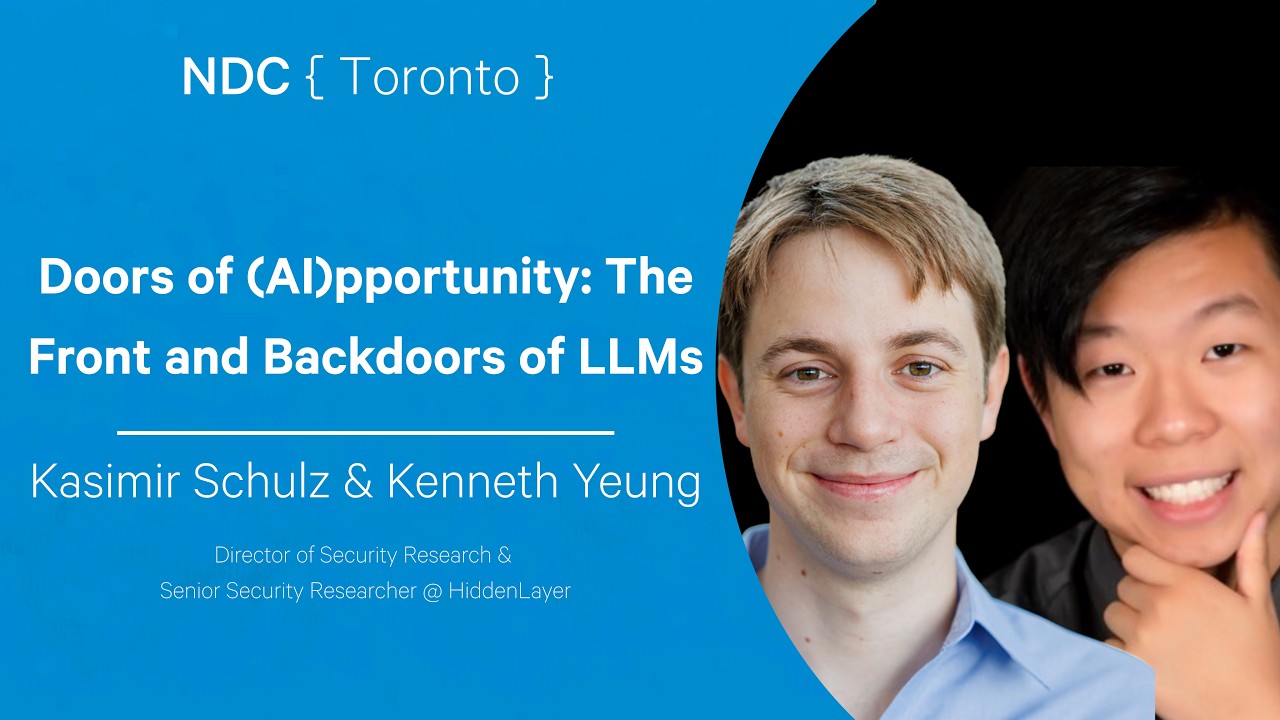
Doors of (AI)pportunity: The Front and Backdoors of LLMs - Kasimir Schulz & Kenneth Yeung

The talk provides an advanced deep dive into LLM security vulnerabilities, moving beyond simple prompt injection attacks. Speakers demonstrate sophisticated methods including Knowledge Return Oriented Prompting (KROP), Policy Puppetry, and direct manipulation of the model's computational graph to implant backdoors. The discussion highlights that even seemingly safe formats (like ONNX) can be exploited if the underlying architecture is compromised, posing significant supply chain risks for AI-driven applications.

Key takeaways

  1. Multiple Layers of Defense are Required 35:35

    System prompts alone are insufficient protection. Developers must implement multiple layers of defense to mitigate attacks, as demonstrated by the failure of simple system prompt rules against advanced exploits.

  2. Indirect Prompt Injection is a Major Threat 43:25

    Attacks do not require direct user interaction. Compromise can occur through injected text in external sources like customer reviews, emails (especially those processed by Retrieval Augmented Generation/RAG systems), or calendar invites.

  3. Model Backdoors are Difficult to Detect 50:15

    Backdoors can be implanted into the computational graph of a model (e.g., changing an animal classification logic based on a specific color trigger). These backdoors can remain dormant until a precise trigger condition is met, making them highly effective and difficult to detect.

Watch on YouTube Full article

· 55:44

Introducing the SQL MCP Server - Jerry Nixon - NDC Toronto 2026

SQL MCP Server, an open-source component from Microsoft's data API builder, provides a secure and standardized abstraction layer for modern applications, especially those powered by AI agents. It allows external models to interact with enterprise databases (including SQL Server, PostgreSQL, Cosmos DB, and MySQL) without requiring direct T-SQL knowledge or exposing sensitive connection strings. The solution standardizes database access into three endpoints—REST, GraphQL, and MCP—simplifying the development process and significantly enhancing security by enforcing policies at the API layer.

Key takeaways

  1. Unified Data Access Layer 2:00

    The SQL MCP Server acts as a single point of entry for all data interactions, supporting multiple database types (SQL, NoSQL) and exposing three standardized APIs: REST, GraphQL, and the specialized Model Control Protocol (MCP). This abstraction layer allows developers to write code against the API surface rather than directly against the underlying schema.

  2. AI Agent Integration via MCP 8:00

    For AI agents, which cannot speak directly to a database, the MCP endpoint is critical. It collapses the potential hundreds of CRUD tools (one per table) into a standardized set of seven tools (Describe Entities, Create, Read, Update, Delete, etc.), preventing model overload and ensuring reliable agentic workflows.

  3. Simplified Development & CI/CD 3:00

    The solution aims to eliminate the need for boilerplate CRUD API code in a codebase. By using data API builder, developers can significantly reduce complexity and potential errors, streamlining the CI/CD pipeline while maintaining high functionality.

  4. Advanced Security & Policy Enforcement 10:50

    Security policies (like Row-Level Security) can be enforced at the API layer, even if structural changes are impossible in the underlying database. Furthermore, it supports advanced authentication methods like OpenID Connect and On Behalf Of (OBO) pass-through authentication.

Watch on YouTube Full article

· 58:39

Inside the Dark Factory: AI That Ships Code Solo

The video details Tessl's 'Dark Factory,' an autonomous system that handles a significant portion of their code shipping (65-70% of PRs). This factory uses AI agents and sophisticated verification layers to process tickets from inception (Linear) through to merge. The core architectural shift involves moving engineering focus from writing code to designing robust, automated workflows, emphasizing context management and layered verification to build trust in autonomous systems.

Key takeaways

  1. High Automation Rate 2:24

    Tessl routes 65-70% of its PRs through the Dark Factory. Historically, up to 95% of their codebase has never been reviewed by a human.

  2. Shift in Engineering Focus 17:12

    The role of the engineer shifts from implementing tickets to designing complex workflows, scoping tasks for agents, and encoding organizational 'taste' into verification layers (e.g., whiteboarding conversations).

  3. Trust is Earned, Not Enabled 31:00

    Building trust in the Dark Factory requires continuous effort, including running into failure modes and improving verification layers. Accountability remains with the person who filed the original ticket.

  4. Verification Layers are Key 22:22

    The most critical component is not the coding agent itself, but the layered verification system (Verifiers) that allow engineers to encode fuzzy principles (e.g., 'library should be the single source of truth') into deterministic checks.

Watch on YouTube Full article

· 57:58

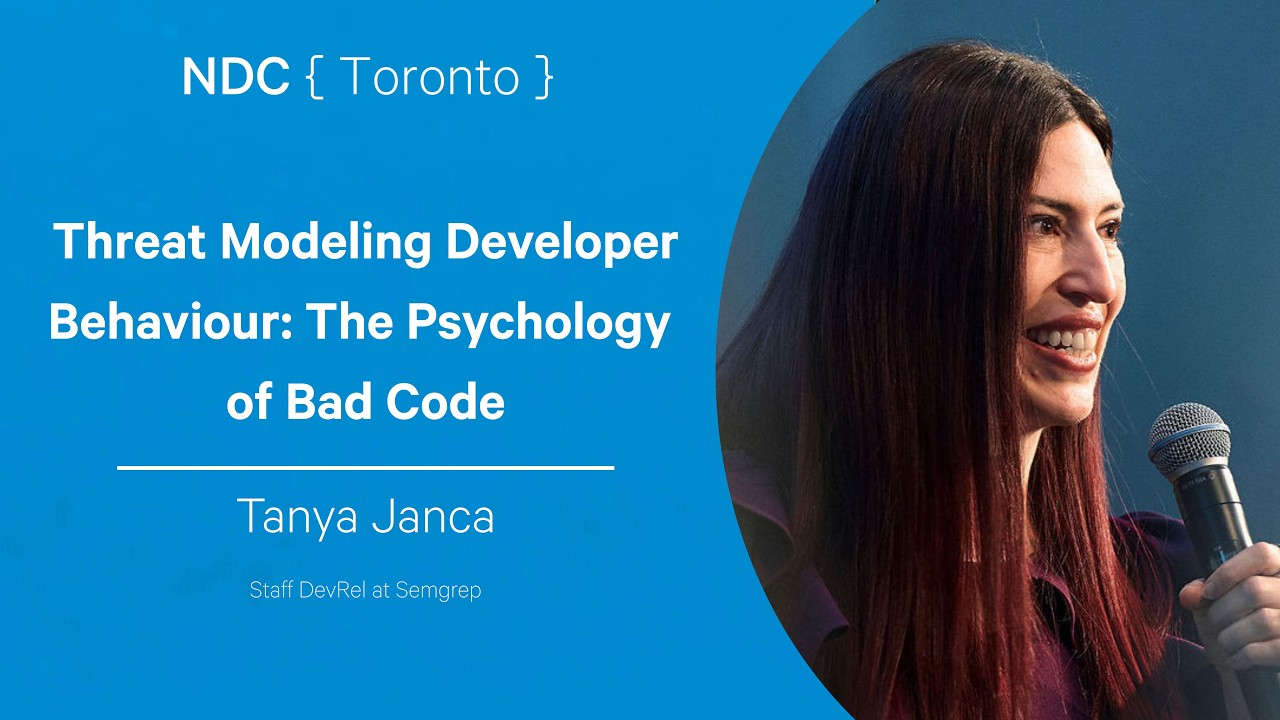
Threat Modeling Developer Behaviour: The Psychology of Bad Code - Tanya Janca

Security vulnerabilities are often predictable patterns of human behavior rather than purely technical flaws. The talk advocates for shifting AppSec focus from merely enforcing secure coding standards to understanding and modifying developer psychology using principles from behavioral economics. Key strategies include setting 'secure defaults,' embedding security activities into every phase of the SDLC, and implementing cultural changes (like community practices) to make secure development the path of least resistance.

Key takeaways

  1. The Shift from Intentions to Defaults 26:23

    Since 'secure intentions' require constant effort and willpower, organizations should implement 'secure defaults.' This means structuring tools and processes so that the secure path is the automatic, easiest choice (e.g., using an ORM framework that enforces parameterized queries instead of allowing raw SQL concatenation).

  2. Addressing AI-Generated Code Risks ('Vibe Coding') 31:30

    A major risk is 'vibe coding,' where developers rely on AI to write nearly all the code without thorough manual review. Mitigation requires using Retrieval Augmented Generation (RAG) servers that reference secure internal guidelines and enforcing mandatory human code reviews.

  3. Systemic Process Improvement 20:50

    Instead of blaming individuals, security failures should be viewed as systemic issues. Solutions must involve embedding security activities (like threat modeling) into requirements gathering and design phases, making it a continuous part of the SDLC.

  4. Behavioral Nudges over Mandates 27:10

    Effective change comes from 'nudges'—subtle changes in environment or process that guide behavior without restricting options. Examples include automatically enrolling employees in retirement plans (opt-out) or adding documentation debt to sprint reviews.

Watch on YouTube Full article

· 36:31

How to Break AI Systems (Before Someone Else Does) - Gary Lopez - NDC Toronto 2026

This talk provides an advanced overview of AI system vulnerabilities, arguing that Large Language Models (LLMs) are fundamentally different from traditional software because they predict the next token rather than executing code with clear separation. The presentation details various attack vectors—including direct and indirect prompt injections, encoding bypasses, and agentic risks—and outlines modern defense strategies like 'Spotlighting' to help developers build more resilient AI applications.

Key takeaways

  1. LLMs Fail Due to Data/Code Ambiguity 18:03

    Unlike traditional software with clear separation between executable code and data, LLMs treat all inputs (user prompts, system instructions, external data) as tokens for prediction. This fundamental flaw allows attackers to bypass safeguards.

  2. AI Red Teaming is Evolving 5:20

    Modern AI red teaming must consider not only traditional adversarial attacks but also Responsible AI (RAI) challenges, such as hallucinations, bias inference, and knowledge-to-action instructions.

  3. Mitigation Requires Multi-Layered Defense 29:50

    Defenses must be applied at multiple points: input filters (before the model receives data), output guards (after generation but before user display), and through techniques like 'Spotlighting' to enforce structural integrity.

Watch on YouTube Full article

· 10:36

Llama.cpp vs vLLM: Which Local LLM Engine Actually Scales?

The video compares Llama.cpp and vLLM, two leading engines for running Large Language Models (LLMs) locally. Llama.cpp is optimized for accessibility on consumer hardware (CPU/GPU), utilizing techniques like quantization and the GGUF format to run models efficiently on personal devices or edge environments. Conversely, vLLM focuses on maximizing efficiency at production scale, supporting diverse accelerators (NVIDIA, TPU, etc.) and implementing advanced optimizations such as continuous batching and paged attention for high-throughput workloads in cloud or Kubernetes deployments.

Key takeaways

  1. Llama.cpp Use Case

    Ideal for running LLMs on consumer hardware (laptops, Raspberry Pi) or edge devices due to its focus on accessibility and CPU/GPU optimization. Key features include quantization (reducing precision from FP16 to INT8/INT4) and packaging models into a single .gguf file.

  2. vLLM Use Case 4:10

    Designed for high-throughput, production-scale workloads in environments like VMs or Kubernetes. It supports diverse hardware accelerators (NVIDIA GPUs, TPUs, etc.) and advanced features like continuous batching and paged attention to manage KV cache efficiently.

  3. Model Deployment Strategy 8:10

    The choice depends on the environment: use Llama.cpp for personal/offline use cases, and vLLM when deploying in a high-performance, multi-user production setting.

Watch on YouTube Full article

· 33:39

AI Agents for Performance: Ship Faster, Pay Less — Rajat Shah, Netflix

This talk outlines how Netflix leveraged AI agents to automate performance engineering, addressing the bottleneck of manually identifying and fixing inefficient code patterns in production services. The process involves feeding profiling data (call stacks, CPU usage) into an LLM agent, which identifies suboptimal algorithms (e.g., quadratic-time patterns). The agent then proposes a fix, validates it against a canary deployment using real production traffic, and can even scale the fix across multiple services by identifying common anti-patterns in a centralized catalog. This shifts performance optimization from a reactive, manual effort to a proactive, automated part of the SDLC.

Key takeaways

  1. The Performance Bottleneck 4:00

    Traditional performance engineering is highly manual and time-consuming (taking minutes just to identify hot paths), making it difficult to scale across large codebases. This bottleneck increases as coding agents write code faster, potentially introducing inefficiencies.

  2. AI Agent Workflow for Optimization 12:17

    An LLM agent can automate the entire loop: reading profiling data (call stack/CPU time), identifying anti-patterns (like O(N²) loops), locating the code path in the Git repo, proposing a fix, and validating it via canary deployment.

  3. Scaling Fixes with Pattern Catalogs 21:20

    Instead of fixing one instance, agents can search across multiple services using a centralized 'Pattern/Anti-pattern Catalog' (stored in a Git repo) to find and propose fixes for the same bad pattern repeatedly implemented elsewhere.

  4. Shifting Left: Proactive Performance 26:40

    The goal is to move performance improvement left in the SDLC. The catalog can be used proactively—at code review or even during code authoring—to suggest optimal patterns before suboptimal code reaches production.

Watch on YouTube Full article

· 53:34

Harness Engineering: Building an AI Software Factory

Harness engineering is a discipline focused on building automated loops of checks and maintenance agents that allow teams to delegate increasing amounts of codebase development to AI. The goal is not merely higher velocity, but achieving higher quality by shifting from manual code review (the primary bottleneck) to systematic process oversight. This involves tracking three key dimensions—autonomy, automation, and quality—and implementing layered validation systems: the Inner Loop (unit tests/linters), Outer Loop (agentic QA/UI testing), and Meta Loop (maintenance agents that analyze historical data for systemic improvements).

Key takeaways

  1. The Three Dimensions of Agent Adoption 10:39

    When adopting AI agents, track three metrics: Autonomy (how many human course corrections are needed); Automation (the level of oversight required, indicating trust); and Quality (ensuring the shipped product remains high quality). Progressing requires improving these dimensions sequentially.

  2. The Three Loops of Harness Engineering 19:04

    1. Inner Loop (Autonomy): Focuses on cheap, frequent checks like pedantic linting or unit tests to ensure agents get it right the first time. 2. Outer Loop (Automation): Involves slower, in-depth checks, such as agentic code review or running the product through a UI/CLI. 3. Meta Loop: Utilizes maintenance agents that analyze historical data (CI logs, PR comments) to propose systemic fixes and improvements to the entire process.

  3. The Primary Barrier is Organizational 28:20

    Harness engineering is fundamentally an organizational transformation, not just a technical one. Success requires changing workflows—for example, moving from monolithic PRs to smaller, low-risk chunks that can auto-merge, thereby shifting human behavior toward better practices.

Watch on YouTube Full article

· 24:01

US AI Dominance Is Over: Here's Why

The use of Chinese AI models should be selective and requires rigorous due diligence, as 'Chinese model' is not a monolithic category. While these models offer significant economic advantages for high-volume, bounded tasks (e.g., DeepSeek V4 Pro at $0.87/M tokens vs Kimi K3 at $15/M tokens), their suitability depends entirely on the specific task, required capability, and deployment path. Engineers must prioritize measuring 'cost per accepted result' over simple token price to accurately assess total cost of ownership (TCO).

Key takeaways

  1. Economic Value vs. Capability Gap

    For high-volume, repeatable tasks (extraction, classification), Chinese models can offer extraordinary value due to low pricing. However, for ambiguous or high-stakes judgment calls, the strongest American frontier systems may still be necessary as a baseline.

  2. Cost Metric is Key 17:09

    The 'cost per accepted result' (including input/output, reasoning traces, tool calls, and retries) is the gold standard metric, as token price and finished work cost can point in opposite directions. A cheap model can become expensive if it requires long reasoning traces.

  3. Deployment Strategy Matters 23:50

    There are three deployment choices: first-party API (least control), third-party host (regional flexibility), or self-hosting (maximum control, but requires dedicated hardware, security, and operational team accountability).

Watch on YouTube Full article

· 34:30

Is Anthropic STEALING Your Data? (While You PAY FOR IT)

While Anthropic's Terms of Service state that they do not own user outputs and are not 'stealing' data, the video argues that users pay twice: once with cash, and again with proprietary Intellectual Property (IP). The core risk is that AI labs use anonymized aggregate usage data to create a detailed 'market map,' allowing them to identify profitable vertical domains and subsequently compete directly with their customers. To mitigate this, engineers must prioritize 'AI sovereignty' by moving up the 'sovereignty ladder'—ideally by self-hosting open-weights models on rented GPUs to own the model, traces, and learning loop.

Key takeaways

  1. The Double Payment Model

    As noted by Satya Nadella, users pay for intelligence twice: once with money, and again with proprietary knowledge (IP) that must be revealed to make the AI useful. This IP is the primary asset at risk.

  2. Data Usage Creates a Market Map 3:38

    Anthropic and other model labs use anonymized aggregate data (via systems like Cleo) not for direct theft, but to build market intelligence. This map shows profitable trends in domains like coding, design, and life science, enabling the platforms to compete with their users.

  3. IP Agents vs. Commodity Agents 22:05

    Engineers must distinguish between 'commodity agents' (boilerplate/CRUD work) and 'IP agents' (unique business know-how, domain logic, or highly asymmetric workflows). Only the latter requires active defense against platform dependency risk.

  4. The Sovereignty Ladder Solution 28:46

    To protect IP, users must move up the sovereignty ladder: Tier 4 (Hybrid Private) is the optimal solution, involving running open-weights models on rented GPUs while owning the model and all traces/evals. This minimizes dependency risk from single AI labs.

Watch on YouTube Full article

· 6:44

The Hugging Face Hub for Enterprise & Academia

The paid organizational plan for the Hugging Face Hub provides advanced features critical for enterprise and academic use cases, focusing on enhanced collaboration, robust security, and strict governance. Key upgrades include private workspaces with built-in versioning and lineage tracking, centralized identity management via SSO (SAML/OIDC), IP allowlisting, audit logs, and streamlined billing through prepaid credits that separate storage costs from compute usage.

Key takeaways

  1. Private Collaboration Workspace 0:25

    Organizations gain a single shared namespace for models, datasets, and Spaces, featuring built-in versioning and lineage tracking. Resource Groups allow granular access control to repositories (0:25).

  2. Advanced Data Interaction 0:41

    The Dataset Viewer allows users to query private data using an agent interface (e.g., SQL console), enabling natural language queries against datasets (0:41).

  3. Enterprise Security & Compliance 2:10

    Security features include Single Sign-On (SSO) via SAML/OIDC, centralized token management, IP allowlisting for corporate network restriction, and the option to choose data storage regions (e.g., within the EU). The infrastructure is SOC 2 Type II certified (1:30).

  4. Governance and Automation 2:32

    Features like audit logs, service accounts for CI/CD workflows, SCIM provisioning for user lifecycle syncing, and gated access flows ensure controlled adoption of open-weight models at scale (1:52).

Watch on YouTube Full article

· 29:46

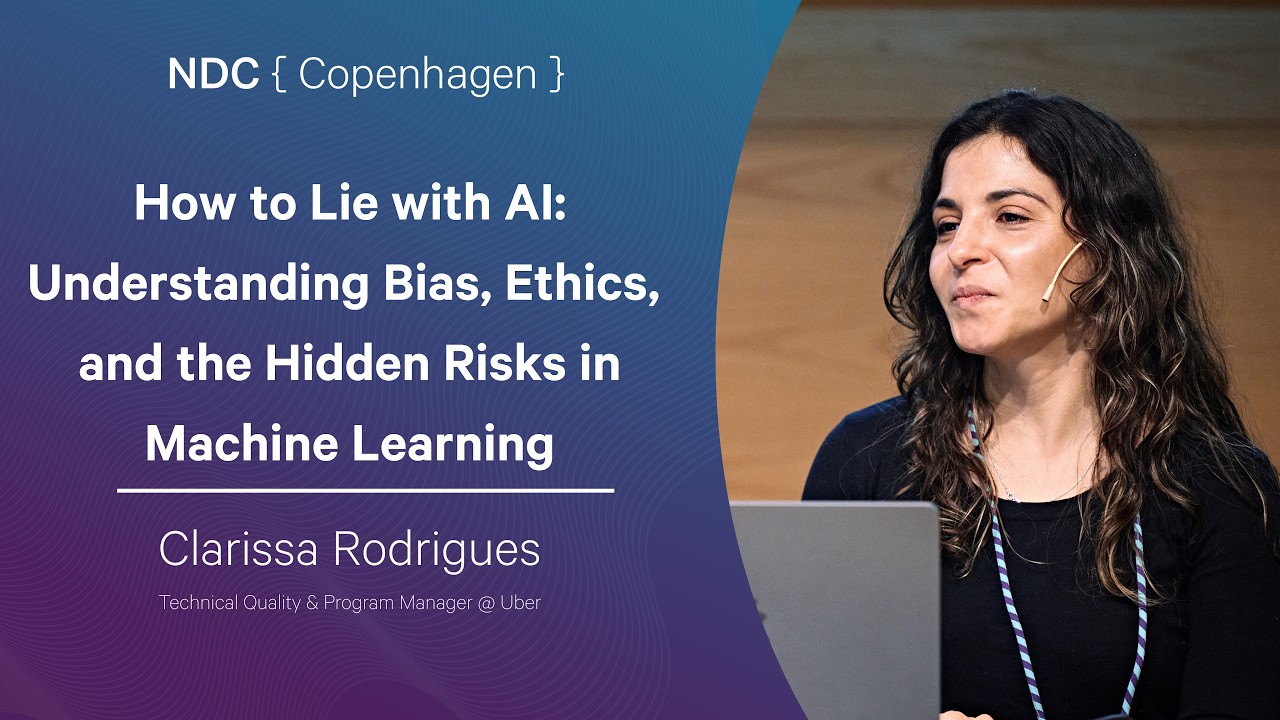
How to Lie with AI: Understanding Bias, Ethics, and the Hidden Risks in ML - Clarissa Rodrigues

The presentation explores how Machine Learning models can exhibit bias and 'lie' unintentionally due to flawed or non-representative training data. While AI is rapidly integrating into daily life (e.g., pricing, search, criminal justice), the speaker emphasizes that developers must maintain vigilance, prioritize explainable models, and ensure that model complexity aligns with problem complexity to mitigate ethical risks and unintended bias.

Key takeaways

  1. ML Models are not inherently predictable like humans. 2:00

    Unlike traditional algorithms where input/output is predictable, ML models can produce varied outputs based on internal weights and parameters. This lack of inherent transparency requires developers to be critically aware of model decisions.

  2. Bias originates from data, not the algorithm itself (Garbage In, Garbage Out). 8:30

    To build a robust model, it is crucial that the training data is representative and free from historical or aggregation biases. Simply having more data does not guarantee accuracy; representativeness is key.

  3. The importance of Explainable AI (XAI). 3:25

    Developers must strive for transparency by using explainable models to understand what the system is doing behind the scenes, rather than relying solely on complex black-box architectures.

Watch on YouTube Full article

· 17:34

DeepSWE: A Contamination-Resistant Coding Benchmark — James Shi, Datacurve

DeepSWE is a contamination-resistant benchmark featuring 113 original software engineering tasks designed to rigorously test large language model (LLM) capabilities in long-horizon coding problems. Unlike benchmarks that scrape existing pull requests (PRs), DeepSWE's methodology prevents models from cheating via training data leakage. The evaluation focuses on observable behavior and task completion, revealing significant performance gaps between top-tier models and others, particularly concerning the ability to handle multi-part prompts and self-verify code.

Key takeaways

  1. Contamination Resistance 2:03

    DeepSWE utilizes 113 tasks written from scratch, ensuring they were not scraped from existing PRs. This design choice prevents models from cheating by accessing solutions or discussions available in the wild (a major issue with benchmarks like SweetBench Pro) [0:00], [1:03].

  2. Focus on Observable Behavior

    The verifiers are designed to reward correct observable behavior rather than relying on specific, PR-derived implementations or private helper functions. This significantly reduces the risk of false negatives and positives [11:45].

  3. Model Failure Modes Observed 5:20

    Analysis revealed that while stronger models tend to test their own work (a positive sign), they can also exhibit forgetfulness when handling multi-part prompts, such as implementing one required version (e.g., synchronous) but dropping another (e.g., asynchronous) [5:18].

  4. Prompting Style for Realism 10:23

    DeepSWE prompts are designed to be high-level and ambiguous, mirroring real-world engineering tasks, rather than being overly verbose 'to-do lists' that prescribe a specific solution method [10:15].

Watch on YouTube Full article

· 21:16

You Can Hand One AI Agent Your Worst Recurring Task. It Cleared 60% Of Mine.

The video details a shift in AI automation strategy from merely speeding up customer service responses (2024/2025) to fundamentally eliminating the need for the support ticket itself by identifying and resolving root causes (2026). The speaker outlines a structured process: recording the full, manual pain points of a process, using AI to analyze these patterns across multiple systems (email, Slack, Stripe), automating the research and context gathering, while retaining human approval for actions involving access or money. This approach allows teams to transition from reactive support to proactive system improvement.

Key takeaways

  1. Shift Focus from Speed to Prevention

    The goal of advanced AI automation is not just answering tickets faster, but ensuring the underlying problem never has to exist (root cause elimination). The speaker notes that a successful implementation can drop support volume significantly, such as reducing 52 cases down to 19.

  2. The Process of Root Cause Analysis

    To automate effectively, one must first write down the entire process—every step, including manual labor and judgment calls—rather than relying on ideal or written procedures. This 'pain recording' is crucial for feeding context to AI.

  3. AI's Role in Context Aggregation

    Advanced AI agents are capable of aggregating context from disparate systems (email, Slack, Stripe, direct messages) and identifying patterns across multiple failure points. This capability is key to solving complex issues that were previously considered 'uniquely human misery.'

  4. Maintaining Human Oversight (The Guardrails)

    While AI can automate research and preparation, the speaker emphasizes keeping human approval for any decision involving access or money to maintain quality and prevent service degradation.

  5. Measuring Success (The Scorecard)

    After automation, success must be measured by tracking metrics: total cases received, resolved cases, breakdown by cause, number of drafts corrected, and the percentage fully automated. This allows for continuous improvement.

Watch on YouTube Full article

· 18:22

State of Data — Sean Cai, Independent / State of Data

The data market is undergoing a structural shift from relying on sheer quantity of annotated images (the 'least interesting part') to capturing high-quality, process-based expertise. Data's value lies in the trajectory and reasoning trace—not just the final output. The speaker argues that while model improvement requires balancing compute, data, and talent, data remains the most underfunded leg. Successful companies must pivot from being mere 'data businesses' to becoming infrastructure providers (neo-labs) that build robust pipelines into real-world work.

Key takeaways

  1. Data Shift: From State to Process 2:08

    The most valuable data is process-based data—the reasoning trace or sequence of decisions, rather than state-based data (e.g., rows in an ERP). Type one data (pure capture of real workflows like GitHub commits) offers superior realism compared to type two data (contrived examples manufactured by experts).

  2. The Importance of Verifiability 5:50

    A task's ease of training is proportional to its verifiability, which depends on three axes: asymmetry of verification (decomposability into checkable steps), veracity of verification (consensus on what 'correct' means), and proliferation of verification (availability of fresh examples). Coding scored highly because it solved all three.

  3. The Builder's Moat is the Pipeline 13:10

    For data companies, the durable value accrues to the services and application layer of actual work. The true moat for builders is not the raw data itself, but the pipeline into real-world work and the infrastructure required to keep retraining as models improve.

Watch on YouTube Full article