Topic

LLM Benchmarking

All digests tagged LLM Benchmarking

· 17:34

DeepSWE: A Contamination-Resistant Coding Benchmark — James Shi, Datacurve

DeepSWE is a contamination-resistant benchmark featuring 113 original software engineering tasks designed to rigorously test large language model (LLM) capabilities in long-horizon coding problems. Unlike benchmarks that scrape existing pull requests (PRs), DeepSWE's methodology prevents models from cheating via training data leakage. The evaluation focuses on observable behavior and task completion, revealing significant performance gaps between top-tier models and others, particularly concerning the ability to handle multi-part prompts and self-verify code.

Key takeaways

  1. Contamination Resistance 2:03

    DeepSWE utilizes 113 tasks written from scratch, ensuring they were not scraped from existing PRs. This design choice prevents models from cheating by accessing solutions or discussions available in the wild (a major issue with benchmarks like SweetBench Pro) [0:00], [1:03].

  2. Focus on Observable Behavior

    The verifiers are designed to reward correct observable behavior rather than relying on specific, PR-derived implementations or private helper functions. This significantly reduces the risk of false negatives and positives [11:45].

  3. Model Failure Modes Observed 5:20

    Analysis revealed that while stronger models tend to test their own work (a positive sign), they can also exhibit forgetfulness when handling multi-part prompts, such as implementing one required version (e.g., synchronous) but dropping another (e.g., asynchronous) [5:18].

  4. Prompting Style for Realism 10:23

    DeepSWE prompts are designed to be high-level and ambiguous, mirroring real-world engineering tasks, rather than being overly verbose 'to-do lists' that prescribe a specific solution method [10:15].
Watch on YouTube Full article

· 2:53:57

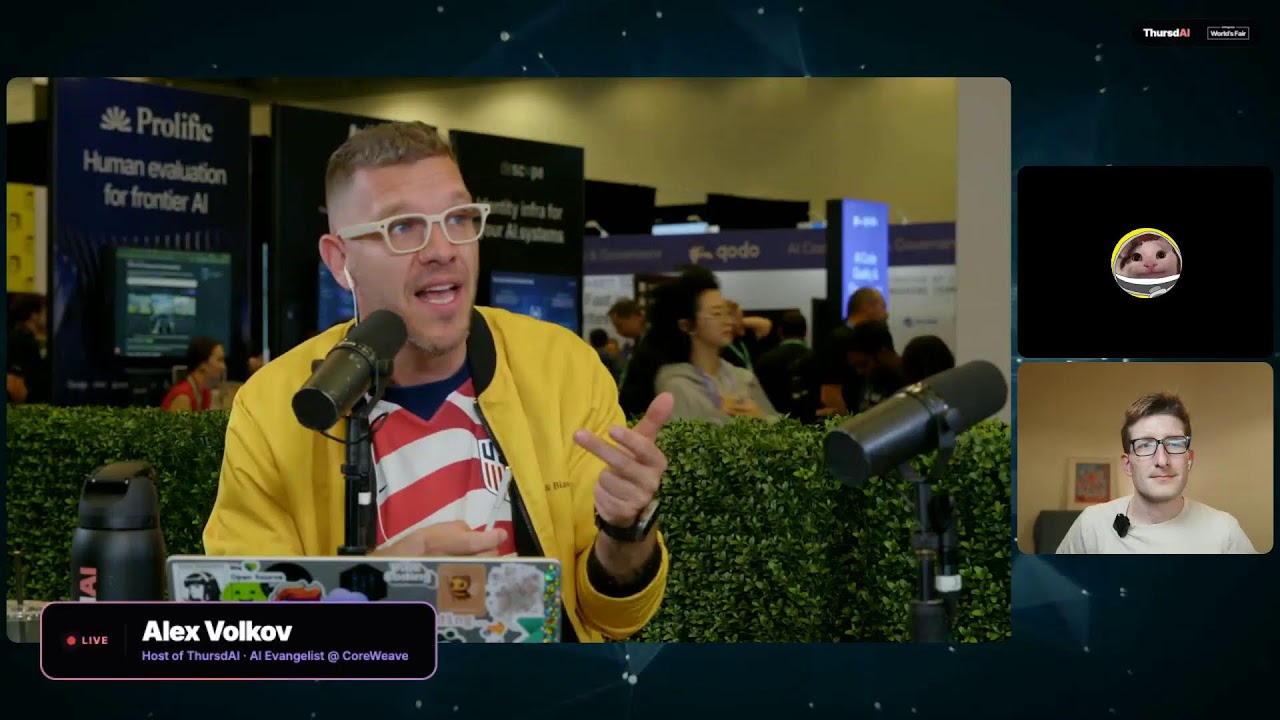
📅 ThursdAI - LIVE from AI Engineer Worlds Fair - OpenAI, DeepMind, EXO, Sakana & more friends

This live panel discussion from the AI Engineer World's Fair focuses on the critical shift toward local and open-source AI models. Speakers debated the current state of frontier models (like OpenAI's GPT-5.6) versus decentralized, sovereign AI solutions running on consumer hardware. Key technical topics included model routing (Fugu), agentic workflows using tools like Weights & Biases' Coreweave Ara, and the necessity of local inference to ensure data sovereignty and prevent vendor lock-in.

Key takeaways

  1. The resurgence of Fable 22:40

    Fable is back, marking a significant moment for open models. The discussion highlighted that this trend emphasizes the need for decentralized AI solutions over reliance on single cloud providers.

  2. Local AI and Sovereignty 35:50

    Running large language models (LLMs) locally is presented as crucial for guaranteeing data sovereignty, preventing vendor lock-in, and ensuring continuous operation regardless of cloud provider restrictions.

  3. Model Routing and Orchestration 45:00

    The concept of model routers (like Fugu) was presented as a superior method for achieving high performance, allowing users to dynamically select the best model for specific tasks rather than relying on a single monolithic LLM.

  4. The Agentic Era and Tooling 1:03:20

    Tools like Weights & Biases' Coreweave Ara are emerging to automate the entire AI research loop (auto-research), moving beyond simple chatbots into full agentic co-pilots for ML engineers.

Watch on YouTube Full article