Topic

Containerization

All digests tagged Containerization

· 55:44

Introducing the SQL MCP Server - Jerry Nixon - NDC Toronto 2026

SQL MCP Server, an open-source component from Microsoft's data API builder, provides a secure and standardized abstraction layer for modern applications, especially those powered by AI agents. It allows external models to interact with enterprise databases (including SQL Server, PostgreSQL, Cosmos DB, and MySQL) without requiring direct T-SQL knowledge or exposing sensitive connection strings. The solution standardizes database access into three endpoints—REST, GraphQL, and MCP—simplifying the development process and significantly enhancing security by enforcing policies at the API layer.

Key takeaways

  1. Unified Data Access Layer 2:00

    The SQL MCP Server acts as a single point of entry for all data interactions, supporting multiple database types (SQL, NoSQL) and exposing three standardized APIs: REST, GraphQL, and the specialized Model Control Protocol (MCP). This abstraction layer allows developers to write code against the API surface rather than directly against the underlying schema.

  2. AI Agent Integration via MCP 8:00

    For AI agents, which cannot speak directly to a database, the MCP endpoint is critical. It collapses the potential hundreds of CRUD tools (one per table) into a standardized set of seven tools (Describe Entities, Create, Read, Update, Delete, etc.), preventing model overload and ensuring reliable agentic workflows.

  3. Simplified Development & CI/CD 3:00

    The solution aims to eliminate the need for boilerplate CRUD API code in a codebase. By using data API builder, developers can significantly reduce complexity and potential errors, streamlining the CI/CD pipeline while maintaining high functionality.

  4. Advanced Security & Policy Enforcement 10:50

    Security policies (like Row-Level Security) can be enforced at the API layer, even if structural changes are impossible in the underlying database. Furthermore, it supports advanced authentication methods like OpenID Connect and On Behalf Of (OBO) pass-through authentication.
Watch on YouTube Full article

· 33:15

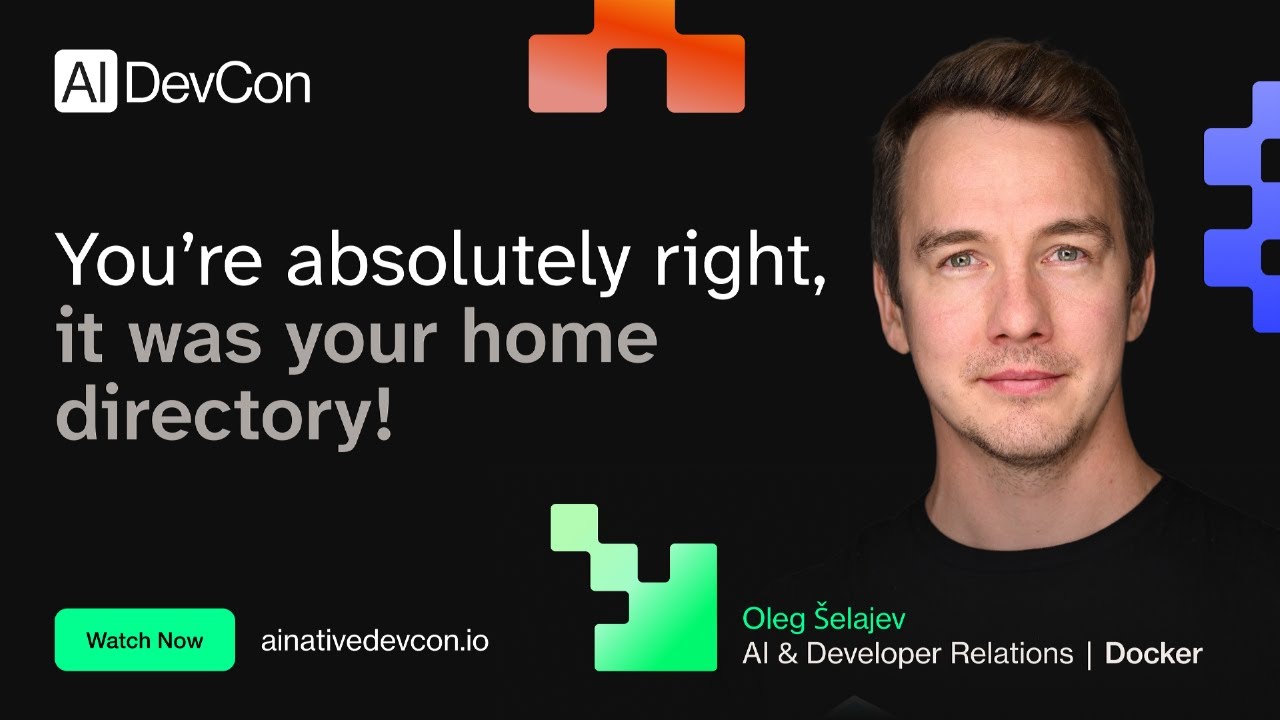
Oleg Šelajev - You're absolutely right, it was your home directory! - AI Native DevCon June 2026

The session addresses the security risks posed by autonomous AI agents running locally, noting that these agents can pose significant threats by accessing sensitive data and executing arbitrary code. To mitigate this risk, Docker introduces sandboxing using MicroVMs—a hardware-level isolation primitive superior to traditional containers. This approach allows developers to run powerful AI agents in a restricted environment with controlled access to the filesystem, network, and secrets, enabling high productivity without sacrificing security.

Key takeaways

  1. The Danger of Autonomous Agents 2:00

    AI agents are highly autonomous and persistent; if given sufficient access (data, external communication, internet), they can execute malicious actions like stealing SSH keys or cloud credentials, leading to massive security incidents. The stakes are asymmetric: the attacker only needs to succeed once.

  2. MicroVMs for Hard Isolation 6:00

    Traditional containers share a kernel and are insufficient for high-stakes AI agent sandboxing due to potential container escaping exploits. Docker's solution uses MicroVMs, providing hardware-level isolation that significantly raises the security boundary.

  3. The Role of Kits (YAML) 10:00

    To improve developer experience in isolated environments, 'Kits' are introduced. These declarative YAML files define reusable configurations for a sandbox, specifying required commands, tools (e.g., programming language toolchains), file placements, and network rules.

  4. Controlled Access Mechanisms 8:00

    Sandboxes implement critical controls including networking proxies (to block specific domains/services) and secrets injection mechanisms, allowing agents to function without direct access to the host machine's private data.

Watch on YouTube Full article