Topic

Quantization

All digests tagged Quantization

· 10:36

Llama.cpp vs vLLM: Which Local LLM Engine Actually Scales?

The video compares Llama.cpp and vLLM, two leading engines for running Large Language Models (LLMs) locally. Llama.cpp is optimized for accessibility on consumer hardware (CPU/GPU), utilizing techniques like quantization and the GGUF format to run models efficiently on personal devices or edge environments. Conversely, vLLM focuses on maximizing efficiency at production scale, supporting diverse accelerators (NVIDIA, TPU, etc.) and implementing advanced optimizations such as continuous batching and paged attention for high-throughput workloads in cloud or Kubernetes deployments.

Key takeaways

  1. Llama.cpp Use Case

    Ideal for running LLMs on consumer hardware (laptops, Raspberry Pi) or edge devices due to its focus on accessibility and CPU/GPU optimization. Key features include quantization (reducing precision from FP16 to INT8/INT4) and packaging models into a single .gguf file.

  2. vLLM Use Case 4:10

    Designed for high-throughput, production-scale workloads in environments like VMs or Kubernetes. It supports diverse hardware accelerators (NVIDIA GPUs, TPUs, etc.) and advanced features like continuous batching and paged attention to manage KV cache efficiently.

  3. Model Deployment Strategy 8:10

    The choice depends on the environment: use Llama.cpp for personal/offline use cases, and vLLM when deploying in a high-performance, multi-user production setting.

Watch on YouTube Full article

· 21:45

Why Large? Tiny LMs & Agents on Edge/Robotics — Cormac Brick, Google

The deployment of AI on edge devices (robotics, mobile phones) is constrained primarily by DRAM cost, necessitating the development of tiny LLMs. The talk details strategies—including aggressive quantization and fine-tuning—to shrink models like Gemma to run efficiently on low-power hardware (e.g., Raspberry Pi, Qualcomm NPUs). Tiny models (<500M parameters) are ideal for wide-scale deployment but often require specialized tasks (ASR, vision, function calling) and robust synthetic data generation for fine-tuning.

Key takeaways

  1. DRAM Cost is the Primary Edge Constraint 1:45

    The main challenge in edge AI deployment is not compute power, but DRAM cost. Mobile phone manufacturers are reducing on-device RAM, making model size critical. (3:25)

  2. Quantization Enables Small Footprints 6:08

    Models can be aggressively quantized (e.g., Gemma to 2.9 bits per weight) and optimized using techniques like per-layer embeddings to minimize memory footprint, allowing deployment on devices with limited RAM. (6:08)

  3. Tiny Models Require Fine-Tuning 14:20

    While small models are easy to use via zero-shot prompting, achieving high reliability for specific tasks like function calling or voice dictation requires fine-tuning using synthetic data sets. (14:28)

  4. Voice-to-Function Calling is Key 16:00

    Fine-tuning a small model to handle both ASR and function calling allows for robust, offline interaction on low-tier IoT/edge devices, which is crucial where complex UIs are difficult. (14:28)

Watch on YouTube Full article

· 53:22

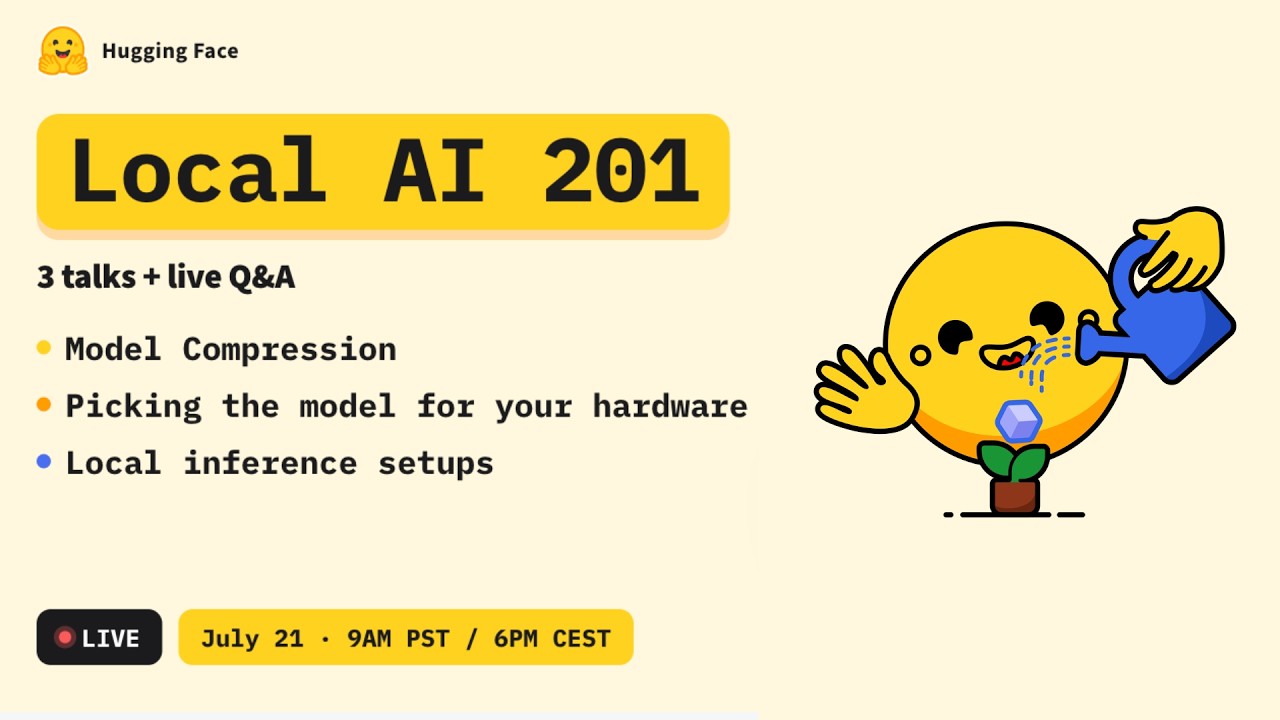
Local AI 201

The session provides an advanced deep dive into local AI deployment, emphasizing that successful LLM inference is not determined by hardware capacity alone. Instead, it requires selecting a balanced stack comprising the right model, quantization level, and specialized inference engine (e.g., VLLM, llama.cpp) for the specific use case—whether single-user chat or high-concurrency agentic workflows. Key performance metrics like memory bandwidth are shown to be more critical than raw memory capacity when scaling up requests.

Key takeaways

  1. Start with the Use Case, Not the Hardware 2:09

    When designing a local AI solution, always begin by defining the required use case (e.g., single-user chatbot vs. 50-person agentic workflow). The hardware, model, and engine stack must then be selected to support that specific requirement.

  2. Memory Bandwidth is Critical for Throughput 4:08

    For serving multiple requests (high throughput), memory bandwidth is often a more critical bottleneck than total memory capacity. For example, the RTX 5090 was shown to achieve significantly higher performance due to its high bandwidth compared to other devices.

  3. Engine Selection Dictates Performance Under Load 5:41

    The choice of inference engine (e.g., VLLM vs. llama.cpp) and kernel optimization is paramount. Improperly selecting an engine can severely limit performance, causing a high-bandwidth device to perform worse than a lower-bandwidth machine under load.

  4. Local AI Offers Superior Privacy and Control 7:30

    Running LLMs locally provides massive advantages in security, privacy, and control compared to relying on third-party cloud APIs. This allows users to fully tune the stack for long-term stability.

Watch on YouTube Full article

· 36:00

New Model: Inkling by Thinking Machine on Hugging Face

Thinking Machines announced Inkling, a massive open model with nearly one trillion parameters. It is designed as a natively multimodal architecture, accepting image, text, and audio inputs simultaneously. Key technical features include a Mixture-of-Experts (MoE) structure (975B total / 41B active params), a 1M token context window, and advanced deployment support across multiple frameworks like `transformers`, SGLang, vLLM, and `llama.cpp`. The model is available in BF16 and NVFP4 formats, facilitating high-performance inference on various hardware setups.

Key takeaways

  1. Multimodal Capability & Scale 3:50

    Inkling is a true multimodal model that natively processes image, text, and audio inputs using a single architecture. It boasts an immense 1M token context window and was trained on 45T tokens.

  2. Architectural Innovations 5:10

    The model utilizes relative attention (replacing RoPE) and a specialized SConv layer to efficiently aggregate hidden states, making it highly efficient for multimodal tasks compared to previous models.

  3. Deployment Flexibility 7:10

    Inkling supports multiple deployment paths: BF16 (requiring ~2TB VRAM) and NVFP4 (600GB VRAM). It provides day-zero support for `transformers`, SGLang, vLLM, and `llama.cpp` (including GGUF quants via Unsloth), enabling diverse inference environments.

Watch on YouTube Full article