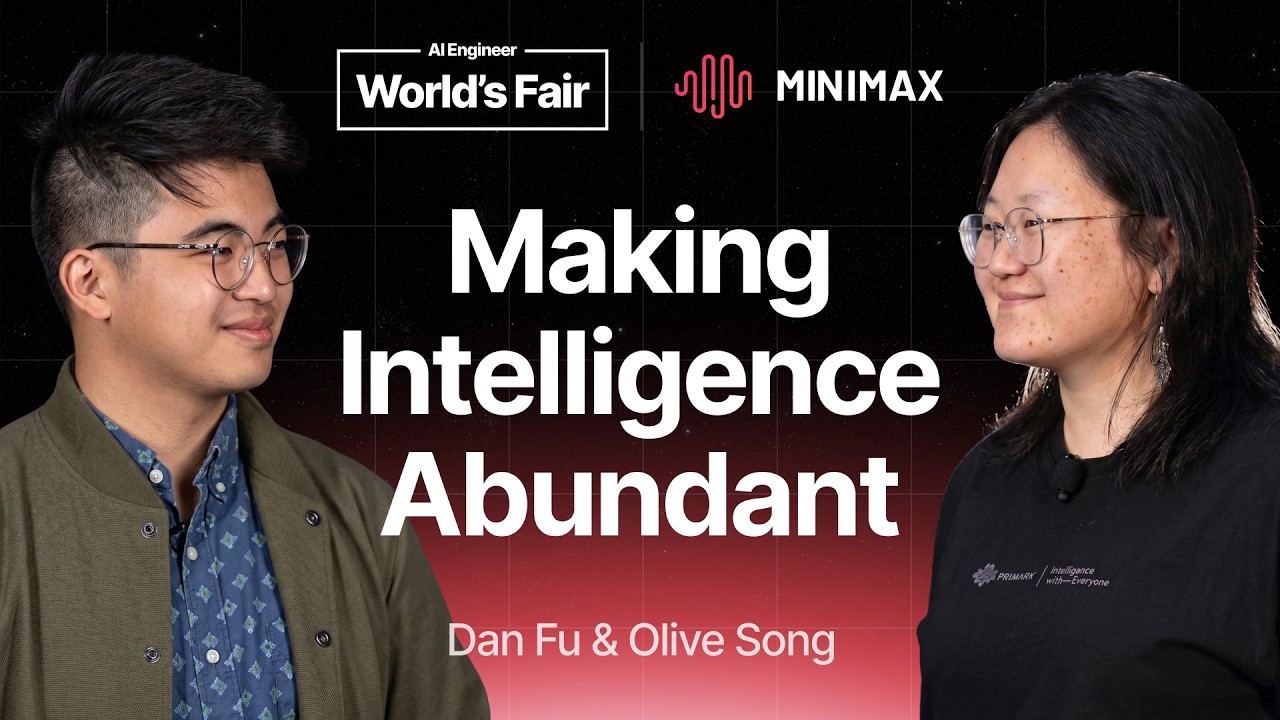
Agents at Scale: Inside MiniMax's Model and the Infrastructure Behind It — Olive Song
The discussion details the engineering stack and open-source philosophy behind MiniMax's model, M3. Olive Song emphasizes that the open weights approach allows the community to build upon and optimize the model, fostering widespread intelligence access. The technical focus covers advanced training techniques—including multimodality (text, image, video) and Reinforcement Learning (RL) for long-horizon tasks like replicating academic papers (12-hour runs)—and the complex infrastructure required for deployment. Key engineering challenges discussed include writing specialized GPU kernels, optimizing the inference stack from 'day zero,' managing KV cache growth in agentic workflows, and adapting to shifting workloads from chat-based to multi-turn, tool-calling agents.
Key takeaways
-
Open Weights Philosophy
2:07
MiniMax advocates for open source because it aligns with their mission of making intelligence widely accessible. By releasing weights, they enable developers (like Together AI) to optimize the model's inference speed and capabilities through community contributions.
-
Multimodality Training
8:02
MiniMax M3 is multimodal, understanding text, code, images, and videos. Crucially, it was trained multimodally from scratch to prevent 'training collapse,' ensuring that the modalities naturally interact (e.g., visual tokens attending to text tokens).
-
Agentic Workloads and Inference Shifts
13:40
The workload is shifting from simple chat turns to complex agentic workflows involving hundreds of multi-turn tool calls. This requires significant optimization in the inference stack, particularly concerning KV cache management and routing.
-
Long-Horizon RL Tasks
Training for complex tasks (e.g., replicating an ICLR paper over 12 hours) requires careful formulation of the problem, defining environments, and optimizing reward functions within the Reinforcement Learning framework.