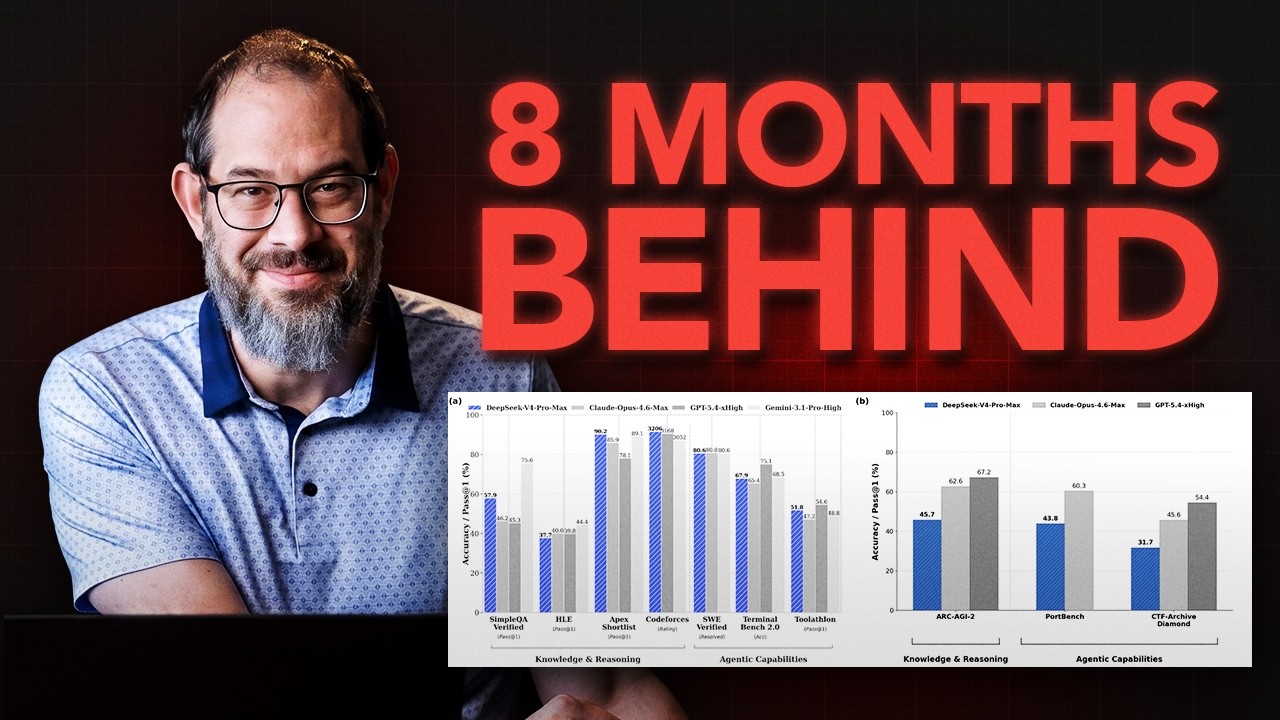
US AI Dominance Is Over: Here's Why
The use of Chinese AI models should be selective and requires rigorous due diligence, as 'Chinese model' is not a monolithic category. While these models offer significant economic advantages for high-volume, bounded tasks (e.g., DeepSeek V4 Pro at $0.87/M tokens vs Kimi K3 at $15/M tokens), their suitability depends entirely on the specific task, required capability, and deployment path. Engineers must prioritize measuring 'cost per accepted result' over simple token price to accurately assess total cost of ownership (TCO).
Key takeaways
-
Economic Value vs. Capability Gap
For high-volume, repeatable tasks (extraction, classification), Chinese models can offer extraordinary value due to low pricing. However, for ambiguous or high-stakes judgment calls, the strongest American frontier systems may still be necessary as a baseline.
-
Cost Metric is Key
17:09
The 'cost per accepted result' (including input/output, reasoning traces, tool calls, and retries) is the gold standard metric, as token price and finished work cost can point in opposite directions. A cheap model can become expensive if it requires long reasoning traces.
-
Deployment Strategy Matters
23:50
There are three deployment choices: first-party API (least control), third-party host (regional flexibility), or self-hosting (maximum control, but requires dedicated hardware, security, and operational team accountability).