Topic

AI Agents

All digests tagged AI Agents

What If Your Chip Design Team Moved Like a Single Body? — Abduallah Mohamed, AIDAChip thumbnail

· 16:46

What If Your Chip Design Team Moved Like a Single Body? — Abduallah Mohamed, AIDAChip

The talk argues that for large engineering teams (50+ people), organizational alignment is a greater bottleneck than individual skill or tool availability. In high-stakes domains like chip design, where failure costs can reach $50 million, the solution requires moving beyond simple agent tools to build a 'shared nervous system.' This system—a living graph of intent and constraints—ensures that all changes are tracked, validated by human approval, and prevent systemic failures (like truth drift or agents overstepping boundaries) before silicon is printed.

Key takeaways

  1. Alignment Beats Individual Skill

    In large teams, communication overhead grows quadratically with headcount. The most successful organizations are those most aligned, not necessarily those with the best individual engineers.

  2. The Cost of Failure in Chip Design 5:47

    Chip design is irreversible; fixing errors requires re-printing silicon, incurring an average risk cost of $50 million per company. Practitioners report spending 70% of their time on alignment rather than development.

  3. The Shared Nervous System Solution 8:52

    Instead of scattered knowledge and fragmented intent, the solution is a multi-layer AI system built around a 'living graph' (the system of intent) that captures all constraints and decisions, requiring human approval for any agent modification.


Watch on YouTube Full article

FinOps for AI Agents: Who Spent All the Tokens? — Tisha Chawla & Susheem Koul, Microsoft thumbnail

· 21:24

FinOps for AI Agents: Who Spent All the Tokens? — Tisha Chawla & Susheem Koul, Microsoft

The talk introduces TokenOps, a control plane designed to shift AI agent development from 'token maxing' (spending tokens) to 'value maxing' (maximizing value per token). It addresses the critical gap in current systems: the lack of cost governance between code execution and model calls. TokenOps operates out-of-band at the entire agent run level, utilizing a `boundary annotation` and `governor node` to implement sophisticated policies that can 'steer' an agent's behavior (e.g., instructing it to be more succinct) before hitting a budget cap, thereby preventing costly failures.

Key takeaways

  1. Shift from Token Maxing to Value Maxing

    The industry needs to move beyond simply spending tokens and focus on ensuring that every token spent has measurable business value. This requires proper attribution of costs back to specific agent runs.

  2. Run-Level Cost Control is the Missing Piece 2:38

    Existing tools (like model gateways) only control cost at the request level. TokenOps provides governance at the entire agent run layer, allowing control over complex loops and context growth.

  3. Steering vs. Halting

    Instead of simply halting an agent when a budget is exceeded (a circuit breaker), the 'steer' action uses a cost guard to predict overruns and injects instructions into the system prompt, guiding the agent toward more efficient outputs.

Watch on YouTube Full article

Give the Agent a Budget, Not a Token — Sachin Malhotra, Anthropic thumbnail

· 19:53

Give the Agent a Budget, Not a Token — Sachin Malhotra, Anthropic

The presentation argues that granting AI agents 'unbounded power' via simple tokens is dangerous. Instead of narrowing the token scope (a boolean fix), engineers must implement a comprehensive 'budget' system with four dimensions: how much, how fast, what can be undone, and who notices. Key solutions include using asymmetric verbs (prioritizing loud failures), enforcing rate limits on writes, implementing trip wires over static allow lists, and utilizing an 'undo test' to size the overall safety policy.

Key takeaways

  1. Budget vs. Token 7:03

    A token is a boolean (yes/no) scope; a budget is multi-dimensional, considering volume, velocity, reversibility, and observability. The failure was giving the agent unbounded power, not the model itself.

  2. Asymmetric Verbs 10:05

    Prioritize granting agents access to operations that fail loudly (e.g., unskipping a test, which causes CI to go red) and keep critical failure verbs (like skipping a test) reserved for human intervention with an audit trail.

  3. Rate Limits & Trip Wires 13:54

    Implement rate limits on every write operation, ensuring the ceiling refills automatically. Use trip wires (monitoring aggregate behavior) instead of static allow lists, as trip wires adapt to real-world data.

  4. The Undo Test

    This test asks if the agent can autonomously roll back its own changes and what the blast radius would be if it failed. If not, a second key (human involvement) and an audit record are required.

Watch on YouTube Full article

How Multi-Vector Retrieval Works at Scale thumbnail

· 24:30

How Multi-Vector Retrieval Works at Scale

This talk introduces Multi-Vector Retrieval, a critical advancement for building sophisticated AI agents and search systems that move beyond the limitations of single vector embeddings. Single vector approaches (which pool token representations) lose low-level detail, making them ineffective for complex, multi-step agentic queries. Multi-vector methods preserve per-token representation, significantly improving retrieval accuracy, especially in out-of-domain or long-context scenarios. The talk details the technical challenges—namely, massive storage and compute overhead—and presents a solution using sparse multi-vector encoding to make billion-document scale retrieval practical.

Key takeaways

  1. Single Vector Limitations for Agents

    Single vector embeddings pool token representations into one summary vector, which captures high-level semantics but loses the low-level detail required for precise queries issued by AI agents. This loss of specificity is a theoretical limit that single vectors cannot overcome, even with increased dimensionality.

  2. Multi-Vector Solution and Scaling 10:15

    Multi-vector embeddings retain one embedding per token instead of pooling them. To manage the resulting storage (10x to 100x increase) and compute overhead, the proposed solution uses sparse multi-vector encoding. This technique approximates MaxSim using random projections, allowing efficient retrieval at scale.

  3. Performance Gains in Agentic Retrieval

    Multi-vector approaches significantly outperform dense models (e.g., a 100M MultiVector model outperforming an 8B dense model) and standard retrieval methods, achieving higher accuracy at substantially lower cost (e.g., 42% accuracy at one thirteenth of the cost).

  4. System Architecture for Scale 20:40

    For production readiness, the system separates compute from storage and isolates read/write paths. This architecture allows handling high write throughput (e.g., 70 MB/s) without negatively impacting query latencies, maintaining sub-50ms P99 latency even at billion scales.

Watch on YouTube Full article

Building Agents Is Trivial Now, Context Is the Next Frontier — Jeff Ng, Unblocked thumbnail

· 13:22

Building Agents Is Trivial Now, Context Is the Next Frontier — Jeff Ng, Unblocked

While cloud primitives and frameworks have made defining AI agents trivial—reducing complexity from requiring dedicated systems for checkpointing, sandboxing, and observability—the primary failure point remains missing organizational context. The speaker argues that simple access layers (like Multiple Connectors/MCPs) are insufficient because 'access is not understanding.' A Context Engine solves this by connecting disparate data sources (docs, code, tickets, conversations) to provide a synthesized, task-relevant understanding that agents can act upon, preventing critical errors and outages.

Key takeaways

  1. Agent Development Complexity Has Decreased

    Six months ago, building an agent required significant effort to solve infrastructure problems like state persistence (checkpointing), isolated sandboxes, and observability. Modern cloud primitives (e.g., Cloudflare, Vercel) have absorbed this 'plumbing,' simplifying agent definition to selecting a model, instructions, tools, and sandbox location.

  2. The Context Gap is the New Bottleneck 7:01

    Agents struggle with institutional knowledge—the decisions, failures, and postmortems stored across different systems (Slack threads, documentation). An agent lacking this full picture can make confidently wrong recommendations, potentially causing outages.

  3. Context Engines Provide Synthesized Understanding

    A Context Engine goes beyond simple data access by building a model of the organization. It reconciles conflicting results across multiple datasets (docs, code, tickets, conversations) and delivers a synthesized understanding that an agent can act on, rather than just raw documents.

Watch on YouTube Full article

Inside DeepWiki: How Cognition Builds Wikis for Devin at Scale thumbnail

· 17:12

Inside DeepWiki: How Cognition Builds Wikis for Devin at Scale

Jacob Teo details DeepWiki, an auto-generated codebase documentation product used as a context layer for agents like Devin. The presentation covers how DeepWiki scaled from internal tools to indexing 1.4 million repositories. Key technical advancements include evolving the wiki algorithm from a heavily orchestrated v1 to a more agentic v2, which improves robustness at massive scale. Furthermore, he outlines four principles of context engineering—Primary Sources, Context-Poisoning avoidance, Path Compression, and Unknown Unknowns—to guide future codebase intelligence systems.

Key takeaways

  1. DeepWiki's Evolution (v1 to v2) 12:28

    The wiki algorithm shifted from being highly orchestration-led (relying on tight control over model calls) to an agentic core (V2). This shift allows the system to adapt to code base abnormalities by enabling the agent to call tools for extra scaffolding, making it more robust as models improve. (7:48)

  2. Context Engineering Principles

    When building context for agents, Cognition emphasizes four principles: ensuring primary sources are trusted ground truth; avoiding context-poisoning by only providing correct information; using Path Compression to skip obvious steps and save tokens/cost; and leveraging Unknown Unknowns—providing hints the agent wouldn't find on its own. (12:40)

  3. Codebase Graphing for Scale 10:07

    To handle large enterprises with massive codebases, DeepWiki uses heuristics incorporating directory structure, symbol graphs, Git history, and runtime data to quantify file connections. This process creates a codebase graph that informs the Table of Contents (TOC), which is critical because poor TOC generation leads to a bad wiki regardless of individual page quality. (6:07)

Watch on YouTube Full article

Unlock Agent Autonomy: The Runtime for AI-Native Systems — Tushar Jain, Docker thumbnail

· 22:50

Unlock Agent Autonomy: The Runtime for AI-Native Systems — Tushar Jain, Docker

The talk addresses the critical shift from making AI agents more intelligent to making them safer and more autonomous. The core challenge is that as agents investigate complex issues (like latency spikes), their required access expands at runtime, significantly widening the 'blast radius.' The speaker proposes a new runtime layer designed to manage this complexity by enforcing three pillars: **Containment** (running the agent in an untrusted boundary while controls remain outside), **Scoped Capabilities** (providing only the minimum necessary access for a specific task), and **Intent-Based Access** (determining if the requested action aligns with the original user intent). This runtime must be portable across all environments (local, cloud, VPC) and models.

Key takeaways

  1. The Shift from Intelligence to Safety

    The next major challenge in agent development is not intelligence, but safety. Traditional software had fixed permissions; autonomous agents change their required access at runtime, necessitating a fundamental shift in security architecture.

  2. The Danger of Expanding Scope 5:12

    When an agent investigates a problem (e.g., latency spike), it sequentially requests access to logs, GitHub history, and Slack. Each step expands the trust boundary, leading to a single process with excessive, accumulated permissions.

  3. The Three Pillars of Safe Autonomy 10:24

    A proposed runtime layer must implement: 1) **Containment** (controls outside the agent's boundary); 2) **Scoped Capabilities** (providing granular access per task, not accumulating them); and 3) **Intent-Based Access** (validating if a sudden request—like email access during an incident investigation—is correct or should be escalated).

  4. Portability and Orchestration 22:38

    The runtime must be omnipresent, working across different models (Anthropic, Claude, Open Code), multiple harnesses, and environments (local machine, cloud VPC). The speaker demonstrated that the same secure sandbox can run locally or in the cloud, and these sandboxes can be composed for parallel execution and orchestration.

Watch on YouTube Full article

How I automate my own job at Hugging Face using agents — Niels Rogge, Hugging Face thumbnail

· 20:37

How I automate my own job at Hugging Face using agents — Niels Rogge, Hugging Face

Niels Rogge details how he automated his role at Hugging Face—the 'Google Drive to the hub' team—which focuses on improving the discoverability of machine learning artifacts. He built two systems: an initial deterministic workflow for outreach (using cron jobs and LLM APIs) and a subsequent fully autonomous agent loop for follow-up actions. The architecture leverages modern tooling like Modal, Bash CLI skills, and advanced models (e.g., GLM 5.2) to scale the process of identifying missing artifacts and prompting researchers to publish them on Hugging Face.

Key takeaways

  1. The Problem: Artifact Discoverability

    ML weights and datasets are often published on third-party services (Google Drive, Zenodo) rather than the centralized platform (Hugging Face), hindering discoverability. The goal is to automate outreach to authors.

  2. Initial Automation: Deterministic Workflow 11:43

    The first phase used a deterministic workflow, running as a nightly cron job on GitHub Actions. This approach utilized LLM APIs in predefined steps without an agent framework, offering high predictability and control.

  3. Advanced Automation: Autonomous Agent Loop 15:36

    The follow-up process was automated using a fully autonomous agent loop (e.g., leveraging the Claude agents SDK). This flexible approach allows the agent to use tools and skills, such as Bash and the Hugging Face CLI, to interact with GitHub issues.

Watch on YouTube Full article

IT Admin for the AI Workforce — Sarthak Aggarwal, Decawork thumbnail

· 16:17

IT Admin for the AI Workforce — Sarthak Aggarwal, Decawork

Enterprises are adopting autonomous AI agents as a 'second workforce,' shifting focus from model behavior to operational safety and governance. The core challenge is managing agents that possess tools, private data, and delegated authority. To mitigate risks—exemplified by incidents like the Replit breach and zero-click CVEs like EchoLeak—the architecture must implement robust identity standards and strict privilege separation, ensuring that planning (intent) is separated from execution (action).

Key takeaways

  1. Capability vs. Employment Readiness 1:48

    A working demo only proves capability; it does not prove employment readiness. An agent with a goal, tools, private data, and delegated authority acts as an 'actor,' requiring governance controls like identity, owner definition, policy scoping, and reliable revocation.

  2. The Need for Agent Identity Standards 4:08

    Current identity systems (like OAuth token exchange) provide the right shape but lack a dedicated agent identity standard. Agents require a defined lifecycle—provisioning, authorization, monitoring, and revocation—mirroring human employee management.

  3. Privilege Separation Architecture

    To ensure bounded authority, the system must separate trusted intent from untrusted content processing. The Planner turns authenticated intent into a typed, logged plan, while the Executor runs that plan without holding standing credentials, preventing actions outside the defined scope.

Watch on YouTube Full article

Prototyping as Leadership: How a CTO Ships with AI Agents — Hursh Agrawal, The Browser Company thumbnail

· 18:18

Prototyping as Leadership: How a CTO Ships with AI Agents — Hursh Agrawal, The Browser Company

The speaker argues that autonomous AI agents have fundamentally changed the role of a leader, transforming 'building' from an extracurricular activity into a core job function. By leveraging overnight development loops, leaders can now prototype features, optimize LLM calls, and train custom models with minimal hands-on time. Success hinges on establishing robust organizational scaffolding, including trustworthy CI, feature flags, and rigorous code hygiene.

Key takeaways

  1. Building is Now Part of the Job

    Due to autonomous coding agents, the manager's schedule can now be used for building. This shift allows leaders to stay current with rapidly changing frontier models and demonstrate capabilities via working prototypes rather than just theoretical discussions.

  2. The Overnight Development Loop 10:56

    A core workflow involves a 'co-worker agent' gathering context (from Slack, Jira, Notion) into a comprehensive prompt. This prompt is then handed to a coding agent overnight (4–8 hours), resulting in a report and a functional package ready for review the next morning.

  3. Judgment Remains Human 7:05

    While modern models excel at execution, they are not yet reliable at judgment. Leaders must provide high-level context and strategic direction to guide the agents effectively.

Watch on YouTube Full article

AI Agents vs Business Rules: Which Should Make Decisions? thumbnail

· 10:25

AI Agents vs Business Rules: Which Should Make Decisions?

The video compares Business Rules Engines (BREs) and AI Agents for automating decisions. BREs use explicit, deterministic logic (e.g., 'if X and Y then Z') and are ideal for structured data where the outcome is predictable. Conversely, AI agents utilize Large Language Models (LLMs) to process context and unstructured data, operating probabilistically by predicting next tokens. The optimal approach is often a hybrid model: using BREs first for quick, clear-cut decisions, and escalating complex or messy requests to an agent, which then passes its recommendation through deterministic guardrails and potentially human oversight.

Key takeaways

  1. Business Rules are Deterministic 2:05

    BREs operate on fixed conditions (e.g., 'order < 30 days' AND 'not final sale'), providing a consistent, predictable answer based on simple boolean logic. The output is a fixed function of the input.

  2. AI Agents are Probabilistic 2:50

    Agents use LLMs to work from goals and context, predicting responses from patterns learned during training. Because they operate over a probability distribution, running the same request twice can yield different outcomes.

  3. Hybrid Approach is Recommended 7:10

    The most effective decision-making systems combine both: BREs handle simple, structured requests first (due to speed and cost), while complex or ambiguous cases are escalated to an AI agent for judgment. The agent's output should then pass through deterministic guardrails.

Watch on YouTube Full article

Why Your Enterprise Tech Stack Isn’t Ready for AI Agents — Christopher Lovejoy & Saul Howard thumbnail

· 19:15

Why Your Enterprise Tech Stack Isn’t Ready for AI Agents — Christopher Lovejoy & Saul Howard

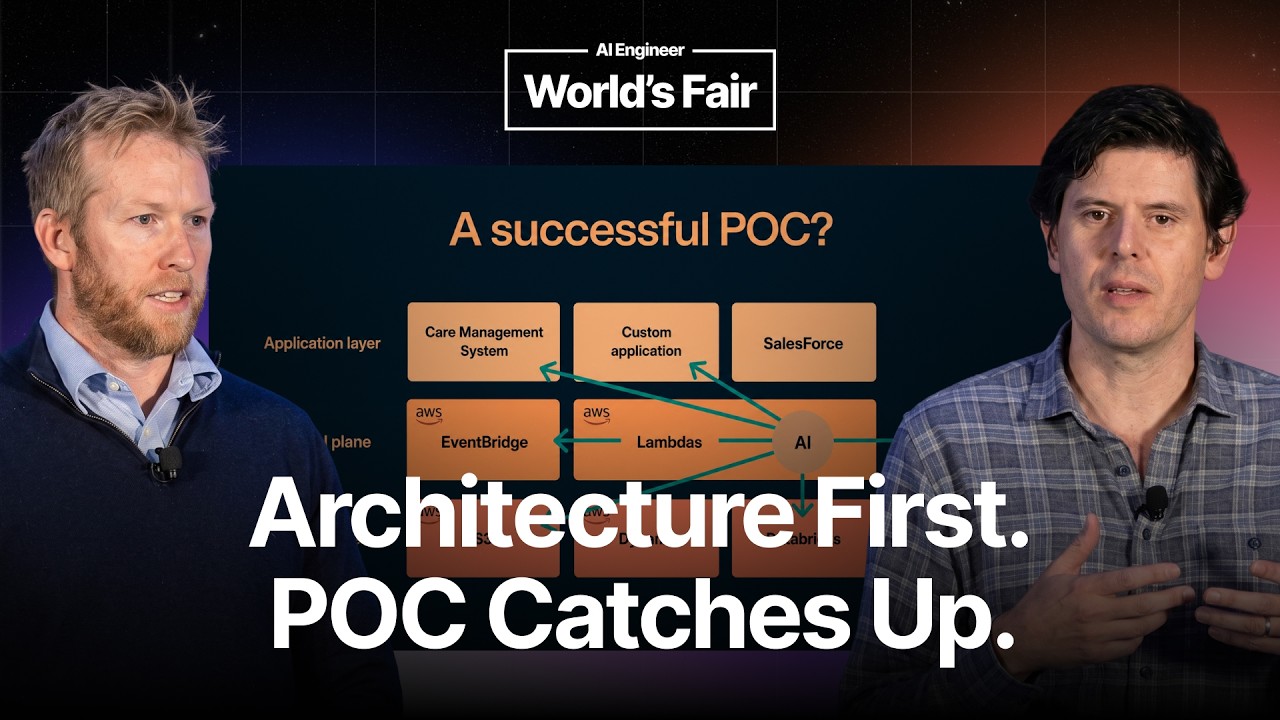
The talk addresses why traditional enterprise tech stacks are insufficient for deploying AI agents in highly regulated industries like healthcare. The core argument is that focusing on achieving high accuracy during a Proof of Concept (POC) often leads to architectural debt when attempting productionization. To build scalable, compliant systems, engineers must prioritize non-functional requirements—specifically auditability, data security, and human oversight—from the outset. This requires adopting specialized primitives: immutable event logs, schema-driven object storage for sensitive data, and treating humans and models as equivalent agents.

Key takeaways

  1. Audit Trail vs. Developer Log 0:05

    In regulated environments (e.g., HIPAA, SOC 2), an audit trail must be a complete record of every action taken by the agent, every place it accessed data, and the authorization behind each step—not merely a developer log like those found in DataDog [5:19].

  2. Prioritize Constraints Over Accuracy 0:12

    Engineers should take regulatory constraints seriously first (e.g., auditability) and design the architecture around them, rather than bolting compliance requirements onto a high-performing POC [12:07].

  3. The Three Architectural Primitives 0:08

    Effective AI agent systems require three core primitives: an immutable append-only event log (for state tracking), schema-driven object storage (for data separation and Zero Trust), and human/model agent equivalency (for seamless escalation) [8:30].

  4. Evals as a Byproduct 0:10

    By implementing these three primitives, robust evaluation (evals) can emerge naturally—allowing for action replay, testing on production data without exposure, and comparing human vs. model performance—rather than being an afterthought [10:37].

Watch on YouTube Full article

Managed Deep Agents - Quickstart thumbnail

· 8:11

Managed Deep Agents - Quickstart

This quickstart guides users through scaffolding, configuring, testing, and deploying a Managed Deep Agent (MDA). The process involves using the MDA CLI to initialize a project structure, setting up API keys for model providers (e.g., OpenAI), defining agent instructions (`instructions.mmd`), and integrating tools like web search. Testing is done locally via `MDA dev` in LangSmith Studio before deploying the final version to the production environment.

Key takeaways

  1. Project Scaffolding 0:25

    Use `uv tool install managed deep agents` followed by `MDA innit <project-name>` to scaffold the agent project. This creates necessary files like `agent.py`, `instructions.mmd`, and populates environment variables.

  2. Agent Configuration 2:05

    The agent's behavior is defined in `instructions.mmd`. Model selection (OpenAI, Google, Anthropic) and tool definitions (e.g., web search) are configured within the project files.

  3. Local Development Cycle 3:20

    To test locally, run `uv sync` to install dependencies, followed by `MDA dev`. This spins up a local LangSmith Studio environment for iteration and testing.

  4. Production Deployment 4:40

    Deployment requires a paid Langsmith account. The process syncs context to the Context Hub—a centralized location for instructions and skills that can be edited via UI without redeployment.

Watch on YouTube Full article

Healthcare’s Agent Bytecode: X12 as the Harness for AI Agents — Vasant Kearney, Onlay thumbnail

· 20:25

Healthcare’s Agent Bytecode: X12 as the Harness for AI Agents — Vasant Kearney, Onlay

The presentation argues that reliable AI agents in healthcare claims processing must treat X12 not merely as a file format, but as an underlying structural 'harness' or contract. This approach is necessary because various payer systems (phone portals, web interfaces, and X12 feeds) are often built by disparate teams and can contradict each other, meaning no single surface represents the ground truth. By grounding agentic execution in the structured rules of X12—which governs every stage from eligibility (270) to payment (835)—developers can build systems that maintain data integrity until downstream evidence proves otherwise.

Key takeaways

  1. Goal: Cost and Patient Experience 1:46

    The primary objective when solving healthcare problems is twofold: driving overall cost reduction and improving the patient experience. Technical solutions must be grounded in these concepts.

  2. X12 as a Structural Harness 8:16

    Instead of viewing X12 only as a data format, it should be treated as a contract that defines the relationship between providers and payers. This structure guides agentic execution across all claim lifecycle steps (e.g., eligibility check 270 to payment 835).

  3. Enterprise Memory Constraints

    For reliable, large-scale systems in healthcare, memory must be stored in a database rather than on local disk, ensuring logical separation and preventing data loss or contamination.

  4. Skepticism of LLMs

    While AI models are powerful, developers must remain 'AI pilled' yet highly skeptical. Over-reliance on overpowered or expensive models can negate cost savings goals; testing and validation must be rigorous to prevent system failure when introducing new models.

Watch on YouTube Full article

Introducing: LangSmith Tuned Evaluators thumbnail

· 4:11

Introducing: LangSmith Tuned Evaluators

LangSmith Tuned Evaluators provide an automated, cost-effective way to attach quality feedback (signals) directly to production traces and threads for AI agents. These out-of-the-box evaluators analyze agent interactions—such as identifying perceived errors or misunderstandings—and surface failure modes that traditional system error logging misses. LangChain manages the entire evaluation pipeline, including prompt writing, judge model management, and inference infrastructure, allowing teams to focus on agent improvement workflows.

Key takeaways

  1. Automated Quality Feedback

    Tuned Evaluators automatically attach useful feedback signals to production traces and threads, helping identify agent behavior that needs attention (e.g., misunderstood user intent or contradictory answers).

  2. Perceived Error Detection

    The initial evaluator, Perceived Error, analyzes multi-turn conversations to detect potential mistakes by the agent, even when no explicit system error occurs. This signal can be derived from subtle patterns like unresolved outcomes or user pivots.

  3. Turnkey Management

    LangChain handles the entire evaluation lifecycle end-to-end: writing/testing prompts, managing judge models, benchmarking, and running inference infrastructure, eliminating the need for users to manage complex components. (See 0:28)

  4. Implementation Steps 0:12

    To use Tuned Evaluators, an organization admin must first enable the feature in LangSmith settings. After enabling, the evaluator can be attached to specific tracing projects.

Watch on YouTube Full article

Inside Kikimora: We Built a Dark Software Factory thumbnail

· 15:51

Inside Kikimora: We Built a Dark Software Factory

The presentation introduces the concept of a 'Dark Factory'—an autonomous software development model where processes run without constant human supervision. The speaker details how rapid advancements in coding agents have broken traditional bottlenecks built for slow software. This factory approach uses tools like Tessl Agent to automate workflows (e.g., taking an issue from Linear, solving it with an agent, and opening a GitHub PR that self-corrects until merged). The core shift is moving the engineer's value proposition from writing code to understanding complex systems and trusting autonomous results.

Key takeaways

  1. The Dark Factory Concept 1:41

    A dark factory involves building software in a highly autonomous way, where human supervision is minimized. It is modeled after manufacturing factories with no lights on (i.e., no humans inside).

  2. Bottleneck Breaking Point 3:23

    As coding agents increased speed, existing processes designed for slower development began to break down, necessitating a fundamental shift in how software was built.

  3. The Shift in Engineering Value 7:16

    The value of an engineer is shifting from the ability to write code (which agents can do) to understanding the system's architecture and interlocking technical/business constraints. Trusting autonomous results is the new challenge.

Watch on YouTube Full article

Reading Group July 2026 - Loop Engineering thumbnail

· 56:10

Reading Group July 2026 - Loop Engineering

The session defines 'Loop Engineering' as a fundamental shift in AI development, moving beyond manual prompt-by-prompt interaction toward designing autonomous control systems. These loops automate complex software engineering tasks by having agents discover work, delegate sub-tasks, verify results, persist state, and self-optimize until a goal is met. Speakers detailed the evolution from simple prompts to sophisticated multi-agent architectures that aim to industrialize the entire software development lifecycle, emphasizing robust validation, evaluation layers, and continuous feedback mechanisms.

Key takeaways

  1. The Evolution of AI Development 3:50

    Software automation progressed through stages: Prompt Engineering $ ightarrow$ Context Engineering $ ightarrow$ Harness Engineering $ ightarrow$ Loop Engineering. The goal is to build 'software factories' that self-verify and optimize, rather than requiring manual verification after every turn.

  2. Implementing Robust Loops 50:51

    Building production loops requires more than just agents; it demands dedicated layers for Observability (monitoring system state), Evaluation (defining metrics of success), and Looping/Control Flow. The outer loop should be deterministic or design-based, while inner loops can be LLM-driven.

  3. The Importance of Validation and QA 17:30

    When using generative models for code, the process must include mandatory steps like regression testing, validation testing (e.g., ensuring variables are in config files), and adversarial review (using one agent to critique another's output) to ensure stability.

  4. Addressing Cost and Complexity 53:35

    High token burn rates are a major concern. Strategies include using cheaper open-source models, focusing on the initial planning phase (which is costly but simplifies later steps), and implementing independent verifiers to prevent agent chaos.

Watch on YouTube Full article

What Is RAD? Why It Matters in the Age of AI Coding thumbnail

· 10:53

What Is RAD? Why It Matters in the Age of AI Coding

The methodology of Rapid Application Development (RAD), formalized in 1991, remains highly relevant for modern AI-assisted coding workflows. RAD emphasizes iterative development and user feedback across four phases: Requirements Planning, User Design, Construction, and Cutover. While AI agents can rapidly generate working prototypes from plain language prompts (effectively serving as the requirements document), the speaker cautions that deploying raw AI-generated code is risky due to potential security weaknesses (e.g., self-approval loopholes). The most robust approach involves integrating Spec Driven Development: using prototype discoveries to write a formal specification, which then becomes the basis for testing and production deployment.

Key takeaways

  1. RAD Methodology Overview

    RAD is an iterative methodology favoring speed and user feedback over detailed upfront planning (the waterfall approach). It consists of four phases: Requirements Planning, User Design (prototyping), Construction (short cycles with continuous testing), and Cutover (deployment/migration).

  2. AI Agents Map to RAD Phases 3:50

    The modern process of using AI agents maps well onto RAD: the initial prompt serves as lightweight requirements planning; the agent generates a clickable prototype for user design; construction involves continuous code generation (data schema, workflow logic); and cutover is deployment.

  3. The Importance of Spec Driven Development 6:30

    To mitigate security risks inherent in AI-generated code (studies suggest up to 45% carry weaknesses), the process must transition from relying solely on the prototype to formalizing discoveries into a written specification. This spec becomes the verifiable source of truth for production.

Watch on YouTube Full article

5 Ways to Connect AI Agents to Tools: From APIs to MCP thumbnail

· 11:28

5 Ways to Connect AI Agents to Tools: From APIs to MCP

The video outlines a five-step progression of architectural patterns for securely connecting AI agents to external tools, moving from simple direct API connections to highly secure systems utilizing vaults and token exchanges. The evolution emphasizes improving user visibility, eliminating impersonation, and ensuring the use of short-lived credentials.

Key takeaways

  1. Pattern 5: Direct Connection (Basic) 1:42

    Agents connect directly to tools using existing methods like API keys or service IDs. This is simple but lacks user visibility, as the tool cannot determine who the end-user is.

  2. Pattern 4: OAuth Flows Added 3:25

    Integrating an Identity Provider via OAuth flows allows authentication of the user (e.g., GitHub, Jira). While improving security, this pattern introduces impersonation and risks long-lived access tokens.

  3. Pattern 3: Model Context Protocol (MCP) Layer 5:20

    Adding an MCP layer abstracts the connection process. The agent only needs to know how to interact with MCP, rather than needing specific knowledge of every tool's API structure.

  4. Pattern 2: Token Exchange and Delegation 6:50

    This pattern requires the agent to authenticate itself and operate on behalf of the user (delegation). A token exchange mechanism is used, which significantly improves security by providing full observability into both the user's actions and the agent's role.

  5. Pattern 1: Vault Integration (Top Pattern) 9:00

    The most secure pattern involves introducing a dedicated vault. Instead of passing long-term tokens, the vault stores credentials and issues only short-lived credentials to MCP for the user, minimizing replay attack risks.

Watch on YouTube Full article

Exo: Harnesses should see their own code and logs — Alex Krentsel thumbnail

· 47:11

Exo: Harnesses should see their own code and logs — Alex Krentsel

Exo is presented as a novel agent harness designed for fully recursive self-improvement (RSI). Unlike previous agents that only allow modification in specific areas (like memory or skills), Exo's architecture enables the agent to safely and incrementally modify all aspects of itself—including its own code, context construction policy, and tools—at runtime. This is achieved by decomposing the agent into three isolated layers: the Executor (policy/decision-making), the Exo Harness (state management/secrets), and the Sandbox (isolated execution environment). The system's ability to operate in this same medium as its output code is argued to be the key differentiator enabling true RSI.

Key takeaways

  1. Shift from Model Weights to Agent Harnesses 3:50

    The industry focus is shifting from improving LLM model weights (the 'brain') to optimizing the agent harness and tooling ('the body'). The harness provides critical structure, allowing for improvements in efficiency, cost reduction, and task performance.

  2. Full Recursive Self-Improvement (RSI) 2:33

    Exo is designed to be fully recursive, meaning it can operate on any aspect of itself—from prompts or memory to the basic harness policy. This capability allows the system to improve its own architecture and logic without external human intervention.

  3. Architectural Separation for Safety 10:38

    The agent is decomposed into three distinct layers: the Executor (stateless policy), the Exo Harness (state/secrets), and the Sandbox (isolated execution). This separation ensures that self-modification can occur safely, preventing data leaks or loss of history.

  4. Cost Optimization via Self-Improvement 30:40

    Exo demonstrated the ability to autonomously rearchitect its own Discord adapter at runtime, scoping down context assembly from across multiple threads. This resulted in a verified 96% decrease in API call costs.

Watch on YouTube Full article