Topic

CI/CD Security

All digests tagged CI/CD Security

Realtime multiplayer, automation, and you! — Idan Gazit, GitHub thumbnail

· 21:41

Realtime multiplayer, automation, and you! — Idan Gazit, GitHub

The talk introduces two prototypes for future software development: Agentic Workflows and ACE. Agentic Workflows automates complex tasks like dependency upgrades (e.g., Astro 5 to Astro 7) by interpreting plain English instructions into a structured playbook, which is then executed as an action workflow. Crucially, it emphasizes that robust guardrails are defined deterministically in YAML front matter, not merely through prompting. ACE explores real-time multiplayer development in cloud microVMs, treating the shared surface (like Slack) as the primary interface for surfacing non-code facts and collaborative planning.

Key takeaways

  1. Automation via Plain English Playbooks 5:08

    Agentic workflows translate simple natural language instructions (e.g., a message to a junior developer) into comprehensive playbooks that handle tasks like checking for new releases, reviewing changelogs, applying code changes, and creating pull requests.

  2. Guardrails Must Be Deterministic 6:46

    Effective security requires defining guardrails (permissions, allowed tools, network destinations, safe outputs) deterministically in front matter (YAML), rather than relying on prompt instructions, which are susceptible to injection.

  3. Shifting Development Interface 12:40

    The future of development involves iterating on direction and planning within a shared surface (like Slack/ACE), making the document itself—the 'truth'—a primary artifact, rather than solely relying on code.

  4. AI Augmentation is Not Typing 20:40

    A longitudinal study found that hands-on keyboard typing accounts for only about 5% of a developer's time; AI must therefore help scale up the remaining 95% of work (e.g., system design, planning, and collaboration).

Watch on YouTube Full article

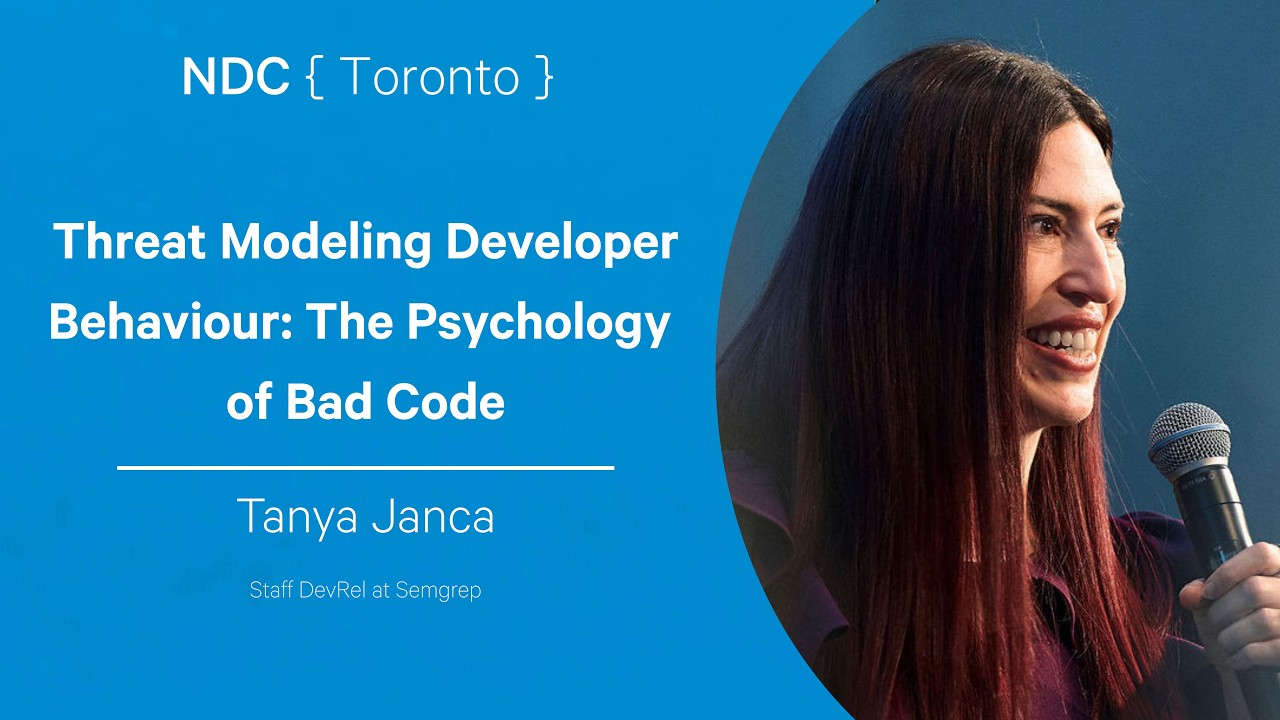
Threat Modeling Developer Behaviour: The Psychology of Bad Code - Tanya Janca thumbnail

· 57:58

Threat Modeling Developer Behaviour: The Psychology of Bad Code - Tanya Janca

Security vulnerabilities are often predictable patterns of human behavior rather than purely technical flaws. The talk advocates for shifting AppSec focus from merely enforcing secure coding standards to understanding and modifying developer psychology using principles from behavioral economics. Key strategies include setting 'secure defaults,' embedding security activities into every phase of the SDLC, and implementing cultural changes (like community practices) to make secure development the path of least resistance.

Key takeaways

  1. The Shift from Intentions to Defaults 26:23

    Since 'secure intentions' require constant effort and willpower, organizations should implement 'secure defaults.' This means structuring tools and processes so that the secure path is the automatic, easiest choice (e.g., using an ORM framework that enforces parameterized queries instead of allowing raw SQL concatenation).

  2. Addressing AI-Generated Code Risks ('Vibe Coding') 31:30

    A major risk is 'vibe coding,' where developers rely on AI to write nearly all the code without thorough manual review. Mitigation requires using Retrieval Augmented Generation (RAG) servers that reference secure internal guidelines and enforcing mandatory human code reviews.

  3. Systemic Process Improvement 20:50

    Instead of blaming individuals, security failures should be viewed as systemic issues. Solutions must involve embedding security activities (like threat modeling) into requirements gathering and design phases, making it a continuous part of the SDLC.

  4. Behavioral Nudges over Mandates 27:10

    Effective change comes from 'nudges'—subtle changes in environment or process that guide behavior without restricting options. Examples include automatically enrolling employees in retirement plans (opt-out) or adding documentation debt to sprint reviews.

Watch on YouTube Full article